





































































3 Stocks to benefit as India’s co-working market is expected to hit ₹26,167 Crore
The coworking industry in India is undergoing a major shift in 2025. With hybrid work models becoming mainstream and technology evolving rapidly, coworking spaces are redefining how professionals collaborate. A GoodWorks CoWork report highlights a growing focus on flexibility, community, and sustainability, making it essential for businesses to track emerging trends. The sector is expanding […] The post 3 Stocks to benefit as India’s co-working market is expected to hit ₹26,167 Crore appeared first on Trade Brains.


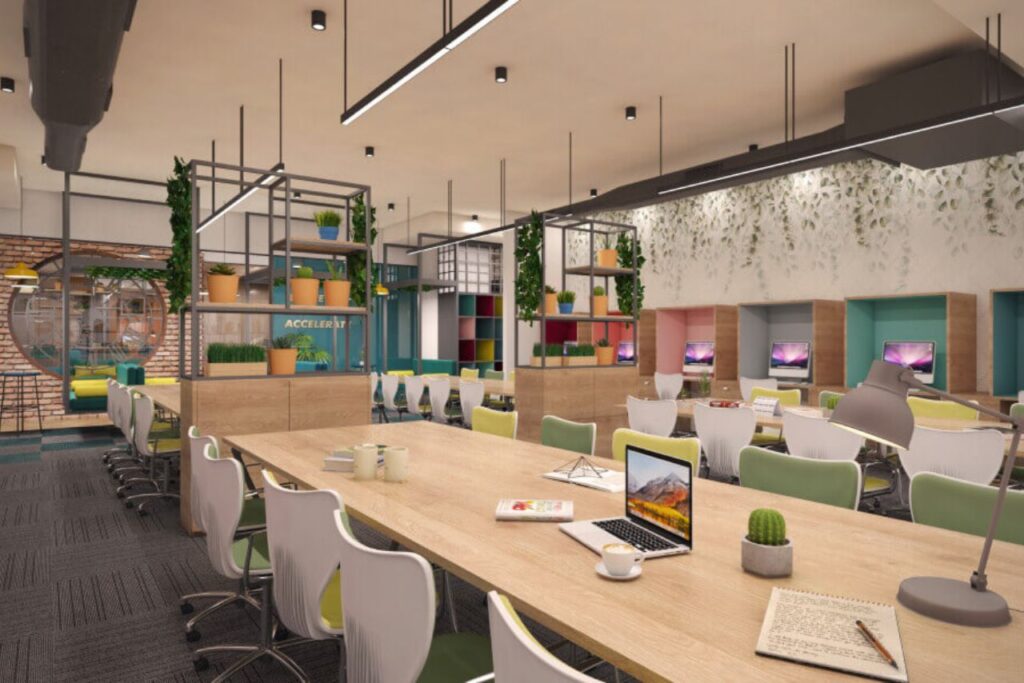
The coworking industry in India is undergoing a major shift in 2025. With hybrid work models becoming mainstream and technology evolving rapidly, coworking spaces are redefining how professionals collaborate. A GoodWorks CoWork report highlights a growing focus on flexibility, community, and sustainability, making it essential for businesses to track emerging trends.
The sector is expanding at record pace. According to Mordor Intelligence, the Indian coworking market is valued at USD 2.08 billion in 2025 and is projected to reach USD 2.91 billion by 2030 (Rs. 26,167 crore) at a CAGR of 7 percent. Growth is driven by the rise of hybrid schedules, India’s booming startup ecosystem with over 157,000 DPIIT-recognised startups as of December 2024, and companies seeking cost-efficient alternatives to traditional offices.
While metros like Bengaluru and Mumbai still dominate, coworking is rapidly spreading to Tier-2 and Tier-3 cities. Government support for entrepreneurship, wider remote work adoption, and lower real estate costs are powering this shift. Cities such as Jaipur, Coimbatore, and Tirunelveli are emerging as new coworking hotspots.
Technology is also rapidly reshaping the coworking ecosystem, turning shared offices into smart, intuitive, and highly flexible workplaces. Operators are increasingly adopting IoT-enabled infrastructure, high-speed connectivity, advanced video collaboration tools, and AI-driven systems that personalise user experiences and optimise space utilisation. At the same time, demand for private offices is rising as companies prioritise privacy, brand-aligned environments, and scalable setups within coworking frameworks. This shift reflects a growing need for workplaces that balance openness with focused, secure spaces.
Beyond infrastructure upgrades, coworking hubs are evolving into vibrant community and collaboration centres. They now host events, workshops, and mentorship programmes while offering industry-specific setups like creative studios and tech labs. AI is further streamlining operations through predictive maintenance, automated access controls, and enhanced security. Operators are also embedding inclusive design principles, fostering diverse communities, and adding lifestyle amenities such as cafeterias, lounges, recreational zones, game areas, and libraries
Here are some of the listed players that will benefit:
EFC (I) Ltd
EFC (I) Ltd, established in 2014 by first-generation entrepreneur Mr. Umesh Sahay, is a BSE-NSE listed workspace solutions company headquartered in Pune. The firm operates more than 80 centres across 10 cities in seven states, serving over 600 reputed Indian and global corporates with high-quality, fully managed workspaces. The company has a market capitalisation of Rs. 2,627 crore, and its current market price is Rs. 264.
EFC (I) Ltd runs a diversified business model built across three interconnected verticals, Leasing, Design & Build, and Furniture, allowing it to capture value across the entire workspace lifecycle.
Its Leasing segment focuses on customised, fully serviced, visually appealing and tech-enabled managed office solutions for startups, enterprises and coworking communities. The company has a presence in 10 cities with 3.23 million square feet under management, offering more than 68,000 seats with an average occupancy of 90 percent. It serves over 680 clients, with average rents in the range of Rs. 6,750 to Rs. 7,250 per seat.
The company operates 86 centres, with an owned-to-leased mix of 18:68, and enjoys an average enterprise client tenure of 45 months. Around 24 percent of its revenue comes from top clients, while 66 percent of revenue is enterprise-centric. Its owned properties span 279,460 square feet and include Sprint Wakdewadi, Marisoft IT Park, Sprint Towers and Konark Alpha. The segment contributes 50.7 percent to the overall revenue as of Q2FY26.
The Design & Build vertical delivers comprehensive interior solutions covering conceptual design, planning and full-scale execution. Its services encompass general contracting, project management and MEP services. The company manages more than 6.68 lakh square feet through a team of 80+ designers and engineers, catering to 35+ marquee clients across 11+ locations, and has already designed a cumulative 4.70 million square feet. The broader Indian Design & Build market is projected to grow at a CAGR of 28.5 percent and reach USD 150.4 billion by 2030. The segment contributes 43.8 percent to the overall revenue as of Q2FY26.
The Furniture business focuses on designing and manufacturing workstations, executive desks, lounge seating and storage solutions for both commercial and residential environments. It has a total manufacturing capacity of Rs. 2,750-3,000 million, a current order book of Rs. 250+ million (Rs. 25 crore) and a portfolio of more than 900 SKUs. The segment contributes 5.5 percent to the overall revenue as of Q2FY26.
EFC (I) Ltd operates through a multi-brand ecosystem that includes: EFC, which provides scalable workspace solutions for entrepreneurs, SMEs and enterprise clients. BIGBOX, which specialises in premium managed offices for enterprises and startups. SPRINT, which offers affordable, fully managed workspaces for teams of all sizes. WHITEHILLS, which focuses on premium commercial interiors with functional, modern designs and EK DESIGN, which manufactures furniture products across India and international markets. The company’s client roster features well-known names such as Bajaj Finserv, Godrej, Hitachi, Johnson & Johnson, Red Bull, MCX, Flipkart, NoBroker, ICRA, Ekart, Exide and Poonawalla Fincorp.
In Q2FY26, the company reported sales of Rs. 255 crore compared to Rs. 166 crore in Q2FY25, marking a 53.61 percent increase. Operating profit rose from Rs. 79 crore to Rs. 111 crore, translating to a 40.50 percent rise, while the operating profit margin declined from 48 percent to 44 percent. Profit before tax increased from Rs. 56 crore to Rs. 76 crore, reflecting a 35.71 percent growth, and net profit improved from Rs. 37 crore to Rs. 57 crore, registering a 54.05 percent increase year-on-year.
Awfis Space Solutions Ltd
Awfis Space Solutions Ltd, India’s leading and flexible workspace solutions provider, operates the largest network of agile workspaces in the country. The company enables small and large corporations to book and utilize workspaces seamlessly according to their requirements.
Its comprehensive offerings include Flex Space Solutions (coworking and customised managed offices), Mobility Solutions, Design & Build, Awfis Café, and TechLabs advanced tech infrastructure. With over 200 centres across 18 cities and a client base exceeding 3,000 companies across industries, Awfis provides scalable and adaptable workspace solutions for businesses of all sizes. The company has a market cap of Rs. 3,819 crore and its current market price is Rs. 534.
Awfis operates in 18 cities, including 9 Tier 2 cities, with a total of 237 centres and 161,000 seats. 61 percent of its seats are managed under the Aggregation Portfolio model, where operators and space owners share both capital expenditure and revenues. The company maintains a blended occupancy of 74 percent, with a weighted average total client tenure of 36 months. In Q2FY26, Awfis added 8,000 seats, contributing to 14,000 seats added in H1FY26 and a total of 35,000 seats added year-on-year.
Awfis’ client mix comprises 61 percent corporates and MNCs, 23 percent SMEs, 15 percent startups, and 1 percent freelancers. The company is focusing on premiumisation, signing 10+ GCCs across 5 elite centres and onboarding 9+ large corporates/MNCs covering approximately 5,000 seats. Notable initiatives include delivering a 67,000 sq. ft. innovation hub for eBay in Bengaluru, partnering with NSE, expanding its enterprise portfolio in Chennai following a 1.65 lakh sq. ft. setup in Mumbai, and signing a Fortune 500 IT client for an additional 1,000 seats across two Tier 2 cities.
In Q2FY26, revenue from coworking space on rent and allied services stood at Rs. 297 crore, while construction and fit-out projects contributed Rs. 69 crore. The company continues to execute a growth strategy focused on building a capital-efficient model, expanding its asset-light Managed Aggregation portfolio, developing mid-size centres, and enhancing product and service offerings through Awfis Transform and allied services. Awfis is also expanding into new and existing markets, targeting key micro-markets in Tier 1 cities and emerging Tier 2 cities, while improving operational efficiency through vendor consolidation, streamlined operations, and leveraging new-age technologies.
In Q2FY26, Awfis reported sales of Rs. 367 crore, up from Rs. 292 crore in Q2FY25, marking a 25.68 percent increase. Operating profit rose from Rs. 100 crore to Rs. 132 crore, a 32 percent growth, while the operating profit margin improved from 34 percent to 36 percent. Profit before tax decreased from Rs. 39 crore to Rs. 16 crore, a 58.97 percent decline, and net profit fell from Rs. 39 crore to Rs. 16 crore, also registering a 58.97 percent reduction year-on-year.
WeWork India Management Ltd
Launched in 2017, WeWork India is one of India’s leading premium flexible workspace operators and is GPTW certified for the period November 2024 to November 2025. The company has been the largest operator by total revenue for the past three fiscal years and has expanded across 8 cities, Chennai, New Delhi, Gurugram, Noida, Mumbai, Bengaluru, Pune, and Hyderabad, with 70 operational centres spanning 7.8 million square feet as of September 2025. The company has a market cap of Rs. 7,753 crore and its current market price is Rs. 578.
The company has a desk capacity of 1,14,500, reflecting a 21.3 percent year-on-year increase, and current occupancy stands at 91,800, up 24.5 percent YoY. With a Net Promoter Score of +75, WeWork India ranks among top-tier global brands. The company recorded a sales velocity of 15,500 desks in Q2FY26, the highest in both quarterly and half-yearly metrics. Total revenue relative to rent stood at 2.9x, the highest among listed peers.
In Q2FY26, core operations, consisting of Workspace as a Service including Private Offices and Managed Offices, contributed 85.6 percent of total revenue, growing 23.4 percent YoY. Value-added services such as events, F&B, customisation, and tech solutions accounted for 10.9 percent of revenue, up 14.4 percent YoY. Digital Products, including Workplace, All Access, On Demand, and Virtual Office, represented 3.5 percent of revenue, up 25 percent YoY. Revenue from core operations is well-diversified by geography, with 61.9 percent from international clients and 38.1 percent domestic.
Top 10 clients contributed 23.2 percent of revenue from core operations in Q2FY26. The company has already signed 26 percent capacity growth. Gross debt stood at Rs. 409.6 crore in Q2FY26, down from Rs. 805.8 crore in Q2FY25.
In Q2FY26, WeWork India reported sales of Rs. 574.70 crore, up from Rs. 469.54 crore in Q2FY25, marking a 22.35 percent increase. Operating profit rose from Rs. 298.18 crore to Rs. 379.80 crore, a 27.36 percent growth, with operating profit margin improving from 63.50 percent to 66.09 percent. Profit before tax turned positive at Rs. 6.24 crore compared to a loss of Rs. 31.46 crore in Q2FY25. Net profit decreased to Rs. 6.41 crore from Rs. 203.74 crore, representing a 96.85 percent decline year-on-year. Interest expenses declined slightly from Rs. 157.17 crore to Rs. 153.19 crore, a 2.53 percent reduction. The net profit declined in Q2FY26 due to a deferred tax credit in Q2FY25.
Written by Manan Gangwar
Disclaimer

The views and investment tips expressed by investment experts/broking houses/rating agencies on tradebrains.in are their own, and not that of the website or its management. Investing in equities poses a risk of financial losses. Investors must therefore exercise due caution while investing or trading in stocks. Trade Brains Technologies Private Limited or the author are not liable for any losses caused as a result of the decision based on this article. Please consult your investment advisor before investing.
The post 3 Stocks to benefit as India’s co-working market is expected to hit ₹26,167 Crore appeared first on Trade Brains.
What's Your Reaction?