







































A Quiet Rotation Into Altcoins May Already Be Underway: Altseason Hopes Return
Altcoins are showing signs of strength as the market prepares for a decisive week shaped by the CLARITY Act markup vote and price action testing key resistance levels across the board. The timing matters — and top analyst Darkfost has identified a shift in altcoin behavior that is worth paying attention to even against a backdrop that remains genuinely difficult. Related Reading: XRP Breaks $1.46 Despite $434M In Futures Selling – Discover What Comes Next The macro environment has not become friendly. US-Iran tensions continue to weigh on global risk appetite, with the ongoing conflict contributing to inflationary pressure that complicates the Federal Reserve’s path and keeps uncertainty elevated across financial markets. Against that backdrop, the fact that altcoins appear to be waking up is the notable development rather than a given. The context for what “waking up” means requires the preceding damage. The altcoin sector corrected by more than 50% — a decline driven partly by Bitcoin’s own correction, given its continued role as the market’s primary directional driver, but equally by a structural problem unique to this cycle. There are now approximately 51 million altcoins in existence, with 46% launched on Solana, 36% on Base, and 10% on BNB Smart Chain. That level of supply dilution across 51 million competing assets creates a liquidity fragmentation problem that no amount of market recovery can fully resolve — and it forms the structural headwind against which any genuine altcoin recovery must prove itself. 2% Above Their Key Level in February. 21% Today Darkfost’s data puts the current altcoin recovery in the precise historical context that gives it meaning. Among altcoins listed on Binance, approximately 21% have now reclaimed the 200-day moving average — the technical level that separates assets in structural recovery from those still trapped in downtrends. That reading represents performance not seen since September 2025, marking a genuine shift from the conditions that defined the worst of the correction. The February comparison is the most alarming data point in the analysis. At the depth of the altcoin decline, only 2% of Binance-listed altcoins were holding above their 200-day moving average. The progression from 2% to 21% over the intervening weeks is not noise — it is a directional shift in market structure that reflects the gradual return of investor interest to a sector that had been almost entirely abandoned. Darkfost’s framing is constructive but measured. The improvement is real, and the direction is encouraging — 21% represents a meaningful starting point for participants looking to build altcoin exposure before a broader recovery takes hold. The indicator is one of the most useful available for timing re-entry into the altcoin market, and its current trajectory is the most positive reading since before the correction deepened. The honest caveat Darkfost preserves is equally important. Calling an altseason from this position would be premature. The road from 21% to the kind of broad-based participation that characterizes a genuine altseason is long, and liquidity across 51 million competing assets remains constrained. The direction has changed. The destination is not yet confirmed. Related Reading: 21Shares Is Launching A Hyperliquid ETF: Here Is What Investors Need To Know Altcoins Attempt Recovery As Market Cap Reclaims Key Long-Term Support The total crypto market cap excluding the top 10 assets is trading near $201 billion after recovering from the sharp selloff that defined the first quarter of 2026. The chart shows that altcoins remain in a fragile but improving structure following a decline that pushed the sector below $160 billion during the February capitulation phase. Since then, buyers have gradually regained control, allowing the market to reclaim the psychologically important $200 billion region. Technically, the structure is beginning to stabilize. Price has recovered above the 200-week moving average, which currently sits near the $195 billion area and has historically acted as a key long-term trend indicator for the altcoin market. Holding above that level matters because previous cycles often used the 200-week average as the transition zone between broad bearish conditions and early-stage recovery phases. Related Reading: Altcoin CEX Volume Ratio Hasn’t Looked Like This Since The 2021 Bull Run: Capital Rotation Or Bear Market Rally? At the same time, the chart also shows that the market remains below the declining 50-week and 100-week moving averages. Those levels, currently between roughly $220 billion and $240 billion, continue to act as overhead resistance and define the broader downtrend structure that altcoins still need to overcome before a sustained expansion phase can begin. Featured image from ChatGPT, chart from TradingView.com


Altcoins are showing signs of strength as the market prepares for a decisive week shaped by the CLARITY Act markup vote and price action testing key resistance levels across the board. The timing matters — and top analyst Darkfost has identified a shift in altcoin behavior that is worth paying attention to even against a backdrop that remains genuinely difficult.
The macro environment has not become friendly. US-Iran tensions continue to weigh on global risk appetite, with the ongoing conflict contributing to inflationary pressure that complicates the Federal Reserve’s path and keeps uncertainty elevated across financial markets. Against that backdrop, the fact that altcoins appear to be waking up is the notable development rather than a given.
The context for what “waking up” means requires the preceding damage. The altcoin sector corrected by more than 50% — a decline driven partly by Bitcoin’s own correction, given its continued role as the market’s primary directional driver, but equally by a structural problem unique to this cycle.
There are now approximately 51 million altcoins in existence, with 46% launched on Solana, 36% on Base, and 10% on BNB Smart Chain. That level of supply dilution across 51 million competing assets creates a liquidity fragmentation problem that no amount of market recovery can fully resolve — and it forms the structural headwind against which any genuine altcoin recovery must prove itself.
2% Above Their Key Level in February. 21% Today
Darkfost’s data puts the current altcoin recovery in the precise historical context that gives it meaning. Among altcoins listed on Binance, approximately 21% have now reclaimed the 200-day moving average — the technical level that separates assets in structural recovery from those still trapped in downtrends. That reading represents performance not seen since September 2025, marking a genuine shift from the conditions that defined the worst of the correction.

The February comparison is the most alarming data point in the analysis. At the depth of the altcoin decline, only 2% of Binance-listed altcoins were holding above their 200-day moving average. The progression from 2% to 21% over the intervening weeks is not noise — it is a directional shift in market structure that reflects the gradual return of investor interest to a sector that had been almost entirely abandoned.
Darkfost’s framing is constructive but measured. The improvement is real, and the direction is encouraging — 21% represents a meaningful starting point for participants looking to build altcoin exposure before a broader recovery takes hold. The indicator is one of the most useful available for timing re-entry into the altcoin market, and its current trajectory is the most positive reading since before the correction deepened.
The honest caveat Darkfost preserves is equally important. Calling an altseason from this position would be premature. The road from 21% to the kind of broad-based participation that characterizes a genuine altseason is long, and liquidity across 51 million competing assets remains constrained. The direction has changed. The destination is not yet confirmed.
Altcoins Attempt Recovery As Market Cap Reclaims Key Long-Term Support
The total crypto market cap excluding the top 10 assets is trading near $201 billion after recovering from the sharp selloff that defined the first quarter of 2026. The chart shows that altcoins remain in a fragile but improving structure following a decline that pushed the sector below $160 billion during the February capitulation phase. Since then, buyers have gradually regained control, allowing the market to reclaim the psychologically important $200 billion region.

Technically, the structure is beginning to stabilize. Price has recovered above the 200-week moving average, which currently sits near the $195 billion area and has historically acted as a key long-term trend indicator for the altcoin market. Holding above that level matters because previous cycles often used the 200-week average as the transition zone between broad bearish conditions and early-stage recovery phases.
At the same time, the chart also shows that the market remains below the declining 50-week and 100-week moving averages. Those levels, currently between roughly $220 billion and $240 billion, continue to act as overhead resistance and define the broader downtrend structure that altcoins still need to overcome before a sustained expansion phase can begin.
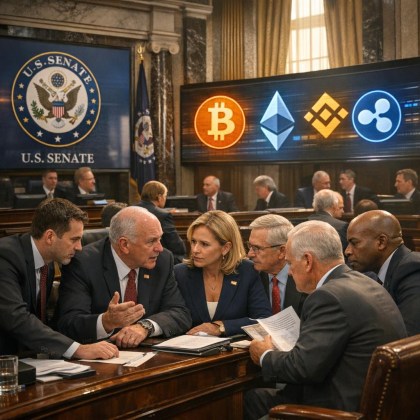
Featured image from ChatGPT, chart from TradingView.com
What's Your Reaction?