








































Auto Ancillary Stock With Leadership in Manufacturing Critical Safety Components for Global OEMs
Synopsis: Backed by 17 manufacturing plants, 27% international revenue, operations across 30+ countries, new order wins, a diversified auto components portfolio, and growing exports, the company is strengthening its position as a global mobility supplier with multiple long-term growth drivers beyond the domestic automobile market. Introduction India’s auto ancillary sector is increasingly becoming a key […] The post Auto Ancillary Stock With Leadership in Manufacturing Critical Safety Components for Global OEMs appeared first on Trade Brains.

Synopsis: Backed by 17 manufacturing plants, 27% international revenue, operations across 30+ countries, new order wins, a diversified auto components portfolio, and growing exports, the company is strengthening its position as a global mobility supplier with multiple long-term growth drivers beyond the domestic automobile market.
Introduction
India’s auto ancillary sector is increasingly becoming a key part of the global automotive supply chain, with select manufacturers building strong positions in safety-critical components that demand years of engineering expertise and customer trust. Backed by a diversified product portfolio, a global manufacturing footprint, growing exports, improving financial performance, and long-standing relationships with leading OEMs, one such player is steadily strengthening its long-term growth story beyond the domestic automobile market.
With a market capitalization of Rs. 3,325 crore, the shares of Rane (Madras) Limited were trading at Rs. 1,203 per share, with a 52-week range of Rs. 1,264 to Rs. 608, with a P/E of approximately 30x.
A Business Built on High Entry Barriers
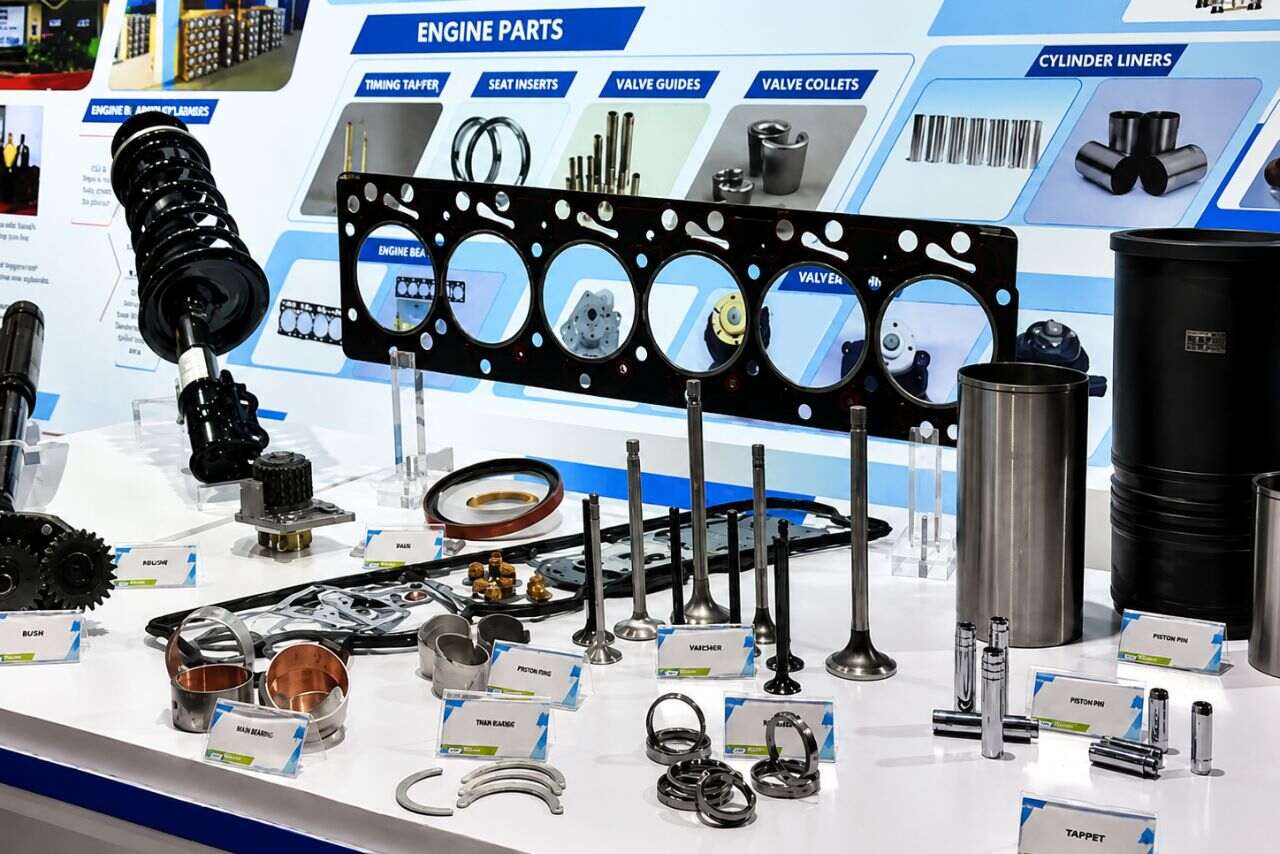
Rane (Madras) Limited is not in the crowded, commoditized end of the auto components market. It makes parts for steering systems, brake linings, disc pads, engine valves, valve guides and suspension products where a single quality failure could have serious safety consequences. This fact determines the entire structure of the industry. Here, OEMs don’t swap suppliers on a whim; qualification cycles for safety-critical parts can take years, with rigorous testing, auditing, and validation.
Once a supplier is approved, it will likely be embedded in the OEM’s supply chain for the life of the vehicle platform. This is not a marketing moat or brand moat. This is a moat of trust built over decades with regulatory and engineering complexity to keep new entrants out.
Diversification That Actually Diversifies
A lot of companies claim diversification, but Rane (Madras) spread across vehicle categories, is genuinely broad. Passenger vehicles account for 55% of India’s OEM revenue, commercial vehicles 20%, tractors 14%, two/three-wheelers 9%, with the remainder coming from rail, defence, and other niche segments. This matters because each of these categories runs on a different demand cycle: passenger vehicle sales respond to consumer sentiment and financing costs, tractors move with monsoon patterns and rural income, and commercial vehicles track infrastructure and freight activity.
In Q4 FY26 alone, this played out clearly: commercial vehicle revenue for the company grew 23% year-on-year even as passenger vehicle growth came in at a more modest 8%, and tractors grew 32% on the back of strong rural demand. When one segment cools, another often picks up the slack.
A Client List That Reads Like a Global Auto Directory
Rane (Madras) has built a customer portfolio that includes many of the world’s leading automotive OEMs, highlighting its strong engineering capabilities and long-standing industry relationships.
Its major customers include Maruti Suzuki, Tata Motors, Mahindra & Mahindra, Hyundai, Honda, Toyota, Kia, Ashok Leyland, Hero MotoCorp, TVS Motor, Bajaj Auto, Royal Enfield, Escorts Kubota, TAFE, BMW, Volvo, Daimler, Volkswagen Group, Nissan, Renault, Magna, Knorr-Bremse, Brembo, Cummins, and Dana.
Being a supplier to such well-established global OEMs is not a matter of luck; it requires years of consistent quality, engineering excellence, delivery reliability, and adherence to stringent international standards. The longevity of these relationships reflects the trust Rane has built with some of the most demanding automotive manufacturers in the world, reinforcing its position as a globally competitive auto component supplier.
A Genuinely Global Manufacturing Footprint
Structurally, Rane (Madras) is well placed to benefit from the wider trend of global auto OEMs diversifying their sourcing towards India. It has a presence across more than 30 countries and has 17 manufacturing plants, 16 in India and one in Mexico.
Total revenue for FY26 stood at ₹3,879 crore (approximately $440 million) with 27% of the same coming from international markets. That international mix is not a rounding error, it is a sizable chunk of the business that takes away the dependence on the domestic auto cycle and adds a layer of geographic diversification that many purely domestic ancillary players simply do not have.
Five Business Verticals, One Platform
Rather than betting everything on one product line, the company operates across five distinct verticals: steering & linkages, brake components, engine components, light metal castings, and aftermarket products. Steering & linkages is the biggest contributor representing about 49% of quarterly sales. This is followed by aftermarket products, brake components, engine components and light metal castings. This structure means growth does not depend on one product category continuing to do well if the aftermarket slows down, steering exports can pick up pace, as happened in Q4 FY26 when international sales grew 27% due to strong uptake of steering products.
The Numbers Behind the Story
The FY26 financials back up the qualitative thesis. Consolidated revenue grew 13.4% year-on-year to ₹3,878.6 crore, EBITDA rose a sharper 19.4% to ₹355.6 crore, taking margins to 9.2%. Profit after tax more than doubledup 185.5% to ₹107.5 crore, while ROCE improved by 303 basis points to 14.4%. The balance sheet also strengthened meaningfully, with net debt-to-equity falling from 1.16x a year earlier to 0.94x.
Look at the quarterly trend and the improvement becomes even clearer: PAT margin has climbed steadily from 0.7% in Q4 FY25 to 3.5% in Q4 FY26, while ROCE has moved from 11.3% to 14.4% over the same five quarters. This isn’t a one-off beat; it’s a gradual, consistent operating improvement.
The Investor Takeaway
Rane (Madras) is not a flash-in-the-pan growth story chasing a new-age theme but a steady diversified auto ancillary business based on engineering trust, safety-critical positioning, and a truly global customer and manufacturing base.
The FY26 numbers show margin expansion, deleveraging, and improving capital efficiency all occurring together, which is often the hallmark of a business hitting its operating stride. Whether the momentum sustains will depend on how the India auto sourcing story pans out globally, and how the company keeps translating its engineering credibility into order wins across cycles.
Disclaimer: The views and investment tips expressed by investment experts/broking houses/rating agencies on tradebrains.in are their own, and not that of the website or its management. Investing in equities poses a risk of financial losses. Investors must therefore exercise due caution while investing or trading in stocks. Trade Brains Technologies Private Limited or the author are not liable for any losses caused as a result of the decision based on this article. Please consult your investment advisor before investing.
The post Auto Ancillary Stock With Leadership in Manufacturing Critical Safety Components for Global OEMs appeared first on Trade Brains.
What's Your Reaction?