















































Bitcoin Miner Selling Hits Historic Lows As MPI Signals Structural Shift
Bitcoin has lost the $70,000 level, facing renewed selling pressure as the market struggles to maintain momentum following recent consolidation. The breakdown below this key psychological threshold reflects weakening short-term structure, with traders increasingly cautious amid rising volatility and fading demand. Related Reading: From FOMO to Apathy: Altcoin Volumes Reflect Deepening Market Fatigue However, on-chain […]


Bitcoin has lost the $70,000 level, facing renewed selling pressure as the market struggles to maintain momentum following recent consolidation. The breakdown below this key psychological threshold reflects weakening short-term structure, with traders increasingly cautious amid rising volatility and fading demand.
However, on-chain data presents a more nuanced picture. According to a CryptoQuant report, Bitcoin’s Miners’ Position Index (MPI) is currently sitting at -1.04, one of the lowest readings in its history. Notably, this marks only the third time that the 30-day moving average has approached the -1 threshold, highlighting an extreme condition in miner behavior.
By definition, such depressed MPI levels indicate that miners are sending significantly fewer coins than usual relative to their one-year average. In practical terms, miner selling pressure is structurally low, suggesting that miners are either accumulating newly mined BTC, anticipating higher prices, or both.
This dynamic is typically interpreted as bullish. Miners represent one of the market’s most consistent sources of supply, and when their distribution declines, it removes a key structural headwind. In this context, while price action remains under pressure, the reduction in miner selling introduces a counterbalance that could influence the market’s next phase.
Low MPI Signals Reduced Pressure, Not a Confirmed Bottom
The report further explains that historically, extreme low MPI readings have tended to emerge during periods of miner stress or post-capitulation phases, often aligning with broader macro uncertainty and compressed profitability. These conditions typically reflect a market that has already absorbed significant downside, where miners reduce selling either out of necessity or in anticipation of improved conditions.

However, an important nuance must be considered. While a low MPI clearly signals reduced sell pressure, it does not reliably mark absolute price bottoms. Historical patterns show that Bitcoin’s cyclical lows rarely occur at the exact point where MPI reaches extreme lows. Instead, they tend to form as MPI begins to recover, indicating renewed activity and a shift in market dynamics.
This distinction is critical. The absence of miner selling removes a structural source of supply, but it does not create demand. Price direction ultimately depends on who is absorbing available supply, whether through spot accumulation, ETF inflows, or renewed derivatives positioning.
In this context, low MPI alone is insufficient to sustain upward momentum. The current reading reflects a market with minimal miner-driven pressure, but without clear demand expansion, continuation remains uncertain. Historically, the signal becomes more actionable once MPI starts rising alongside improving liquidity conditions.
Bitcoin Struggles Below $70K as Downtrend Structure Persists
Bitcoin is currently trading around the $68,000–$69,000 range, consolidating after a sharp breakdown that pushed the price below the $70,000 level. The chart shows a clear loss of bullish structure, with BTC forming a sequence of lower highs since late 2025 and failing to sustain recovery attempts.
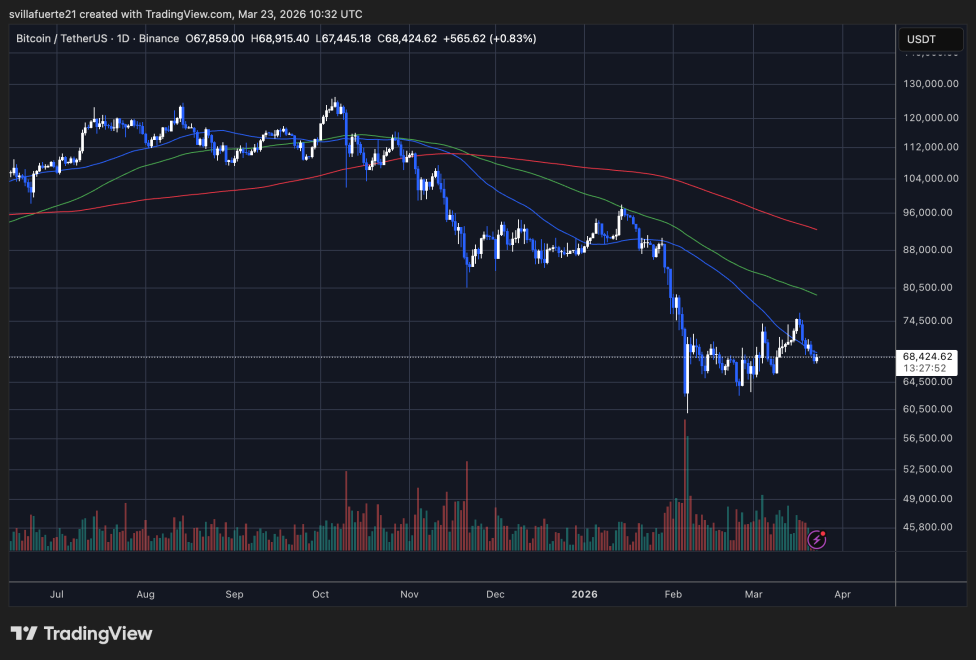
From a technical perspective, the market remains in a confirmed downtrend. Price is trading below the 50-day, 100-day, and 200-day moving averages, all of which are sloping downward. This alignment reflects persistent bearish momentum, with rallies continuing to face rejection near dynamic resistance levels.
The recent bounce from the February lows appears corrective rather than impulsive. Bitcoin briefly approached the $74,000 region but failed to hold gains, indicating weak follow-through from buyers. Volume data supports this interpretation, with the largest spikes occurring during the sell-off phase, suggesting capitulation-driven activity rather than strong accumulation.
In the short term, the $70,000 level now acts as key resistance, while the $65,000 zone serves as immediate support. A sustained reclaim of $70K would be required to shift the short-term structure and signal potential recovery. Until then, BTC remains vulnerable to further downside, particularly if selling pressure intensifies and demand fails to absorb supply.
Featured image from ChatGPT, chart from TradingView.com
What's Your Reaction?