







































































Market Leader: How DOMS Industries Turned Pencils into a ₹15,354 Cr Stationery Empire
Synopsis: DOMS Industries, has risen from a small pencil manufacturer to a market leader with a Rs. 15,354 crore market cap, capturing 32–35 percent of India’s stationery market. Strategic branding, F.I.L.A. partnership, 18 factories, and diversified products drove Rs. 1,913 crore revenue and Rs. 214 crore net profit in FY25, establishing classroom and global dominance. DOMS, a homegrown […] The post Market Leader: How DOMS Industries Turned Pencils into a ₹15,354 Cr Stationery Empire appeared first on Trade Brains.

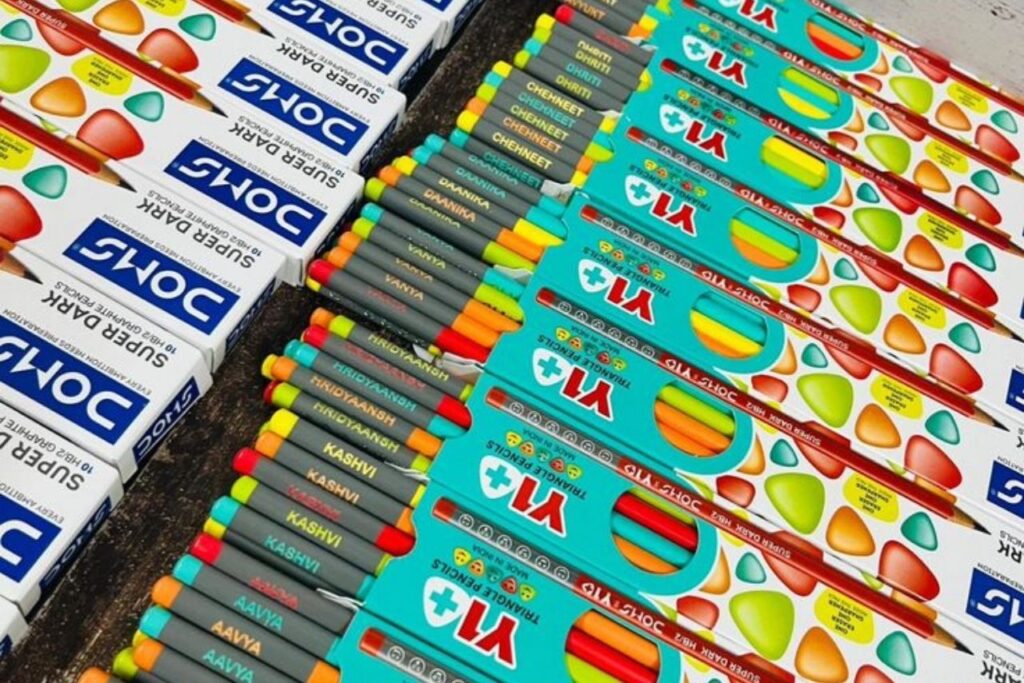
Synopsis: DOMS Industries, has risen from a small pencil manufacturer to a market leader with a Rs. 15,354 crore market cap, capturing 32–35 percent of India’s stationery market. Strategic branding, F.I.L.A. partnership, 18 factories, and diversified products drove Rs. 1,913 crore revenue and Rs. 214 crore net profit in FY25, establishing classroom and global dominance.
DOMS, a homegrown Indian stationery brand, has steadily risen to become a market leader in the country’s stationery segment. From schools and offices to retail shelves nationwide, the brand has carved a niche with its wide range of products, combining quality, innovation, and affordability. Its journey reflects how a focused strategy and understanding of consumer needs can drive growth in a competitive industry.
DOMS Industries Limited, with a market capitalization of Rs. 15,354.02 crore, closed at Rs. 2,530 per equity share, up by 3.16 percent from its previous day’s close price of Rs. 2,452.60 per equity share.
DOMS Industries Limited is an Indian company, founded in 1973 and based in Valsad, that designs, manufactures, and sells stationery and art materials under the DOMS brand both in India and internationally. Its product range includes pencils, erasers, sharpeners, crayons, color pencils, paints, brushes, pens, markers, notebooks, sketch pads, stationery and art kits, as well as baby diapers and wet wipes. The company also provides packaging services, making it a diversified player in stationery, art supplies, and related consumer products.
Started as Small Workshop
DOMS Industries Limited’s story began in 1973 in Umbergaon, Gujarat, when R.R. Industries started manufacturing wooden pencils for other companies. For decades, it remained a backend supplier, far removed from brand-building ambitions. The turning point came in the early 2000s when the promoters decided to move up the value chain. The DOMS trademark was registered in 2005, marking its transition from a supplier to a consumer-facing brand. Its red-and-black pencils soon began appearing in schoolbags across India, quietly laying the foundation for scale.
The F.I.L.A. Partnership
A defining moment arrived in 2012 when Italy’s F.I.L.A Group acquired a minority stake in DOMS, followed by a majority 51 percent holding in 2015. This partnership brought global design sensibilities, manufacturing discipline, and access to international markets. More importantly, it changed DOMS’ mindset from a stationery manufacturer to a global consumer brand. The collaboration helped professionalise operations, expand product categories, and prepare the company for its next phase of growth.
IPO and Market Validation
DOMS public listing in December 2023 marked its arrival in the big league, with its IPO priced between Rs. 750–Rs. 790 per share. The IPO was oversubscribed nearly 93 times, and the stock debuted at Rs. 1,400, a 77.22 percent premium to the upper price band. Within a year, it soared to Rs. 3,115 per share, delivering 294.3 percent returns to early investors. Even after market corrections, it trades around Rs. 2,530, offering over 220 percent gains from the IPO.
For a company built around pencils, erasers, and crayons, the market response underlined something deeper: DOMS had successfully created brand equity in a commodity space. Its listing symbolised how stationery, when executed like FMCG, could deliver scale, margins, and market enthusiasm.
Camlin’s Decline and the Changing Market
To understand DOMS’ rise, one must look at Camlin’s fall. Camlin, with its iconic camel logo, dominated the Indian stationery market for decades. In FY10, it held around 38 percent of the organised market, while DOMS had under 5 percent. Two decades later, DOMS commands 32 percent-35 percent, while Camlin has dropped to roughly 8 percent-10 percent.
After Japan’s Kokuyo Group took control, Camlin lost some of its local cultural connect without gaining enough speed or innovation. Slower product launches, dated packaging, and muted marketing dulled its appeal to newer generations. As the market moved toward design-led products, combo kits, and convenience-driven buying, Camlin fell behind.
Making Stationery Aspirational
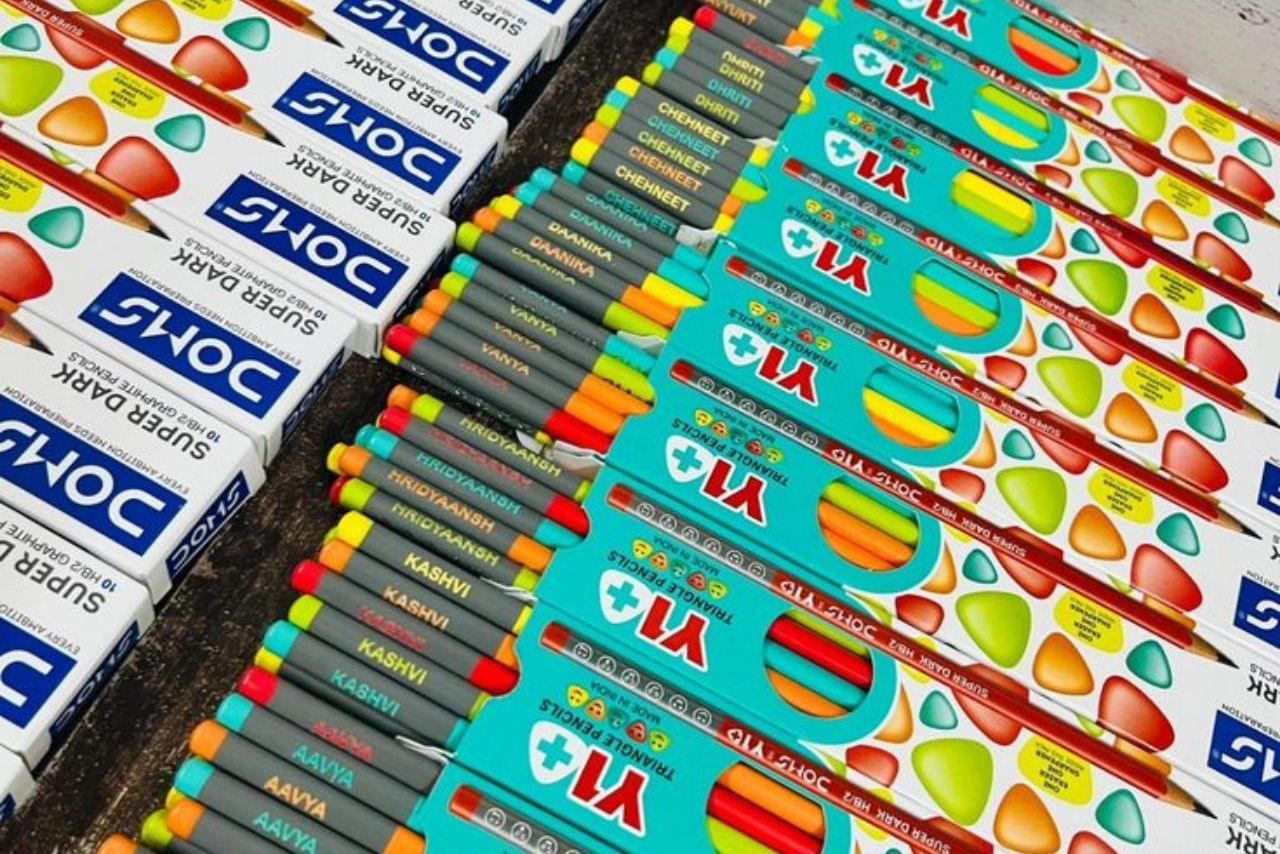
DOMS succeeded where Camlin stalled by reimagining stationery as a lifestyle choice for children. It focused on colourful designs, ergonomic products, trendy packaging, and YouTube art tutorials created a full brand universe. Rather than selling individual pencils, DOMS sold solutions, complete kits that saved time, looked attractive, and felt modern. Over time, it built a full product ecosystem spanning scholastic stationery, art materials, and office supplies. Combo kits now contribute over 40 percent of scholastic sales, saved parents time while giving kids creative options.
The Birthday Return Gift Idea
One of DOMS smartest moves was identifying birthday parties as a marketing channel. Its stationery kits became popular return gifts as it was useful, affordable, and visually appealing. Each birthday became a brand touchpoint, putting DOMS products into dozens of homes without traditional advertising. This organic, classroom-level brand building created powerful word-of-mouth momentum that competitors struggled to replicate.
Community-Led Marketing
DOMS went beyond conventional advertising by building creative communities. Its YouTube channel, with millions of subscribers, and active social media presence focus on art tutorials and children’s creativity rather than direct selling. By positioning itself as a partner in self-expression, DOMS embedded itself emotionally with young consumers, ensuring early brand loyalty that often lasts into adulthood.
Scale, Manufacturing, and Distribution
Behind the branding sits serious operational strength. DOMS runs 18 manufacturing facilities, employs over 13,000 people, and distributes to nearly one million retail outlets across India. Its factories operate with FMCG-like efficiency, high automation, and in-house packaging, allowing tight cost control despite low per-unit pricing. This scale has helped DOMS dominate a previously fragmented market.
Strong Financial Performance
DOMS’ revenue jumped from Rs. 1,537 crore in FY24 to Rs. 1,913 crore in FY25, a 24.46 percent YoY increase, while net profit rose from Rs. 160 crore to Rs. 214 crore, up 33.75 percent. Operating margins strengthened to 17 percent.
DOMS Industries reported strong growth in Q2 FY26, with revenue at Rs. 568 crore, up 24 percent YoY from Rs. 458 crore in Q2 FY25 and up 1.1 percent QoQ from Rs. 562 crore in Q1 FY26. EBITDA rose to Rs. 100 crore, up 16.3 percent YoY from Rs. 86 crore and 1.0 percent QoQ from Rs. 99 crore.
Net profit reached Rs. 61 crore, a 13 percent YoY increase from Rs. 54 crore and a 3.4 percent QoQ rise from Rs. 59 crore. This demonstrates steady growth both year-on-year and quarter-on-quarter, driven by strong demand in stationery and art material segments.
DOMS operational strategy has translated into robust financials. Revenue and profits have grown consistently, supported by improving margins. Even in a low-ticket category, the company has demonstrated that volume, efficiency, and brand power can deliver double-digit profitability.
Global Expansion with Limited Risk
Exports now form a meaningful part of DOMS revenue, supported by F.I.L.A.’s global distribution network across Europe, the Middle East, and Asia. While global trade disruptions and tariffs have raised concerns for manufacturers, DOMS limited exposure to the US market and diversified export base have insulated it from major risks, keeping its international expansion on track. Exports contribute 14 percent of total revenue, with Rs. 166.5 crore to F.I.L.A. affiliates and Rs. 108 crore to third-party customers.
Future Beyond Pencils
DOMS is expanding its Gujarat operations with a 44-acre mega project, investing Rs. 210–225 crore in capex for new plants and machinery. Acquisitions like Uniclan Healthcare (baby hygiene), SKIDO Industries (school bags), and Super Treads Pvt Ltd (paper stationery) broaden its “child-centric” ecosystem. Initiatives like DOMS Art Studio at KidZania Dubai and the Art Plaza Gallery in Mumbai showcase its commitment to creativity.
DOMS transformed humble pencils manufacturing into over Rs. 15,300 crore business with strong profitability, global reach, and unmatched classroom penetration. By blending manufacturing scale, consumer-centric design, and smart marketing, it overtook a century-old brand. While Camlin wrote India’s stationery past, DOMS is defining its future, aiming to be in every pencil case, art room, and office drawer.
Disclaimer: The views and investment tips expressed by investment experts/broking houses/rating agencies on tradebrains.in are their own, and not that of the website or its management. Investing in equities poses a risk of financial losses. Investors must therefore exercise due caution while investing or trading in stocks. Trade Brains Technologies Private Limited or the author are not liable for any losses caused as a result of the decision based on this article. Please consult your investment advisor before investing.
The post Market Leader: How DOMS Industries Turned Pencils into a ₹15,354 Cr Stationery Empire appeared first on Trade Brains.
What's Your Reaction?