
































WeWork India: Why It’s No Longer Just a “Freelancers With MacBooks” Company
Synopsis: WeWork India’s latest numbers suggest the company is quietly transforming into something much bigger than traditional coworking. Enterprise clients, GCCs and managed offices are now driving growth, but behind the strong occupancy and rising margins lies one key question that could decide how sustainable this transition really becomes. For many investors, the word WeWork […] The post WeWork India: Why It’s No Longer Just a “Freelancers With MacBooks” Company appeared first on Trade Brains.


Synopsis: WeWork India’s latest numbers suggest the company is quietly transforming into something much bigger than traditional coworking. Enterprise clients, GCCs and managed offices are now driving growth, but behind the strong occupancy and rising margins lies one key question that could decide how sustainable this transition really becomes.
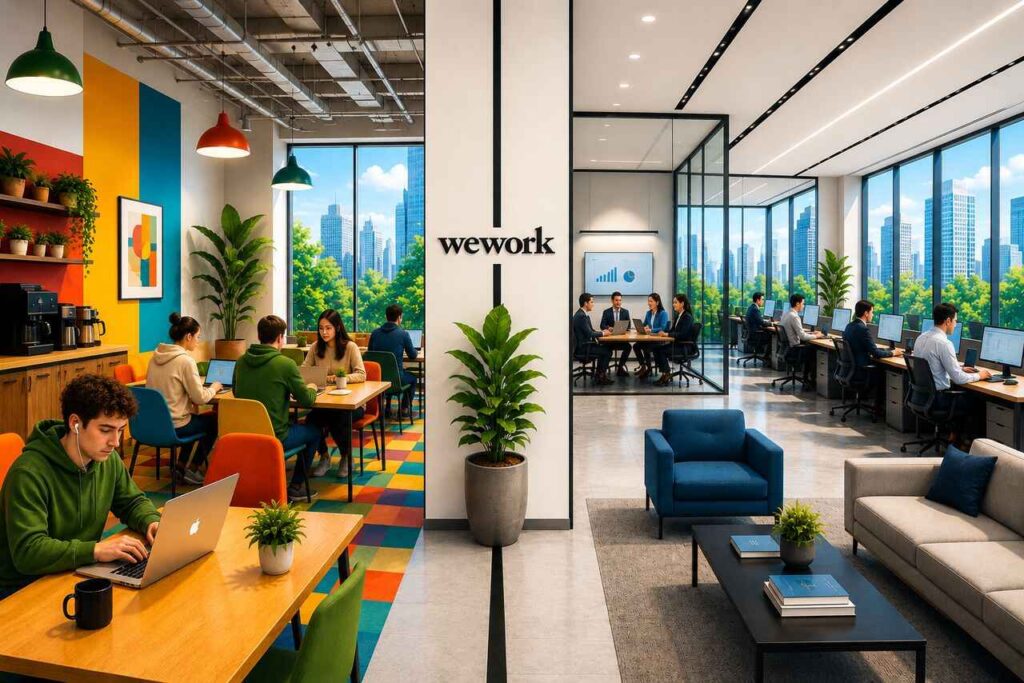
For many investors, the word WeWork still creates one very specific image in mind, freelancers with MacBooks, startup founders in hoodies, shared desks, coffee machines and colourful offices. That may have been the popular image of coworking in its early days, but WeWork India’s latest data shows that the business has moved far beyond that stage.
The company today is not just selling desks to individuals. It is increasingly positioning itself as a flexible workspace infrastructure platform for enterprises, global capability centres, large corporates, startups and fast-growing Indian companies. In simple terms, WeWork India leases Grade A office assets, designs and builds them into ready-to-use workplaces, and then offers those spaces to companies that want flexibility without handling long leases, upfront interiors, operations and daily facility management themselves.
This is important because the company is no longer dependent only on small users taking temporary seats. The centre of gravity has shifted towards enterprises that need speed, flexibility, premium locations and scalable offices.
What The Q4 Numbers Say That Makes The Story Believable
The latest Q4 FY26 numbers show how large the platform has become. WeWork India ended the quarter with 76 centres across 8 cities, 8.6 million square feet of operational area, 11.6 million square feet of total area, 126,900 operational desks and 110,200 members. Portfolio occupancy stood at 86.9 percent, while mature centre occupancy stood at 88.9 percent. Its net promoter score was also at an all-time high of plus 79.
These numbers matter because this business becomes stronger when more seats are filled. Rent, staff, utilities and operating costs are largely fixed at the centre level. Once occupancy rises, additional revenue has a stronger impact on profitability. That is exactly what happened in Q4 FY26.
Total revenue stood at Rs. 709.9 crore, up 10.9 percent quarter-on-quarter and 28.6 percent year-on-year. EBITDA stood at Rs. 164.7 crore, up 22.4 percent quarter-on-quarter and 42.8 percent year-on-year. PAT stood at Rs. 79.6 crore, up 53.1 percent quarter-on-quarter and 141.9 percent year-on-year. EBITDA margin expanded to 23.2 percent and PAT margin improved to 11.2 percent.
For FY26, the company reported total revenue of Rs. 2,477.4 crore, EBITDA of Rs. 499.2 crore and PAT of Rs. 179 crore. Free cash flow from operations stood at Rs. 585.5 crore, while ROCE stood at 28.3 percent for the full year. Management also said the balance sheet turned net debt negative for the first time (when a company’s total cash, cash equivalents, and liquid short-term investments exceed its total outstanding debt).
This is the biggest difference from the old coworking stereotype. A freelancer-led coworking business is fragile. A platform with high occupancy, enterprise contracts, improving margins, positive cash flow and net debt negative balance sheet starts looking like a much more institutional business.
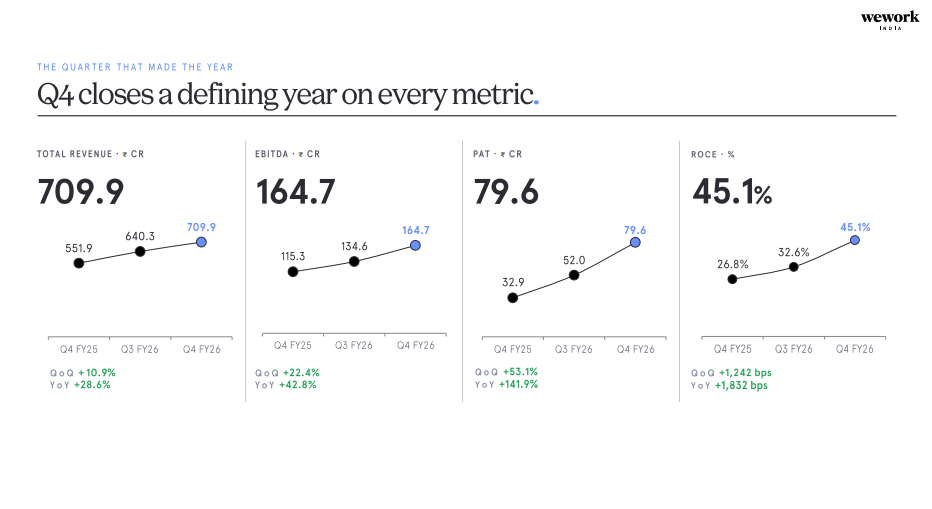
Source: WeWork India Management Q4FY26 Investor Presentation
Enterprise Customers Are Now The Core
The strongest proof of this shift is the customer mix. In Q4 FY26, management said 77 percent of core revenue came from enterprises, Fortune 500 companies alone contributed 28 percent, and 65 percent of revenue came from global members headquartered outside India. The top 10 members contributed about 23 percent of core revenue, showing that the business is not overly dependent on one or two large clients.
This means the business is not mainly a place where individuals rent seats for a few months. A large part of the revenue is coming from established companies that use WeWork’s offices. These companies are not just taking open desks. They are using private offices, full floors, dedicated areas and managed office solutions.
The kind of work happening inside WeWork centres also shows this change clearly. Management said its spaces include a 24×7 command centre monitoring pan-India operations for a major broadcaster, one of only two industrial automation R&D labs in India, AI development centres with GPU-ready workstations, EV testing facilities with battery infrastructure, broadcast studios, clean rooms for mobile product quality assurance and a management school training campus.
That is not casual coworking. That is serious workplace infrastructure. These are not just people checking emails on laptops. These are companies using WeWork locations for operations, technology development, testing, training and specialized enterprise work.
Managed Offices Are Changing The Business
The next important layer is Managed Offices. In a normal WeWork centre, different companies may take private offices or seats inside a branded WeWork space. In a managed office, WeWork builds and operates a customized office for one enterprise customer. The office can be branded for the client and built according to its needs.
This changes the risk profile because managed offices are largely demand-backed. In Q3 FY26, management said Managed Offices had scaled to 26,000 desks across 1.7 million square feet, contributed 21 percent of total revenue, had an annualized run rate of more than Rs. 530 crore and had grown at 63 percent CAGR over two years. Management also said these offices are executed only against committed demand, ensuring immediate utilization and disciplined capital deployment.
By Q4 FY26, management said Managed Offices had more than doubled their share to 21 percent in just two years. Core operations, which include private offices and managed offices, generated Rs. 584 crore in Q4 FY26, up 29 percent year-on-year. Value-added services came in at Rs. 95 crore, up 35 percent, while digital products such as All Access, Virtual Office, Workplace and On-demand contributed Rs. 21 crore, up 15 percent.
This revenue mix shows that WeWork India is becoming more than a rent-per-seat company. It earns from core workspaces, managed offices, customization, value-added services and digital products. The more services it layers on top of the same customer base, the deeper its relationship becomes.
Why AI, GCCs And Flexibility Matter
Management is also trying to connect the business to larger workplace shifts. In the Q4 call, the company said AI hiring in India has increased six times in six years, India ranks second globally in AI talent concentration, and the AI workforce within Indian GCCs is expected to grow fourfold by 2030. It also said 75 percent of enterprises now plan their real estate within a three-year horizon, while five-year-plus leases have fallen sharply by 40 percent.
The logic is simple. Companies do not want to lock themselves into very long office leases when hiring plans are changing quickly. If an AI team can grow from 100 people to 1,000 people, or if a company wants to test a new city before committing to a large campus, flexible offices become useful.
This is where WeWork India’s model becomes relevant. It gives companies the ability to start quickly, expand faster, use premium offices, avoid upfront capex and reduce operational headaches. Management also said more than half of new desks sold during the year came from existing members expanding within the network. That is an important signal because it means existing customers are not just staying, they are also taking more space.
Another new piece is Rivet, the company’s standalone design and build business. Rivet allows WeWork India to design and build workspaces for enterprises, landlords and developers even when the customer is not taking space inside a WeWork centre. The Q4 data says Rivet has no lease liability, is capital-light from day one, earns revenue on milestones rather than occupancy, and can act as a funnel for future managed office or flex demand.
This is important because it gives the company another way to monetize its design, build and procurement capabilities without taking the same lease risk as its core office business. Managed Offices involve building and operating customized enterprise offices, while Rivet only designs and builds offices without lease or occupancy risk.
The Key Risk Investors Should Not Ignore
The story is strong, but the risk has not disappeared. The biggest risk is still the lease mismatch. Crisil Ratings has pointed out that WeWork India’s revenue is predominantly driven by rental income and can be impacted by economic fluctuations, which may affect tenant viability, occupancy and rental income. The company signs long-term lease agreements with landlords, typically for 10 to 15 years with 3 to 5 year lock-ins, while tenant contracts are shorter, usually 2 to 3 years with an average lock-in of 1.0 to 1.5 years.
In simple terms, WeWork India may have to pay rent to landlords for many years, while customers can leave much earlier. During an economic downturn, if companies cut hiring or reduce office space, occupancy can fall while rent commitments remain. This is the core structural risk in the model.
However, there are safety measures. A large part of the portfolio is now mature, and mature centres have already completed lock-in periods, which moderates the mismatch. Occupancy is also high, with portfolio occupancy at 86.9 percent and mature centre occupancy at 88.9 percent in Q4 FY26. Managed Offices also reduce speculative risk because a meaningful part of that expansion is backed by customer demand.
Management said Q1 FY27 would bring 14,000 desks, with more than 40 percent of new capacity coming from Managed Offices. The company is also increasingly signing longer-duration enterprise contracts, with large enterprise commitment periods rising to nearly 32-33 months, improving revenue visibility and reducing lease mismatch risk.
The company also said remaining locked-in core revenue stood at Rs. 2,940 crore against locked-in rental cost of Rs. 986 crore, giving a 3 times positive multiple. FY27 also opened with Rs. 1,885 crore of core revenue already locked in.
Bluntly, WeWork India is no longer a “Freelancers with MacBooks” company. It has become a large enterprise workspace platform with strong occupancy, rising managed office contribution, improving margins, cash generation and a cleaner balance sheet. However, investors should remember that this is still an occupancy-driven real estate operating business where lease discipline, customer retention and capital allocation remain critical.
The bull case is that enterprises, GCCs, AI teams and large corporates continue to choose flexible offices instead of long-term leases. The bear case is that economic slowdown or aggressive capacity addition creates empty seats while rent obligations remain fixed. For now, the Q4 FY26 numbers show that WeWork India is executing well. The key question now is whether it can keep filling new capacity without weakening margins or increasing lease risk.
Disclaimer: The views and investment tips expressed by investment experts/broking houses/rating agencies on tradebrains.in are their own, and not that of the website or its management. Investing in equities poses a risk of financial losses. Investors must therefore exercise due caution while investing or trading in stocks. Trade Brains Technologies Private Limited or the author are not liable for any losses caused as a result of the decision based on this article. Please consult your investment advisor before investing.
The post WeWork India: Why It’s No Longer Just a “Freelancers With MacBooks” Company appeared first on Trade Brains.
What's Your Reaction?