






































What are the Advantages of Solar Panels in Homes? Solar Savings and ROI Explained
What if your electricity bill dropped to almost zero, and stayed that way for 25 years? That’s not hypothetical. It’s one of the major advantages of solar panels in homes. When sized to meet a household’s energy needs, rooftop solar panel systems can lower electricity bills by 90% or more. Some of the best advantages […] The post What are the Advantages of Solar Panels in Homes? Solar Savings and ROI Explained appeared first on Rooftop Solar for your home and more - Blog | SolarSquare.

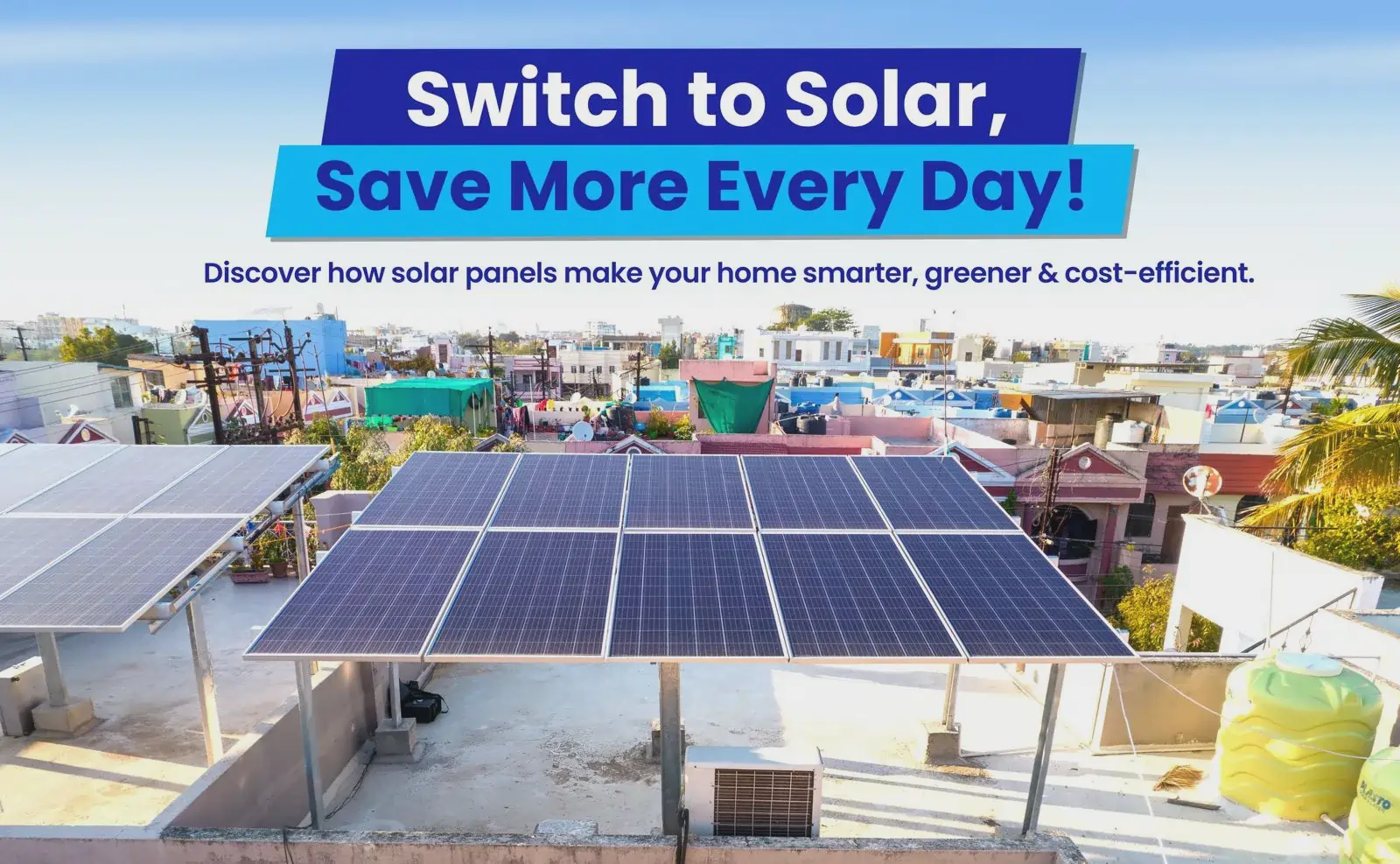
What if your electricity bill dropped to almost zero, and stayed that way for 25 years?
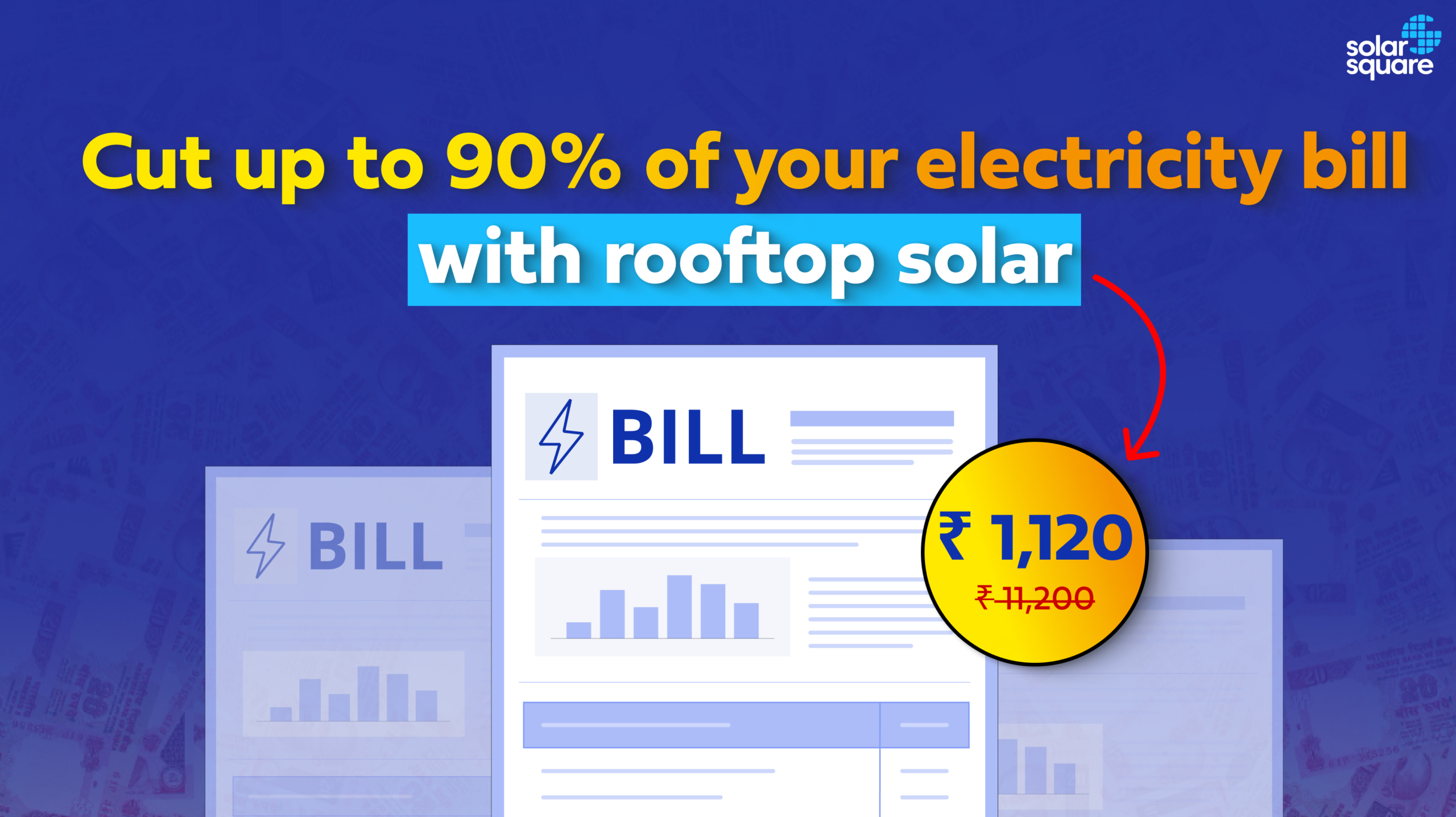
That’s not hypothetical. It’s one of the major advantages of solar panels in homes. When sized to meet a household’s energy needs, rooftop solar panel systems can lower electricity bills by 90% or more.
Some of the best advantages of solar panels on roofs include savings of tens of lakhs of rupees over 25 years of the panels’ life, reduction in air pollution as solar electricity generated by panels is clean, and free electricity generation for more than 25 years, shielding homes against rising electricity tariffs and offering true energy independence.
Wondering how much money we are talking about when we say rooftop solar panel systems save tens lakhs of rupees? Here’s an example of cost vs savings:
| Solar Panel System Size | Cost of Solar Panels for Homes in India’s Pune with Subsidy (Starting Price – Indicative for Base Variant)* | Savings From Solar Panels for Homes Over 25 Years with SolarSquare as Your Solar Company in India* |
| 3 kW | ~Rs. 1.32 lakh | ~Rs. 16.11 lakh |
| 5 kW | ~Rs. 2.22 lakh | ~Rs. 33.46 lakh |
*Please note: The above-mentioned cost of solar panels for homes in Pune with subsidy for on-grid solar systems is indicative as of 12th February 2026 for the SolarSquare Blue 6ft variant. The final solar panel cost for homes in Pune depends on your DISCOM charges, product variant opted for, panel type, inverter type, mounting structure height, type of after-sales service, savings guarantee, roof height, etc. Prices are subject to change. Also, while calculating savings from household solar panels in Pune, we have considered an annual tariff escalation of 3% and an annual plant degradation rate of 1%. The actual final savings from a solar panel system for homes depend on the types of solar panels you’ve installed and their efficiency, intensity of sunlight your rooftop receives, orientation of the panels and tilt angle, the pollution level and weather conditions in your city, the temperature, shadow on the roof, impact of dirt/dust, and how well you maintain your panels after installation.
You must choose the best solar modules to reap the financial advantages of rooftop solar panels in India. TOPCon solar panels are currently the best modules, with an efficiency of up to 26%, and they offer stable performance even as temperatures climb.
Read on to explore all the advantages of solar panels in homes, how these panels work to convert solar renewable energy into electricity, and the possible disadvantages of installing solar panels.
TL;DR Summary Box: Are Rooftop Solar Panels Worth it for Homeowners?
Solar panels, when sized to meet a home’s energy needs, can offer true energy independence by meeting all home energy demands, eliminating the need for expensive grid electricity. This results in zero or near-zero electricity bills for 25 years or more, saving tens of lakhs of rupees. Hence, installing a rooftop solar system is a smart financial decision with ROI far exceeding that from traditional investments such as gold or mutual funds.
Here are the main topics covered in this blog in detail:
| Main Topics | Key Takeaways |
| What are the advantages of solar panels? | The government offers a subsidy to lower the cost of solar panels, making them affordable. Also, these panels generate free electricity from sunlight for 25 years, lowering bills by 90% or more. It results in massive savings and also offsets carbon emissions, tackling air pollution right from your roof. |
| How do rooftop solar panels work? | Solar panels capture sunlight and convert it to direct current (DC) power through the photovoltaic effect. |
| What’s the cost of solar installation in India?* | This depends on multiple factors, including, but not limited to, your city, DISCOM charges, product variant opted for, panel type, inverter type, mounting structure height, type of after-sales service, savings guarantee, roof height, etc.
For instance, as of 12th February 2026, a 2 kW solar system that costs ~Rs. 85,000 in Lucknow with subsidy costs Rs. 1.10 lakh in Ahmedabad, ~Rs. 1.15 lakh in Pune, and ~Rs. 1.45 lakh in Bangalore. Also, prices are subject to change without any prior notice. |
| Are there any disadvantages of installing solar panels on roofs? | Solar panels require professional help for rooftop installation. They should not be treated as a DIY project. Also, not all roofs are equally suitable for solar installation. |
*Please note: The above-mentioned solar panel price for on-grid solar systems with subsidy is indicative as of 12th February 2026 for SolarSquare Blue 6ft variant. The final cost of solar panels for homes in India depends on your city, DISCOM charges, product variant opted for, panel type, inverter type, mounting structure height, type of after-sales service, savings guarantee, roof height, etc. Also, prices are subject to change without prior notice.
What are the Advantages of Solar Panels in Homes?
Installing solar panels to meet your home energy needs can offer freedom from hefty electricity bills that rise by 3-6% annually in India. When solar electricity runs the home, you no longer rely on expensive grid power, resulting in zero or near-zero bills for the entire lifespan of the panels.
Here’s a glimpse of all the advantages of solar panels in homes:
| Top Advantages of Solar Panels on Roofs | What Does it Mean for You? |
| Central government offers the PM Surya Ghar subsidy to homeowners | You can install rooftop solar at affordable rates. |
| Solar panels last for 25 years or more | You get free electricity for the entire lifespan of the panel. |
| They lower electricity bills by 90% or more | Compounded over 25 years, savings from not paying bills are in tens of lakhs of rupees. |
| They increase the sales value of the property | When you plan to put your property on rent or sell it later, you’ll get a higher value than non-solar homes. |
| They reduce pollution in your city | Solar panels offset carbon emissions, lowering your carbon footprint. |
| Solar panels work in all climates | No matter the season, your rooftop solar system will continue generating electricity for your home. |
| They offer true energy independence | You’re no longer dependent on grid power to meet your home’s energy needs. |
| You’re shielded against inflating electricity tariffs | With rooftop solar, you’ll save all the money you would have paid for 25 years for grid electricity. |
Now, let’s have a look at all the advantages of rooftop solar panels in detail.
#1. Subsidy Makes Rooftop Solar Panel Systems Affordable
Solar installation cost in India used to be the biggest hurdle homeowners faced earlier. However, as technology advanced, higher-efficiency solar panels began to decline in cost. And then the government started offering financial help to homeowners installing rooftop solar.
The PM Surya Ghar Muft Bijli Yojana solar subsidy offered today by the central government has made rooftop solar installation extremely affordable in 2026.
Here are the subsidy details:
| Solar System Size | Solar Subsidy Offered Under PM Surya Ghar Muft Bijli Yojana |
| 1 kWp | Rs. 30,000 |
| 2 kWp | Rs. 60,000 |
| 3 kWp and higher | Rs. 78,000 |
Please note: The subsidy is capped at Rs. 78,000 for grid-tied solar systems that are 3 kWp or higher.
#2. Solar Panels Last for 25 Years or More with Proper Maintenance
Installing solar panels today will offer free electricity not just for a few years but for decades to come. That’s because tier-1 solar panels from the best solar manufacturers have a lifespan of 25 years. And the panels, which are professionally maintained throughout their operational life, continue to generate electricity at 80% efficiency thereafter.
#3. Rooftop Solar Can Lower Electricity Bills by 90% or More
Rooftop solar systems generate free solar electricity, which lowers the need to dip into grid power to meet your home’s daily energy requirements. The result is a massive reduction in electricity bills. For most homeowners, the bills drop by 90% or more, resulting in savings of tens of lakhs of rupees over the panels’ 25-year lifespan of generating electricity free of cost.
Let’s give you an idea about the kinds of savings you can receive from solar in a city like Pune:
| Solar Panel System Size | Cost of Solar Panels for Homes in Pune with Subsidy (Starting Price – Indicative for Base Variant)* | Savings From Solar Panels for Homes Over 25 Years with SolarSquare as Your Solar Company in India* | Return on Investment (ROI) |
| 3 kW | ~Rs. 1.32 lakh | ~Rs. 16.11 lakh | ~12.2x |
| 5 kW | ~Rs. 2.22 lakh | ~Rs. 33.46 lakh | ~15x |
*Please note: The above-mentioned cost of solar panels for homes in Pune with subsidy for on-grid solar systems is indicative as of 12th February 2026 for the SolarSquare Blue 6ft variant. The final solar panel cost for homes in Pune depends on your DISCOM charges, product variant opted for, panel type, inverter type, mounting structure height, type of after-sales service, savings guarantee, roof height, etc. Prices are subject to change. Also, while calculating savings from household solar panels in Pune, we have considered an annual tariff escalation of 3% and an annual plant degradation rate of 1%. The actual final savings from a solar panel system for homes depend on the types of solar panels you’ve installed and their efficiency, intensity of sunlight your rooftop receives, orientation of the panels and tilt angle, the pollution level and weather conditions in your city, the temperature, shadow on the roof, impact of dirt/dust, and how well you maintain your panels after installation.
#4. On-Grid Rooftop Solar Panels Increase the Sales Value of the Property
A solar-equipped property commands a premium over homes without solar in the same neighbourhood, and the reason is straightforward economics.
Electricity is one of the largest recurring expenses for Indian households, and it only gets more expensive. When a buyer looks at two similar properties, and one comes with a system that eliminates electricity bills, the math does the selling. Tens of lakhs of rupees in savings already baked into the property over the system’s remaining life is a value a buyer can see before signing a single cheque.
In short, your rooftop solar panel system doesn’t just pay for itself while you live in the home; it pays you again when you sell or rent it.
#5. Solar Panels Can Tackle Pollution Right From Your Roof
Rooftop solar panels offset carbon in mammoth amounts. Even a 1 kW solar system can offset ~26,000 kg of carbon dioxide over its lifetime, the same amount absorbed by 39 full-grown trees over 25 years.
Here’s a tabulated snapshot of how much carbon different-capacity solar systems can offset over their 25-year lifespan:
| Solar System Size | Equivalent to How Many Full-Grown Trees? | Carbon it offsets in 25 Years |
| 1 kW | 39 full-grown trees | ~26,000 kg |
| 2 kW | 78 full-grown trees | ~52,000 kg |
| 3 kW | 118 full-grown trees | ~78,000 kg |
| 4 kW | 157 full-grown trees | ~1,04,000 kg |
| 5 kW | 196 full-grown trees | ~1,30,000 kg |
| 10 kW | 392 full-grown trees | ~2,59,000 kg |
Can you imagine what this could do to the deteriorating air quality index across states like Delhi? If every home switched to solar, the AQI would significantly improve, making the air breathable again.
#6. Tier-1 Solar Panels Work in All Climatic Conditions
Think solar panels need perfect sunshine to generate electricity? Modern Tier-1 TOPCon panels and mono-perc half-cut bifacial panels are built to disagree.
TOPCon (Tunnel Oxide Passivated Contact) cells feature an ultra-thin oxide layer that captures more energy from every photon, including weak, scattered light on cloudy or hazy days. This is why TOPCon panels maintain strong output during monsoons, winter fog, and even heavy haze.
In mono-perc half-cut bifacial panels, the half-cut cell design is an added advantage. Each cell is laser-cut into two halves, creating independent upper and lower panel sections. The practical payoff is massive because when a shadow from your water tank or parapet wall falls across one section, only that section dips. The other keeps producing power at its full capacity.
#7. Properly-Sized Solar Panels Offer True Energy Independence
A solar system sized to match your household’s actual consumption doesn’t just reduce your electricity bill; it actually replaces the grid as your primary power source. Every unit of electricity your home needs, your rooftop produces.
The shift is significant because you stop buying energy and start making it. No more vulnerability to tariff hikes, no more dependence on your DISCOM’s reliability, no more watching your bill climb every summer when ACs run full blast. Your rooftop handles it all.
That’s not partial savings. That’s absolute energy independence.
#8. Solar Panels Shield Against Rising Electricity Tariffs
Electricity tariffs in India don’t stay flat; they steeply climb. Most state DISCOMs revise rates almost every year, and the trajectory has been consistently upward. Over the past decade, residential tariffs across states have risen by 3-6% annually. What may cost you Rs. 8 per unit today could easily cross Rs. 14-15 per unit within the next five-six years.
Can you imagine what a rooftop solar system does to this equation? It locks in your electricity costs at zero for 25+ years!
The moment your PV system is installed, it starts generating electricity. Every unit it produces is a unit you don’t buy from the grid. While your neighbors absorb each tariff revision, your electricity costs stay frozen at what you paid for the system, spread across decades of free generation.
Since most homeowners recover their full investment within 3-5 years, the remaining 20 years are pure insulation from whatever DISCOMs decide to charge.
How do Rooftop Solar Panels Work?
Solar panels work by absorbing solar radiation and converting it into electricity through the photovoltaic effect. Multiple components come together to enable sunlight-to-AC power conversion.
Let’s understand in simple steps how sunlight is converted to electricity:
- Solar cells in solar panels absorb photons from sunlight: Photons, which are energy packets, transfer their energy to electrons within the photovoltaic cells, exciting them. Excited electrons leave their bonds and begin to move in a single direction. This results in the formation of direct current (DC) electricity.
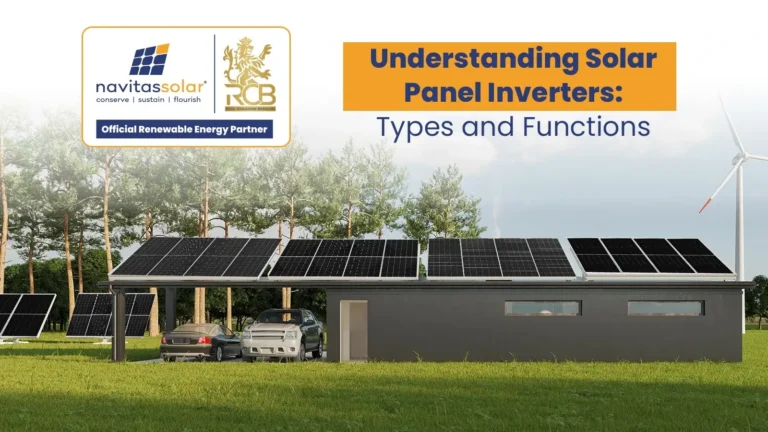
- DC generated by the panels is converted to usable form: In India, DC power is not supplied straight to homes, as it can be lethal. Therefore, a solar inverter first converts DC to alternating current (AC), which powers your home appliances.
Do Solar Panels Work at Night?
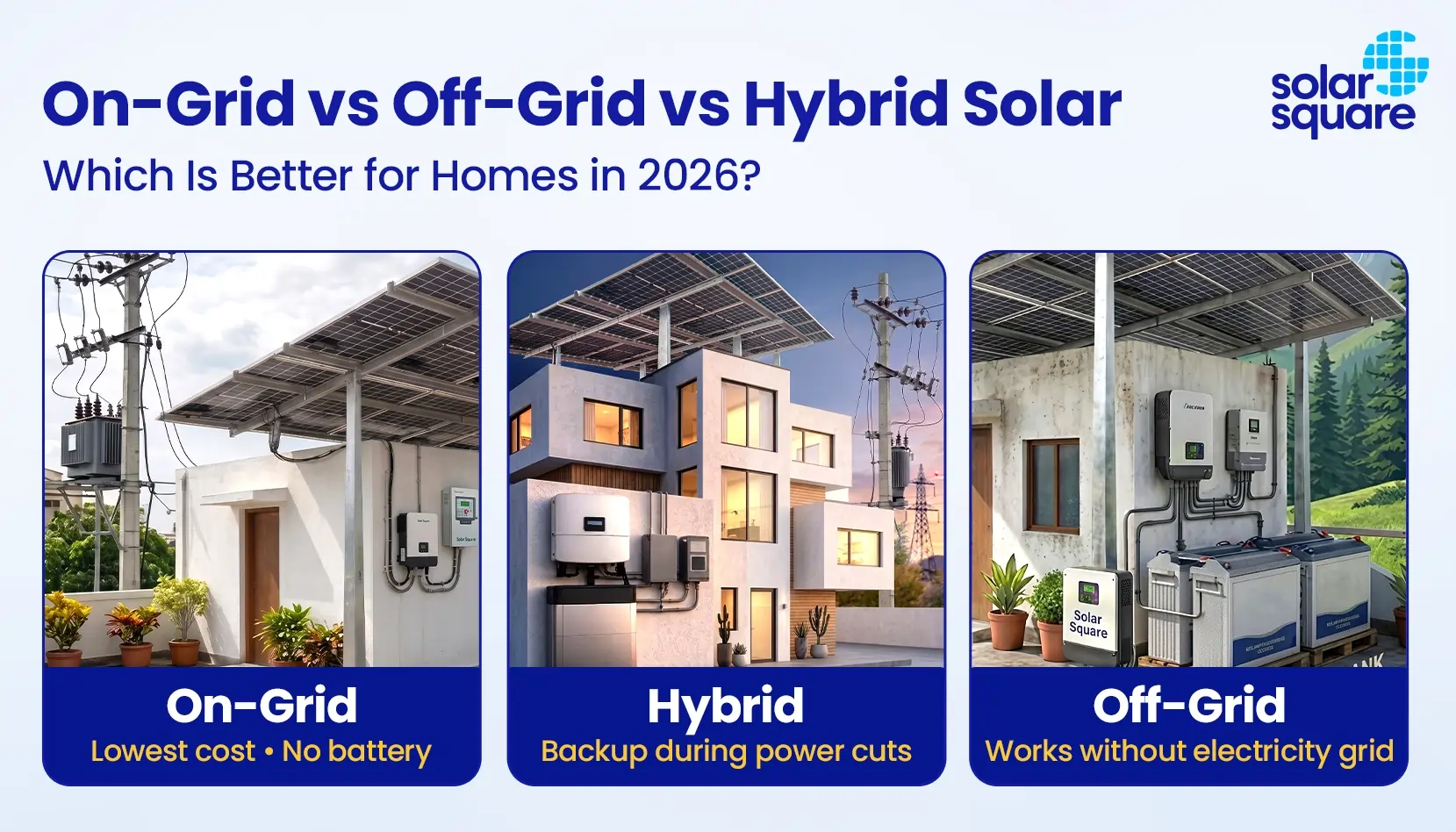
Solar panels require sunlight to produce electricity. Therefore, they can’t work at night. So, would your home go into absolute darkness if you install solar? Well, absolutely not. There are three kinds of solar systems, and each has its own way of ensuring there’s a power supply available throughout the day and night.
- On-grid solar system: It’s connected to the grid. The home runs on solar power during the daytime. Any excess energy not used during the day is sent to the grid. At night, power from the grid is imported to keep the load running. There’s a bi-directional net meter which keeps track of this energy exchange. The process is known as solar net metering. If, during a billing cycle, your system sends more power to the grid than what’s imported, the DISCOM gives you credit. And if your system imports more power than what it exports to the grid, you pay the DISCOM only for those additional units.
- Off-grid solar system: It’s not connected to the grid and uses a battery bank instead. Electricity from panels powers the load during the day, and any surplus energy is used to charge lead-acid or lithium batteries. At night or wherever needed, energy stored in the battery bank is used.
- Hybrid solar system: It combines the best of both worlds: grid connectivity and battery storage. During the day, solar panels power the load first. Any surplus energy charges the battery bank. Once the batteries are fully charged, any excess is exported to the grid through net metering. At night, the system draws from the batteries first before pulling from the grid. This means you have backup power during outages while still earning net metering credits for surplus generation.
What’s the Cost of Rooftop Solar Panels in India in 2026?
The cost of installing rooftop solar panels varies between cities. For instance, a 2 kW solar system that costs ~Rs. 85,000* in Lucknow with subsidy costs ~Rs. 1.45 lakh* in Bangalore.
That said, let’s have a look at the solar panel installation cost in India across various cities for different-capacity solar systems:
| Solar Panel System Size | Cost of Rooftop Solar Panels in India for Homes with Subsidy (Starting Price – Indicative for Base Variant)* as of 12th Feb 2026 |
| 2 kW solar system | Ranges between ~Rs. 85,000 in Lucknow, ~Rs. 1.10 lakh in Ahmedabad, ~Rs. 1.15 lakh in Pune, and ~Rs. 1.45 lakh in Bangalore |
| 3 kW solar system | Ranges between ~Rs. 97,000 in Lucknow, ~Rs. 1.22 lakh in Ahmedabad, ~Rs. 1.32 lakh in Pune, and ~Rs. 1.62 lakh in Bangalore |
| 4 kW solar system | Ranges between ~Rs. 1.47 lakh in Lucknow, ~Rs. 1.67 lakh in Ahmedabad, ~Rs. 1.77 lakh in Pune, and ~Rs. 2.07 lakh in Bangalore |
| 5 kW solar system | Ranges between ~Rs. 1.97 lakh in Lucknow, ~Rs. 2.12 lakh in Ahmedabad, ~Rs. 2.22 lakh in Pune, and ~Rs. 2.92 lakh in Bangalore |
| 10 kW solar system | Ranges between ~Rs. 4.52 lakh in Lucknow, ~Rs. 4.77 lakh in Ahmedabad, ~Rs. 4.87 lakh in Pune, and ~Rs. 5.52 lakh in Bangalore |
*Please note: The solar panel price for on-grid solar systems with subsidy listed in the section above is indicative as of 12th February 2026 for SolarSquare Blue 6ft variant. The final cost of solar panels for homes in India depends on your city, DISCOM charges, product variant opted for, panel type, inverter type, mounting structure height, type of after-sales service, savings guarantee, roof height, etc. Also, prices are subject to change without prior notice.
Solar Installation Cost vs Solar Savings and ROI
Installing rooftop solar offers an ROI greater than that of traditional investments like gold. Don’t believe us? Let’s take you through the cost of rooftop solar panels in a city like Pune and how much savings and ROI they can offer. Have a look.
| Solar Panel System Size | Cost of Solar Panels for Homes in Pune with Subsidy (Starting Price – Indicative for Base Variant)* | Savings From Solar Panels for Homes Over 25 Years with SolarSquare as Your Solar Company in India* | Return on Investment (ROI) |
| 2 kW | ~Rs. 1.15 lakh | ~Rs. 10.74 lakh | ~9.3x |
| 3 kW | ~Rs. 1.32 lakh | ~Rs. 16.11 lakh | ~12.2x |
| 4 kW | ~Rs. 1.77 lakh | ~Rs. 21.48 lakh | ~12.1x |
| 5 kW | ~Rs. 2.22 lakh | ~Rs. 33.46 lakh | ~15x |
| 10 kW | ~Rs. 4.87 lakh | ~Rs. 66.92 lakh | ~13.7x |
*Please note: The above-mentioned cost of solar panels for homes in Pune with subsidy for on-grid solar systems is indicative as of 12th February 2026 for the SolarSquare Blue 6ft variant. The final solar panel cost for homes in Pune depends on your DISCOM charges, product variant opted for, panel type, inverter type, mounting structure height, type of after-sales service, savings guarantee, roof height, etc. Prices are subject to change. Also, while calculating savings from household solar panels in Pune, we have considered an annual tariff escalation of 3% and an annual plant degradation rate of 1%. The actual final savings from a solar panel system for homes depend on the types of solar panels you’ve installed and their efficiency, intensity of sunlight your rooftop receives, orientation of the panels and tilt angle, the pollution level and weather conditions in your city, the temperature, shadow on the roof, impact of dirt/dust, and how well you maintain your panels after installation.
Not from Pune but someplace else? You can use SolarSquare’s free rooftop solar calculator to find the solar savings and ROI you can get in your city by installing solar panels.
Calculate your savings

Forecast your savings with solar on your investment on the SolarSquare’s plant


.svg "Take a 12-month average of your electricity bills, combining all meters before averaging.")
Are there any Disadvantages of Rooftop Solar Panels?
While they’re not exactly disadvantages, there are a few limitations listed below that you must consider before investing in a rooftop solar system in India.
- Solar installation cannot be treated as a DIY project: There’s no law stopping you from installing panels yourself, but it’s a technical process. Roof assessment, finding the right direction and tilt angle, electrical wiring, and net meter setup all demand professional expertise to get things right. If the installation isn’t done right, your panels won’t generate to their full potential. So, choosing the right installer matters as much as choosing the right panels. To avoid this risk, go with a DISCOM-approved solar company with a proven track record. SolarSquare, for instance, is India’s #1 home solar company with over a decade of installation experience.
- May not be suitable for all roof types: Older roofs with weak structural integrity may need reinforcement before they can bear the weight of solar panels, mounting structures, and associated hardware. This adds to the overall cost. Furthermore, roofs with complex layouts featuring multiple levels, skylights, water tanks, or too many obstructions reduce the usable area and make panel placement difficult. However, this doesn’t mean solar is impossible on such roofs. A professional site survey is the reliable way to determine whether your specific roof is a good fit.
Conclusion
Among the many advantages of solar panels in homes, their ability to make electricity bills zero and save tens of lakhs of rupees are among the benefits that make solar installation an investment rather than an expense. After all, investing a few lakhs upfront offers a 10-12x ROI that no other investment can match, let alone beat.
Then there’s the PM Surya Ghar solar subsidy, which makes rooftop solar even more affordable. However, this financial assistance will only be offered till March 31st, 2027, until the government has solarized 1 crore homes under the PM Surya Ghar scheme.
Why wait any longer when you can install rooftop solar today at subsidized prices? Book a free solar consultation call with SolarSquare for any further information.
FAQs
Can I run an AC with a solar panel?
Yes, you can run an AC with solar, but you’ll need an appropriately sized solar system for that. If you have a single 1.5-ton AC at home, you’ll need a 3 kW solar system. For 2 1.5-ton ACs, a 5 kW solar system is required.
How many solar panels are needed for a 1.5-ton AC?
As already explained, a 3 kW solar system is needed to power a 1.5-ton AC. If you use 540-watt solar panels for a 3 kW system, then you’ll need ~6 solar panels. This comes from a simple formula.
Number of solar panels = solar system’s capacity in watts / module’s capacity in watts.
What are the advantages and disadvantages of solar panels?
The most crucial advantages of rooftop solar panels include lowering electricity bills by 90% or more, saving tens of lakhs of rupees over 25 years, and offering true energy independence by reducing reliance on expensive grid power. On the other hand, solar installation requires professional expertise and not every roof is solar-ready. Roofs that require structural reinforcement or layout modifications to accommodate panels can increase overall installation costs.
Is 2 kW enough to run a house?
Yes, a 2 kW solar system is considered enough for a 1-2 BHK home with an annual energy consumption of 2,800 to 2,900 units.
Is a 90% efficient solar panel possible?
No. Even the most advanced lab-tested multi-junction solar cells have only achieved around 47% efficiency, and that too under concentrated sunlight. A 90% efficient solar panel is beyond what current technology can deliver.
Here are the main topics covered in this blog in detail:
Main Topics Key Takeaways What are the advantages of solar panels? The government offers a subsidy to lower the cost of solar panels, making them affordable. Also, these panels generate free electricity from sunlight for 25 years, lowering bills by 90% or more. It results in massive savings and also offsets carbon emissions, tackling air pollution right from your roof. How do rooftop solar panels work? Solar panels capture sunlight and convert it to direct current (DC) power through the photovoltaic effect. What’s the cost of solar installation in India?* This depends on multiple factors, including, but not limited to, your city, DISCOM charges, product variant opted for, panel type, inverter type, mounting structure height, type of after-sales service, savings guarantee, roof height, etc. For instance, as of 12th February 2026, a 2 kW solar system that costs ~Rs. 85,000 in Lucknow with subsidy costs Rs. 1.10 lakh in Ahmedabad, ~Rs. 1.15 lakh in Pune, and ~Rs. 1.45 lakh in Bangalore. Also, prices are subject to change without any prior notice.
Are there any disadvantages of installing solar panels on roofs? Solar panels require professional help for rooftop installation. They should not be treated as a DIY project. Also, not all roofs are equally suitable for solar installation. *Please note: The above-mentioned solar panel price for on-grid solar systems with subsidy is indicative as of 12th February 2026 for SolarSquare Blue 6ft variant. The final cost of solar panels for homes in India depends on your city, DISCOM charges, product variant opted for, panel type, inverter type, mounting structure height, type of after-sales service, savings guarantee, roof height, etc. Also, prices are subject to change without prior notice." } },{ "@type": "Question", "name": "What are the Advantages of Solar Panels in Homes?", "acceptedAnswer": { "@type": "Answer", "text": "Installing solar panels to meet your home energy needs can offer freedom from hefty electricity bills that rise by 3-6% annually in India. When solar electricity runs the home, you no longer rely on expensive grid power, resulting in zero or near-zero bills for the entire lifespan of the panels.
Here’s a glimpse of all the advantages of solar panels in homes:
Top Advantages of Solar Panels on Roofs What Does it Mean for You? Central government offers the PM Surya Ghar subsidy to homeowners You can install rooftop solar at affordable rates. Solar panels last for 25 years or more You get free electricity for the entire lifespan of the panel. They lower electricity bills by 90% or more Compounded over 25 years, savings from not paying bills are in tens of lakhs of rupees. They increase the sales value of the property When you plan to put your property on rent or sell it later, you’ll get a higher value than non-solar homes. They reduce pollution in your city Solar panels offset carbon emissions, lowering your carbon footprint. Solar panels work in all climates No matter the season, your rooftop solar system will continue generating electricity for your home. They offer true energy independence You’re no longer dependent on grid power to meet your home’s energy needs. You’re shielded against inflating electricity tariffs With rooftop solar, you’ll save all the money you would have paid for 25 years for grid electricity. Now, let’s have a look at all the advantages of rooftop solar panels in detail." } },{ "@type": "Question", "name": "How do Rooftop Solar Panels Work?", "acceptedAnswer": { "@type": "Answer", "text": "Solar panels work by absorbing solar radiation and converting it into electricity through the photovoltaic effect. Multiple components come together to enable sunlight-to-AC power conversion.
Let’s understand in simple steps how sunlight is converted to electricity:
Solar cells in solar panels absorb photons from sunlight: Photons, which are energy packets, transfer their energy to electrons within the photovoltaic cells, exciting them. Excited electrons leave their bonds and begin to move in a single direction. This results in the formation of direct current (DC) electricity. DC generated by the panels is converted to usable form: In India, DC power is not supplied straight to homes, as it can be lethal. Therefore, a solar inverter first converts DC to alternating current (AC), which powers your home appliances." } },{ "@type": "Question", "name": "Do Solar Panels Work at Night?", "acceptedAnswer": { "@type": "Answer", "text": "Solar panels require sunlight to produce electricity. Therefore, they can’t work at night. So, would your home go into absolute darkness if you install solar? Well, absolutely not. There are three kinds of solar systems, and each has its own way of ensuring there’s a power supply available throughout the day and night.
On-grid solar system: It’s connected to the grid. The home runs on solar power during the daytime. Any excess energy not used during the day is sent to the grid. At night, power from the grid is imported to keep the load running. There’s a bi-directional net meter which keeps track of this energy exchange. The process is known as solar net metering. If, during a billing cycle, your system sends more power to the grid than what’s imported, the DISCOM gives you credit. And if your system imports more power than what it exports to the grid, you pay the DISCOM only for those additional units. Off-grid solar system: It’s not connected to the grid and uses a battery bank instead. Electricity from panels powers the load during the day, and any surplus energy is used to charge lead-acid or lithium batteries. At night or wherever needed, energy stored in the battery bank is used. Hybrid solar system: It combines the best of both worlds: grid connectivity and battery storage. During the day, solar panels power the load first. Any surplus energy charges the battery bank. Once the batteries are fully charged, any excess is exported to the grid through net metering. At night, the system draws from the batteries first before pulling from the grid. This means you have backup power during outages while still earning net metering credits for surplus generation." } },{ "@type": "Question", "name": "What’s the Cost of Rooftop Solar Panels in India in 2026?", "acceptedAnswer": { "@type": "Answer", "text": "The cost of installing rooftop solar panels varies between cities. For instance, a 2 kW solar system that costs ~Rs. 85,000* in Lucknow with subsidy costs ~Rs. 1.45 lakh* in Bangalore.
That said, let’s have a look at the solar panel installation cost in India across various cities for different-capacity solar systems:
Solar Panel System Size Cost of Rooftop Solar Panels in India for Homes with Subsidy (Starting Price – Indicative for Base Variant)* as of 12th Feb 2026 2 kW solar system Ranges between ~Rs. 85,000 in Lucknow, ~Rs. 1.10 lakh in Ahmedabad, ~Rs. 1.15 lakh in Pune, and ~Rs. 1.45 lakh in Bangalore 3 kW solar system Ranges between ~Rs. 97,000 in Lucknow, ~Rs. 1.22 lakh in Ahmedabad, ~Rs. 1.32 lakh in Pune, and ~Rs. 1.62 lakh in Bangalore 4 kW solar system Ranges between ~Rs. 1.47 lakh in Lucknow, ~Rs. 1.67 lakh in Ahmedabad, ~Rs. 1.77 lakh in Pune, and ~Rs. 2.07 lakh in Bangalore 5 kW solar system Ranges between ~Rs. 1.97 lakh in Lucknow, ~Rs. 2.12 lakh in Ahmedabad, ~Rs. 2.22 lakh in Pune, and ~Rs. 2.92 lakh in Bangalore 10 kW solar system Ranges between ~Rs. 4.52 lakh in Lucknow, ~Rs. 4.77 lakh in Ahmedabad, ~Rs. 4.87 lakh in Pune, and ~Rs. 5.52 lakh in Bangalore *Please note: The solar panel price for on-grid solar systems with subsidy listed in the section above is indicative as of 12th February 2026 for SolarSquare Blue 6ft variant. The final cost of solar panels for homes in India depends on your city, DISCOM charges, product variant opted for, panel type, inverter type, mounting structure height, type of after-sales service, savings guarantee, roof height, etc. Also, prices are subject to change without prior notice." } },{ "@type": "Question", "name": "Are there any Disadvantages of Rooftop Solar Panels?", "acceptedAnswer": { "@type": "Answer", "text": "While they’re not exactly disadvantages, there are a few limitations listed below that you must consider before investing in a rooftop solar system in India.
Solar installation cannot be treated as a DIY project: There’s no law stopping you from installing panels yourself, but it’s a technical process. Roof assessment, finding the right direction and tilt angle, electrical wiring, and net meter setup all demand professional expertise to get things right. If the installation isn’t done right, your panels won’t generate to their full potential. So, choosing the right installer matters as much as choosing the right panels. To avoid this risk, go with a DISCOM-approved solar company with a proven track record. SolarSquare, for instance, is India’s #1 home solar company with over a decade of installation experience. May not be suitable for all roof types: Older roofs with weak structural integrity may need reinforcement before they can bear the weight of solar panels, mounting structures, and associated hardware. This adds to the overall cost. Furthermore, roofs with complex layouts featuring multiple levels, skylights, water tanks, or too many obstructions reduce the usable area and make panel placement difficult. However, this doesn’t mean solar is impossible on such roofs. A professional site survey is the reliable way to determine whether your specific roof is a good fit." } },{ "@type": "Question", "name": "Can I run an AC with a solar panel?", "acceptedAnswer": { "@type": "Answer", "text": "Yes, you can run an AC with solar, but you’ll need an appropriately sized solar system for that. If you have a single 1.5-ton AC at home, you’ll need a 3 kW solar system. For 2 1.5-ton ACs, a 5 kW solar system is required." } },{ "@type": "Question", "name": "How many solar panels are needed for a 1.5-ton AC?", "acceptedAnswer": { "@type": "Answer", "text": "As already explained, a 3 kW solar system is needed to power a 1.5-ton AC. If you use 540-watt solar panels for a 3 kW system, then you’ll need ~6 solar panels. This comes from a simple formula.
Number of solar panels = solar system’s capacity in watts / module’s capacity in watts." } },{ "@type": "Question", "name": "What are the advantages and disadvantages of solar panels?", "acceptedAnswer": { "@type": "Answer", "text": "The most crucial advantages of rooftop solar panels include lowering electricity bills by 90% or more, saving tens of lakhs of rupees over 25 years, and offering true energy independence by reducing reliance on expensive grid power. On the other hand, solar installation requires professional expertise and not every roof is solar-ready. Roofs that require structural reinforcement or layout modifications to accommodate panels can increase overall installation costs." } },{ "@type": "Question", "name": "Is 2 kW enough to run a house?", "acceptedAnswer": { "@type": "Answer", "text": "Yes, a 2 kW solar system is considered enough for a 1-2 BHK home with an annual energy consumption of 2,800 to 2,900 units." } },{ "@type": "Question", "name": "Is a 90% efficient solar panel possible?", "acceptedAnswer": { "@type": "Answer", "text": "No. Even the most advanced lab-tested multi-junction solar cells have only achieved around 47% efficiency, and that too under concentrated sunlight. A 90% efficient solar panel is beyond what current technology can deliver." } }] }
The post What are the Advantages of Solar Panels in Homes? Solar Savings and ROI Explained appeared first on Rooftop Solar for your home and more - Blog | SolarSquare.
What's Your Reaction?