































Azuki TCG: Can a Web3 Anime Brand Win Over the Local Card Shop?
Azuki has always been more than a profile picture project. At its best, it has been a thesis about what happens when crypto-native communities, anime aesthetics, collectibles, gaming, and entertainment IP start to collapse into one another. Now that thesis is being tested in one of the most unforgiving arenas […] The post Azuki TCG: Can a Web3 Anime Brand Win Over the Local Card Shop? appeared first on NFT CULTURE.

Azuki has always been more than a profile picture project. At its best, it has been a thesis about what happens when crypto-native communities, anime aesthetics, collectibles, gaming, and entertainment IP start to collapse into one another.
Now that thesis is being tested in one of the most unforgiving arenas in fandom: the physical trading card game market.
With the launch of Azuki TCG: Gates Awakened (AZK-01), Azuki is attempting something far more ambitious than a merchandise drop. It is trying to move from digital collectibility into analog play. From wallet flex to tabletop strategy. From Web3-native hype to the local game store ecosystem.
And that matters.
Because if Azuki TCG works, it could become one of the clearest examples yet of an NFT-born brand crossing the bridge into mainstream entertainment without requiring the audience to care about wallets, tokens, or crypto mechanics at all. Featured on CardCore.xyz the leading news source for all things collectible cards.
From The Garden to the Game Table
Azuki began as one of the most recognizable anime-inspired NFT projects in Web3. Created by Chiru Labs, the collection quickly built a passionate collector base around its distinct visual identity, lore, and “Garden” mythology.
It also came with baggage. In 2022, founder Zagabond faced significant criticism after revealing involvement with earlier NFT projects that many collectors felt had been abandoned. That history remains part of the Azuki story, and it is one reason some traditional TCG players may approach the new card game with skepticism.
But the move into physical cards is not a small pivot. It is a serious attempt to build Azuki as an entertainment franchise, not just a blockchain collection.
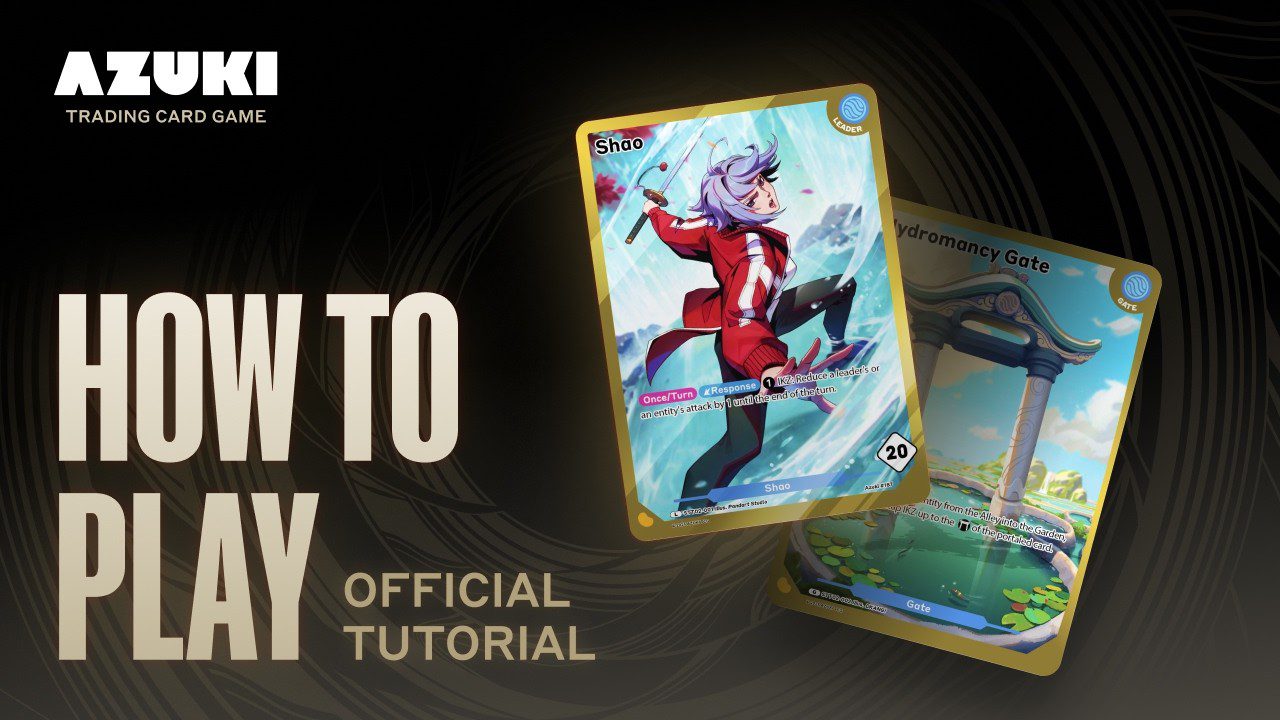
The official Azuki TCG site now lists Gates Awakened (AZK-01) as “out now,” with players choosing between Lightning, Water, Earth, and Fire starter decks and battling across the game’s two major zones: the Garden and the Alley. The site also emphasizes that every card is hand drawn by artists, with featured cards illustrated by creators including Arnold Tsang, also known as Steamboy33.
That detail matters because Azuki’s strongest asset has always been taste. The brand’s visual identity is polished, collectible, and immediately legible. In a TCG market where art direction can be just as important as mechanics, Azuki is entering with a real advantage.
The Art Direction Is the Hook
The first thing players and collectors will notice is the art.
Azuki TCG leans hard into a cel-shaded anime aesthetic, with premium card treatments designed to make the physical product feel like more than a simple licensing extension. For an NFT-native brand, this is a smart move. Azuki’s community was built around visual identity, scarcity, and collectibility. A physical trading card game lets the project translate those same instincts into cardboard.
That translation is important. NFTs taught a generation of collectors to care about editions, traits, provenance, metadata, rarity, and social signaling. TCGs already had many of those behaviors decades before NFTs existed. Chase foils, alt arts, serialized cards, graded slabs, tournament promos, and sealed product speculation all live in the same psychological neighborhood.
Azuki TCG sits directly at that intersection.
The question is whether the cards are merely collectible, or whether the game underneath is strong enough to sustain repeat play.
How Azuki TCG Plays
Azuki TCG is a two-player card game built around 50-card decks, Leaders, Gates, Entities, Spells, Weapons, and a separate resource system.
The most important design choice is the IKZ resource deck. Instead of relying on traditional in-deck mana or energy cards, players use a separate 10-card IKZ resource deck. That helps reduce one of the most frustrating parts of many TCGs: losing because you simply did not draw the resources needed to play your cards.
That puts Azuki closer to modern card game design trends seen in games like Hearthstone, One Piece Card Game, and other systems that try to make resource development more predictable.
The battlefield is split into two horizontal areas:
The Alley is the protected back row, where players can stage Entities and prepare future plays.
The Garden is the active front row, where combat and direct pressure happen.
The game’s signature idea is the Gate mechanic. Once per turn, a player can use their Gate to “portal” an Entity from the Alley into the Garden. When that happens, the Entity’s Gate Power can trigger, creating a tactical push-and-pull between developing your back row and committing threats to the front line.
That is where Azuki TCG gets interesting. The game is not just asking, “Can you pay for the card?” It is asking, “When do you reveal your plan?” and “How long can you afford to set up before your opponent pressures you?”
That kind of spatial tension gives the game its own identity.
Gates Awakened: The First Set
The inaugural set, Gates Awakened (AZK-01), introduces the Azuki universe through a 148-card booster set. According to ICv2’s June 2026 preview, the product launched with booster display boxes priced at $119.99 MSRP and starter decks priced at $12.99 MSRP. Booster boxes include 24 packs, with 12 cards per pack.
The four starter decks are built around Azuki’s elemental leaders:
Raizan represents Lightning.
Shao represents Water.
Bobu represents Earth.
Zero represents Fire.
The starter decks are especially important because TCGs need a low-friction entry point. A collector might buy a booster box because the art is beautiful. A player needs a deck they can open, sleeve, and learn with immediately.
Azuki appears to understand that distinction.
Organized Play Is the Real Test
A trading card game does not live on aesthetics alone.
Beautiful cards can create a launch spike. Organized play creates a community. Weekly locals, regional events, tournament coverage, prize support, judge infrastructure, and deck-building content are what turn a new TCG from a novelty into a habit.
Azuki is clearly aware of this. In March 2026, Azuki announced a $100,000 prize pool commitment for its inaugural competitive season and named CoreTCG as its official tournament organizer. CoreTCG is known for supporting large-scale TCG events, including Yu-Gi-Oh! YCS events, Bandai Nationals, and Bandai Card Fests.
That is not a casual signal. That is Azuki telling the market it wants the game to be taken seriously by competitive players, not just NFT collectors.
The official Azuki TCG site also highlights local card shop partners, store locator functionality, competitive play, event updates, and an app ecosystem around the game.
This is the part that may determine whether Azuki TCG has staying power. The game needs more than collectors ripping packs. It needs people showing up on a Tuesday night to test decks, argue matchups, trade cards, and build local metagames.
Why This Matters for NFTs
For NFTCulture, the most interesting part of Azuki TCG is not simply that an NFT project made a card game. It is that Azuki is testing a broader path for Web3 IP.
For years, NFT projects promised future games, shows, comics, toys, memberships, token-gated worlds, and entertainment ecosystems. Some delivered. Many did not. The gap between roadmap language and actual consumer products became one of the defining credibility problems of the NFT market.
Azuki TCG is different because it does not ask the mainstream player to understand Web3 first.
You do not need an NFT to play.
You do not need a crypto wallet.
You do not need to mint anything.
You can walk into a card shop, buy a starter deck or booster pack, and play a game with another person.
That is powerful because it flips the usual adoption funnel. Instead of asking mainstream consumers to enter Web3, Azuki is pushing a Web3-born brand into a format consumers already understand.
That may be the future of NFT IP: not forcing everything on-chain, but using blockchain-native communities as the launchpad for brands that can move across physical, digital, and experiential formats.
The Skepticism Is Fair
Azuki TCG will still have to earn trust.
Traditional TCG players are not easy to impress. They have seen plenty of games launch with beautiful art, big promises, and early hype, only to disappear once organized play slows down or product support becomes inconsistent.
The NFT connection cuts both ways. For Web3 collectors, it creates instant cultural relevance. For some tabletop players, it may create hesitation.
That is why Azuki’s decision to make the game fully playable as a physical TCG is so important. The product cannot rely on tokenomics. It has to stand on gameplay, art, distribution, community, and support.
That is a healthier test.
The Verdict
Azuki TCG is one of the more compelling experiments in NFT-to-mainstream IP we have seen.
It does not feel like a simple merch extension. It feels like an attempt to build a durable entertainment product around a crypto-native brand. The art is strong. The mechanics appear modern and accessible. The organized play commitment is meaningful. And the retail strategy gives Azuki a shot at reaching players far outside its original holder base.
The challenge now is consistency.
Can Azuki support the game beyond the launch window? Can it keep local stores engaged? Can it create a competitive scene that players care about? Can it convert skeptics who have no interest in NFTs but love great card games?
If the answer is yes, Azuki TCG could become a case study in how Web3 brands evolve beyond speculation and into culture.
Not by abandoning their origins.
But by building something people can actually play.
TL;DR
Azuki TCG: Gates Awakened is a major test for NFT-born intellectual property. Built around premium anime-inspired art, modern resource mechanics, spatial gameplay across the Garden and Alley, and a serious organized play push, Azuki is trying to prove that a Web3-native brand can compete in the physical trading card game market. The NFT history brings skepticism, but the game’s fiat-friendly, no-wallet-required retail approach may be exactly what Web3 IP needs to reach mainstream audiences.
The post Azuki TCG: Can a Web3 Anime Brand Win Over the Local Card Shop? appeared first on NFT CULTURE.
What's Your Reaction?