

































How 1 Chemical Stock Is Riding Every Mega Trend From EV Battery Materials To Semiconductors
Synopsis: Gujarat Fluorochemicals is trying to move beyond its traditional chemicals business by building exposure to EV battery materials, semiconductors, data centres, clean energy and high-performance fluoropolymers through a large capex plan. As industries such as electric vehicles, battery storage, semiconductors, data centres and clean energy grow, the companies supplying critical materials to these sectors […] The post How 1 Chemical Stock Is Riding Every Mega Trend From EV Battery Materials To Semiconductors appeared first on Trade Brains.

Synopsis: Gujarat Fluorochemicals is trying to move beyond its traditional chemicals business by building exposure to EV battery materials, semiconductors, data centres, clean energy and high-performance fluoropolymers through a large capex plan.
As industries such as electric vehicles, battery storage, semiconductors, data centres and clean energy grow, the companies supplying critical materials to these sectors are also coming into focus. These businesses may not always make the final product, but their materials can become important parts of the supply chain.
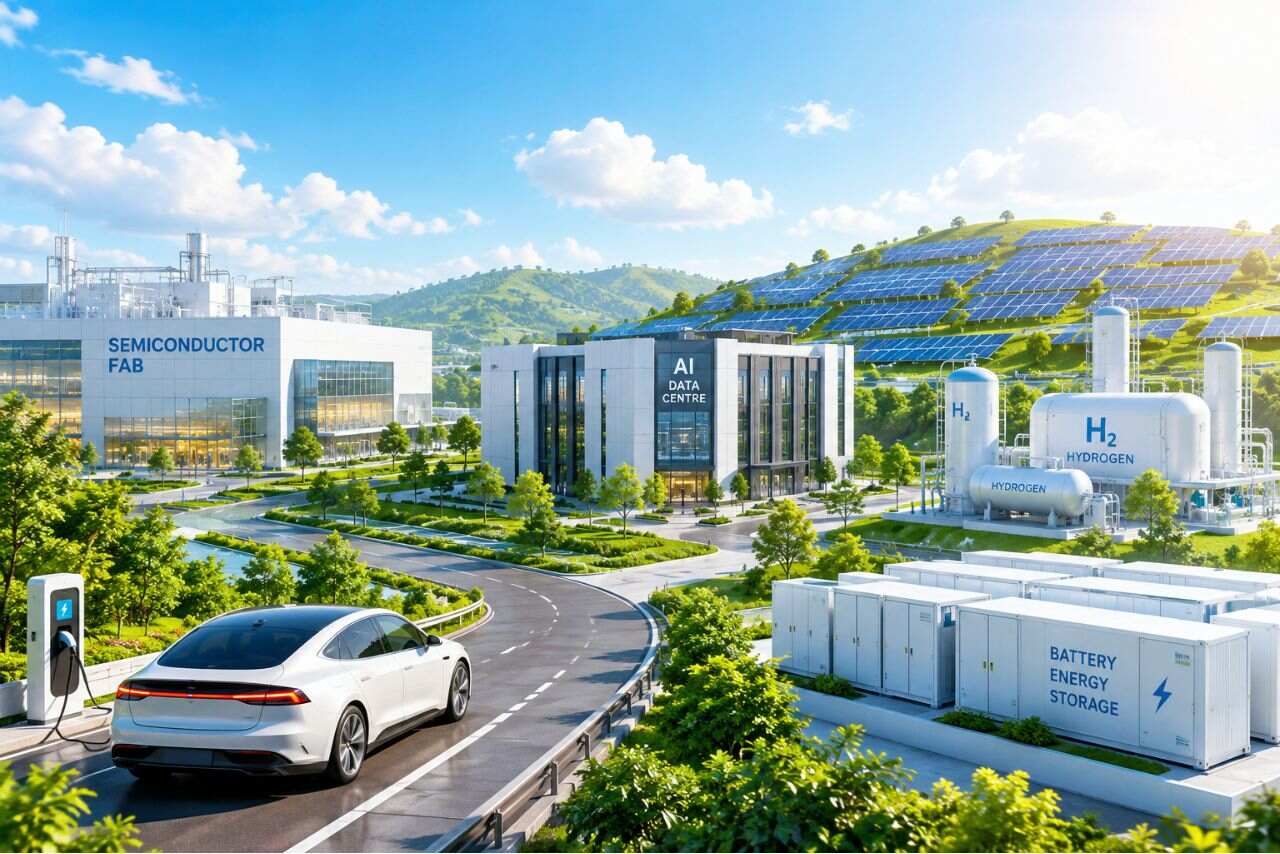
One such company is Gujarat Fluorochemicals Ltd, a specialty chemicals company known for fluoropolymers and fluorochemicals. The interesting part is that the company is now trying to connect its chemistry platform with several future-facing industries, including EV battery materials, semiconductors, battery energy storage, hydrogen, solar and data-centre-linked cooling demand.
The Current Business Is Still The Base
Gujarat Fluorochemicals is not starting from zero. Its core business is built around fluoropolymers, fluorochemicals, bulk chemicals and battery materials. The company makes products such as PTFE, PFA, PVDF, FEP, FKM, refrigerants, caustic soda, chloroform and battery-material products such as LiPF6, LFP CAM, binders, electrolytes and additives.
In Q4FY26, the chemical segment reported revenue of Rs. 1,358 crore, up 11 percent year-on-year. EBITDA stood at Rs. 353 crore, up 13 percent year-on-year, while PAT grew 5 percent year-on-year to Rs. 169 crore. The management said this performance was led by growth in the fluoropolymers segment and the start of R32 production in March 2026.
The fluoropolymer business is especially important because this is where many future themes connect. In Q4FY26, fluoropolymers revenue grew 19 percent year-on-year and 14 percent quarter-on-quarter to Rs. 848 crore. The growth was driven by value-added products and higher volumes across key categories.
EV Battery Materials: The Biggest Future Bet
The most direct future-facing opportunity is battery materials. Gujarat Fluorochemicals, through GFCL EV, is trying to build an integrated battery-materials platform. It is not making EV batteries. Instead, it is trying to supply the ingredients that go inside batteries.
The company’s battery-material portfolio includes LiPF6 salt, LFP cathode active material, PVDF/PTFE binders, electrolyte formulations, additives and natural graphite anode active material. In simple terms, it wants to supply the salt, the cathode material, the binder, the electrolyte and the anode material used in lithium-ion batteries.
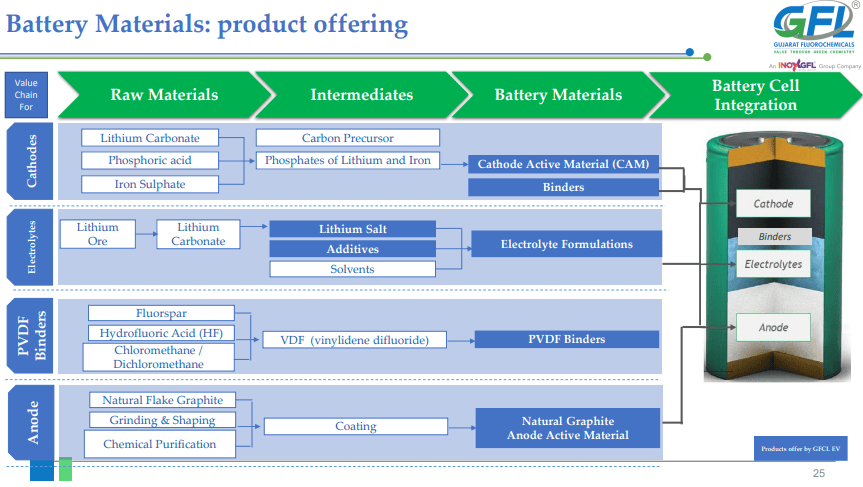
This is important because the company says its portfolio can cater to nearly 70 percent of the value of an LFP battery cell. In an LFP cell, cathode accounts for 42 percent of cost, anode for 20 percent and electrolyte for 10 percent. These are areas where GFCL EV is building products.
The company has already made progress. In Q4FY26, management said all initial phase-one capacities had been commissioned and contracted. It also said marquee anchor customers had been secured across battery-material products, giving confidence on utilisation ramp-up and commercial scale-up.
LiPF6 is the most advanced product in this portfolio. Management said the product has received approvals from most major global electrolyte players, commercial sales are scaling up, and orders are in place for FY27 and beyond. Production is expected to ramp up quarter by quarter.
LFP cathode active material is at a slightly earlier stage. Samples from the plant have received initial approval, while final qualification is expected by the end of Q3FY27. Commercial supply is expected to begin after that, and management said it already has off-take agreements for the entire capacity.
PVDF binders are another product to watch. ICICI Securities noted that the company has completed full qualification for PVDF binders and supplies are expected to begin in H1FY27. It also highlighted that LiPF6 has received orders for FY27 and that LFP is undergoing qualification.
Why Data Centres And AI Matter
At first, it may look odd to connect a chemical company with AI or data centres. But the connection is through electricity and storage. AI and machine-learning infrastructure need large data centres. Data centres need reliable power. As power demand rises and renewable energy becomes more important, battery energy storage systems become necessary to stabilise power supply. Gujarat Fluorochemicals said increasing investment in AI and machine-learning infrastructure, along with rising data-centre capacity, is creating structural demand for energy storage solutions globally.
This is where the battery-material platform becomes relevant. More battery energy storage means more demand for lithium salts, cathode materials, electrolytes, binders and anode materials. The company also says BESS demand is being driven by fast-growing AI usage and storage servers, while BESS combined with renewable power helps stabilise utility grids.
The data-centre link also appears in the refrigerant business. Management said demand for refrigerants is expected to remain healthy due to rising residential air-conditioning, commercial refrigeration, cold-chain infrastructure and cooling infrastructure for AI data centres globally.
Semiconductor And Clean Energy Opportunity
The second major future vertical is semiconductors. Gujarat Fluorochemicals is not making chips. It is making materials that can be used in semiconductor manufacturing.
Fluoropolymers are useful in demanding applications because they can handle heat, chemicals, corrosion and purity requirements. The company said fluoropolymer demand is expected to remain strong due to rising applications in semiconductors, EVs, BESS and clean energy sectors.
It also said high-performance fluoropolymers such as PFA and FKM are expected to grow faster, led by semiconductor fabs, AI-driven data-centre expansion and advanced automotive applications.
The company is also putting money behind this opportunity. Of the Rs. 850 crore planned capex for GFL in FY27, around Rs. 222 crore is meant for new high-purity electronic specialty chemicals for the semiconductor sector. Another Rs. 250 crore will be used for new fluoropolymer capacities, while Rs. 230 crore will go into backward integration and maintenance.
ICICI Securities also noted that demand remains encouraging from the semiconductor industry and that GFL benefited from higher sales of value-added PFA and FKM grades. This is important because it shows the semiconductor angle is not only a distant story but already visible in the fluoropolymers business.
Clean energy is another linked theme. The company has highlighted hydrogen, fuel cells, electrolyzers and solar as long-term demand drivers for fluoropolymers. These are not separate revenue engines today, but they strengthen the broader materials story because advanced energy systems also require specialty materials.
The Rs. 6,000 Crore Capex Plan
The biggest number in this story is the battery-materials capex. Management said GFCL EV has a cumulative capex plan of around Rs. 6,000 crore by FY28. For FY27 alone, the planned capex is around Rs. 2,300 crore for the battery-materials portfolio, mainly for growth capex including the natural graphite anode active material project.
The company is also setting up natural graphite anode active material capacity. With this addition, management says GFCL EV will be able to address nearly 70 percent of the value of an LFP battery cell and position itself as one of the most integrated battery-materials platforms globally.
Management has also guided for nearly 2 times asset turns and over 25 percent EBITDA margins for the battery-materials portfolio. However, the full earnings potential is expected only by FY29 as facilities ramp up and reach optimal utilisation.
This means the company is in a front-loaded investment phase. Costs are coming first, while revenue will scale later as products receive customer approvals and plants move towards utilisation.
What Are The Risks?
The opportunity is large, but the execution is not simple. Battery materials require customer approvals, product qualification, audits, quality checks and gradual commercial ramp-up. Management itself explained that after capex is put in, there is a gestation period for plant stabilisation, quality and qualification before revenue starts coming in meaningfully.
There is also a near-term drag from GFCL EV. ICICI Securities noted that Q4FY26 EBITDA was lower due to higher EV losses, even though the core business EBITDA was broadly in line. It also said it had not projected material revenue from GFCL EV despite improving visibility.
Elara Securities also pointed out that while Gujarat Fluorochemicals has optionality in EV and battery materials, semiconductors, clean energy, hydrogen fuel cells and solar-linked applications, the battery-materials segment will remain a near-term drag due to ramp-up losses. It also flagged PVDF oversupply, EV qualification delays and cost pressure in the fluorine chain as key risks.
So, the story is not that Gujarat Fluorochemicals has already become a battery or semiconductor giant. The story is that it is using its fluorine chemistry platform to build materials for industries that could grow over the next decade.
If execution goes well, the company may move from being seen mainly as a fluorochemicals and fluoropolymers player to a broader advanced-materials company. But if approvals, utilisation or customer ramp-up get delayed, the same future businesses can continue to weigh on near-term profitability.
Disclaimer: The views and investment tips expressed by investment experts/broking houses/rating agencies on tradebrains.in are their own, and not that of the website or its management. Investing in equities poses a risk of financial losses. Investors must therefore exercise due caution while investing or trading in stocks. Trade Brains Technologies Private Limited or the author are not liable for any losses caused as a result of the decision based on this article. Please consult your investment advisor before investing.
The post How 1 Chemical Stock Is Riding Every Mega Trend From EV Battery Materials To Semiconductors appeared first on Trade Brains.
What's Your Reaction?