































Infosys Shares Have Crashed Nearly 50% But Can It Ever Reach ₹2,000 Again?
Synopsis: Infosys shares have fallen nearly 50 percent from their peak despite the company winning large deals and making a big push into AI. While AI could open up new growth opportunities, it could also change the way IT services companies earn money. Can Infosys prove the market wrong and make its way back to […] The post Infosys Shares Have Crashed Nearly 50% But Can It Ever Reach ₹2,000 Again? appeared first on Trade Brains.


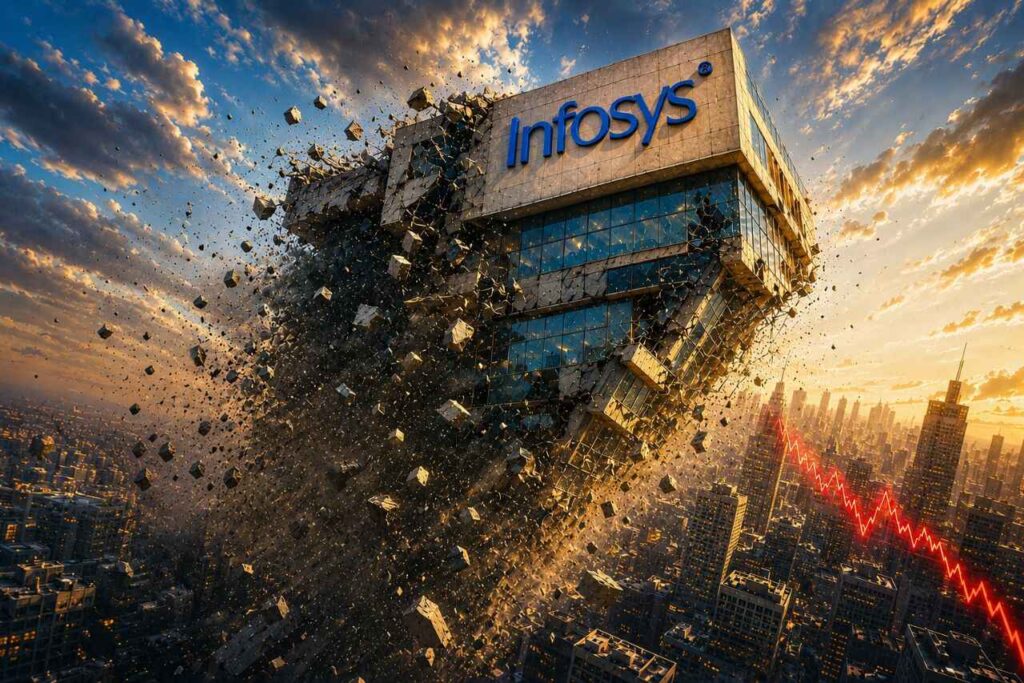
Synopsis: Infosys shares have fallen nearly 50 percent from their peak despite the company winning large deals and making a big push into AI. While AI could open up new growth opportunities, it could also change the way IT services companies earn money. Can Infosys prove the market wrong and make its way back to the Rs. 2,000 mark?
The global technology services industry is going through one of its most confusing phases in years. On one side, artificial intelligence is creating a large new opportunity for companies that help enterprises modernise their systems. On the other side, the same AI tools are also making software development faster, cheaper and more automated. This has created a difficult question for investors. Will AI increase the size of the opportunity for IT services companies, or will it reduce the amount clients are willing to pay for traditional work?
Infosys has become one of the biggest examples of this debate. The stock had touched a high of around Rs. 2,006.45 in December 2024, but has since fallen close to Rs. 1,000 levels. That means the stock has corrected nearly 50 percent from its peak and has returned to levels last seen around the Covid period. For the stock to return to Rs. 2,000 from current levels, it would need to nearly double. The big question is whether the business can support that kind of recovery.
Why Has The Stock Fallen So Much?
The correction in Infosys has not happened because of one single event. It has been a mix of weak global demand, AI-related fear, valuation correction and foreign investor selling. The first major pressure came from the AI shock earlier this year. The launch of advanced autonomous AI agents created fear that many software development and support tasks could be done with fewer people. For a company like Infosys, where a large part of the business depends on people-led technology services, this raised a direct question about future revenue growth.
The second pressure came from the global macro environment. Geopolitical tensions and war-related uncertainty made companies in the US and Europe more careful with spending. Instead of approving large transformation projects, many clients started focusing on cost savings, vendor consolidation and essential technology work. Stronger-than-expected US economic data also kept interest rates higher for longer, which increased pressure on western companies to control costs.
The third pressure came from Accenture. The global IT services major cut the upper end of its FY26 revenue growth guidance by 100 basis points and now expects revenue growth of 3-4 percent, or 2.5-3.5 percent organically excluding federal services. Its third-quarter revenue grew 6 percent year-on-year to USD 18.7 billion, but local-currency growth stood at only 3 percent, its slowest growth in eight quarters. This made investors worry that the weakness is not limited to Indian IT companies, but is visible across global technology spending.
What Is Infosys Saying?
Infosys’ own numbers show why investors are confused. In FY26, the company delivered 3.1 percent growth in constant currency terms. In Q4FY26, growth was 4.1 percent year-on-year in constant currency. The company also reported strong large deal wins of USD 14.9 billion for the full year and USD 3.2 billion in the fourth quarter. Management said full-year large deals were 28 percent higher than the previous year.
However, despite these deal wins, Infosys guided for only 1.5-3.5 percent constant currency revenue growth in FY27. This is the main issue. If a company is winning large deals and talking about AI opportunities, investors expect stronger growth. But the guidance suggests that the near-term environment remains weak.
Management also said that it sees large opportunities in AI services, but at the same time, it sees competitive intensity and an AI productivity impact. This is very important. It means AI is not only an opportunity. It is also changing pricing, delivery and productivity in the existing business.
The AI Problem: Opportunity Or Threat?
Infosys has a serious AI strategy. At its AI Day, the company highlighted six major AI opportunity areas: AI strategy and engineering, data for AI, agents for operations, legacy modernization, physical AI, and AI trust and risk services. It also has Topaz Fabric, its AI platform suite, and Cobalt for cloud. Infosys says these capabilities are already operational with clients.
In Q3FY26, Infosys said it was working with 90 percent of its largest 200 clients on AI. It was also working on 4,600 AI projects, had generated over 28 million lines of code using AI, and had built over 500 agents. This clearly shows that AI is not a small experiment for the company anymore.
But the problem is monetisation. Investors are not asking whether Infosys is doing AI work. They are asking whether AI work can grow revenue meaningfully. If AI helps Infosys complete projects faster, clients may demand lower prices. If the same work earlier required 1,000 engineers and now requires fewer people, clients may want those productivity benefits passed on.
Motilal Oswal’s report captures this concern clearly. According to the brokerage, AI deflation is beginning to bite and that AI is compressing Infosys’ existing book of business. It also expects productivity benefits to be passed on to clients over time. In simple words, the risk is that AI creates new work, but also reduces revenue from old work.
The Bull Case Still Exists
The bearish view is not the full story. PL Capital takes a slightly more balanced view. It says Infosys’ conservative guidance does not fully match the strength of its deal wins. The company won 96 large deals in FY26, including three mega deals, with total large deal TCV of USD 14.9 billion and a net-new mix of around 55 percent that means newly signed large deals represented new business rather than renewals of existing contracts. That is not a weak order book.
PL Capital also highlights that FY27 guidance includes two specific drags. One is a 75-100 basis points impact from the ramp-down of a large European manufacturing client. The second is a 40-50 basis points impact from continued right-shoring and lower onsite mix. Without these drags, the growth picture would look better.
There is also a positive AI angle. PL Capital notes that AI deal momentum is accelerating in areas like productivity automation, platform-led modernization, IT operations, software replacement and mainframe migration. It also mentions AI engagements carry premium pricing, although this is partly offset by the higher cost of specialised talent.
This is the bull case. If AI projects are priced better, if large deals convert into revenue, and if financial services and energy-related verticals accelerate, Infosys can still improve from current growth levels.
What Needs To Happen For Rs. 2,000?
For Infosys to reach Rs. 2,000 again, the market needs to believe that it is not just a 2-3 percent growth company. The company has to show that AI can create more revenue than it destroys.
PL Capital estimates FY28 EPS at around Rs. 87.5, while Motilal Oswal estimates FY28 adjusted EPS at around Rs. 82.9. At these earnings levels, Rs. 2,000 would imply a valuation of roughly 23-24 times FY28 earnings. That is not impossible for a high-quality IT services company, but it requires confidence in growth.
If the market believes Infosys will continue growing slowly at 3-4 percent, the stock may not get that premium valuation. It may trade more like a mature cash-generating business. But if growth moves back toward over 5 percent and AI revenue starts scaling clearly, the market could again give Infosys a higher multiple.
The company also has strengths. It has strong cash generation, high return ratios, stable margins, large global clients, a strong brand, and a healthy dividend payout. Motilal Oswal estimates FY26 free cash flow at 125 percent of net profit.These factors support downside protection, but they alone may not be enough to drive the stock back to Rs. 2,000 quickly.
So Can Infosys Reach Rs. 2,000 Again?
Infosys can reach Rs. 2,000 again, but the path is not simple. The stock does not just need earnings growth. It also needs a change in market perception. Investors need to move from thinking “AI will reduce Infosys’ billing” to thinking “AI will create a larger opportunity for Infosys.”
At the moment, the market is stuck between fear and hope. The fear is that AI will compress old revenue, clients will demand discounts, and growth will remain low. The hope is that Infosys’ large deal wins, Topaz Fabric, AI agents, cloud capabilities and modernization work will create a new growth engine.
The next few quarters will be important. Investors will watch whether FY27 guidance improves, whether deal wins convert into revenue, whether financial services and energy verticals accelerate, and whether AI projects move from pilots to large-scale contracts. Until then, Rs. 2,000 may remain a possible long-term target, but not an easy near-term recovery.
The real question is not whether Infosys can survive AI. It almost certainly can. The real question is whether Infosys can use AI to grow faster than the pressure AI creates on its old business. That answer will decide whether the stock remains stuck near lower levels or eventually begins its journey back toward Rs. 2,000.
Disclaimer: The views and investment tips expressed by investment experts/broking houses/rating agencies on tradebrains.in are their own, and not that of the website or its management. Investing in equities poses a risk of financial losses. Investors must therefore exercise due caution while investing or trading in stocks. Trade Brains Technologies Private Limited or the author are not liable for any losses caused as a result of the decision based on this article. Please consult your investment advisor before investing.
The post Infosys Shares Have Crashed Nearly 50% But Can It Ever Reach ₹2,000 Again? appeared first on Trade Brains.
What's Your Reaction?