









































Top Solar Loan Schemes in India in 2026: Is Solar Financing Worth It for Homeowners?
With electricity bills rising by 3-6% every year in India, rooftop solar has become the go-to solution for homeowners tired of watching their expenses climb. To accelerate solar adoption, the central government launched the PM Surya Ghar Muft Bijli Yojana solar subsidy scheme in 2024, offering generous subsidies to make rooftop solar affordable. But even […] The post Top Solar Loan Schemes in India in 2026: Is Solar Financing Worth It for Homeowners? appeared first on Rooftop Solar for your home and more | SolarSquare.

With electricity bills rising by 3-6% every year in India, rooftop solar has become the go-to solution for homeowners tired of watching their expenses climb. To accelerate solar adoption, the central government launched the PM Surya Ghar Muft Bijli Yojana solar subsidy scheme in 2024, offering generous subsidies to make rooftop solar affordable. But even after the subsidy, the upfront installation cost was a challenge
That’s where solar loan schemes stepped in.
Under the PM Surya Ghar Muft Bijli Yojana, several Public Sector Undertakings (PSUs) now offer dedicated solar loans. Additionally, many Non-Banking Financial Companies (NBFCs) also offer loans to homeowners installing rooftop solar. Their goal is to remove the upfront cost barrier so more homeowners can switch to solar.
- PSUs are banks like SBI and PNB that offer solar loans at very low interest rates. Hence, consumers have to surrender the subsidy.
- NBFCs are the faster alternatives that trade lower rates for speed, subsidy, and convenience.
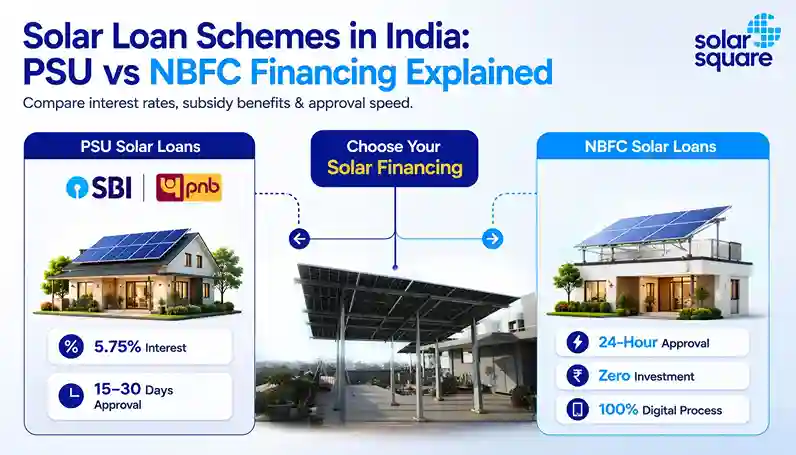
PSU financing is government-subsidized and, in the case of SBI, financed by the World Bank. SBI and PNB solar loans of up to Rs. 2 lakh come at an interest rate of just 5.75% per annum. The loan approval process takes 15-30 days, the bank conducts two physical property visits, and registration on the Jan Samarth Portal is mandatory. And since the interest rate is very low, you have to surrender the subsidy once your loan is approved.
On the other hand, NBFCs focus on speed and convenience. The entire process is digital, loan approvals happen within 24 hours, there are no branch visits or physical inspections, and customers are not required to register on the Jan Samarth Portal. The trade-off is an interest rate of 12-13% per annum, but you get to retain the full subsidy amount.
So, which option makes more financial sense for you? Is solar financing actually worth it for homeowners in India? This blog answers all such questions.
Read on to discover the key aspects of solar loan schemes in India, eligibility criteria, documents needed to receive a solar rooftop loan, benefits and challenges of solar financing, and the cost of installing rooftop solar systems in India.
TL;DR Summary Box: Is PM Surya Ghar Muft Bijli Yojana Scheme a Loan?
The PM Surya Ghar Muft Bijli Yojana, launched in 2024, is a solar subsidy scheme, not a loan. Under this scheme, the government provides financial assistance to homeowners who install rooftop solar systems
However, even after the subsidy, many households still found the initial investment difficult to manage. To address this gap, the government expanded the ecosystem by bringing in PSUs such as SBI and PNB, with SBI securing financial backing from the World Bank.
These banks offer solar loans at 5.75% per annum for loans up to Rs 2 lakh. However, if you opt for a solar loan scheme through PSUs, the subsidy is adjusted since the loan is offered at a highly reduced interest rate.
Homeowners also have another financing option.
Non-Banking Financial Companies, or NBFCs, offer solar loans at an interest rate of 12-13% per annum through a fully digital process. Approvals can happen within 24 hours, documentation is minimal, and there are no branch visits. The biggest advantage is that you get to retain the full subsidy amount.
So, while the PM Surya Ghar scheme itself is not a loan, it works alongside multiple financing options that help homeowners install rooftop solar without paying the full amount upfront.
Here’s a tabulated snapshot of the main topics covered in this blog in detail:
| Main Topics | Key Takeaways |
| What is a solar loan scheme? | A solar loan scheme is a financing option that lets homeowners install rooftop solar through EMIs instead of paying the full cost upfront. |
| What is the SBI solar loan scheme? | It’s a PSU-backed solar loan offering an interest rate starting from 5.75% per annum, requiring Jan Samarth registration and branch visits. |
| What is the PNB solar loan scheme? | It’s a PSU solar loan offering concessional rates from 5.75% per annum with mandatory portal registration and physical verification. |
| What is SolarSquare’s zero-investment solar loan scheme? | It’s an NBFC digital solar loan with 12-13% interest, 24-hour approval, and no upfront out-of-pocket down payment. |
| What documents are needed to secure a solar loan in India? |
|
| What are the benefits of solar loan schemes in India? | Lower interest rates, affordable EMIs, and zero foreclosure charges are some of the best benefits of solar loan schemes. |
| What are the challenges of PSU solar loan schemes? | Longer approval timelines, portal dependency, and mandatory branch visits are a few key challenges. |
| What are the eligibility conditions to receive a solar loan in India? | Applicants must meet age criteria and own the rooftop where the solar system will be installed. |
| Top factors to keep in mind when choosing a bank for a solar loan | Approval speed, documentation ease, digital process, and subsidy treatment. |
What is a Solar Loan Scheme?
A solar loan scheme is a financing option that allows homeowners to install a rooftop solar energy system without paying the entire cost upfront.
Instead of investing the full amount at once, you pay a small down payment and convert the remaining cost into affordable monthly EMIs. These loans are designed specifically for residential rooftop solar systems for homes and are often linked to the PM Surya Ghar Muft Bijli Yojana ecosystem.
In India, solar loans are offered by:
- Public Sector Undertaking (PSU) banks such as SBI and PNB.
- Non-Banking Financial Companies (NBFCs) that provide faster, digital approvals.
The objective is to remove the upfront cost barrier and accelerate rooftop solar adoption.
Different solar loan schemes come with specific interest rates, tenure limits, eligibility rules, and processing timelines.
Let’s break down their key aspects in detail.
Key Aspects of Solar Loan Schemes in India
PSU solar loan schemes in India offer structured interest slabs starting at 5.75% for loans up to Rs. 2 lakh, flexible tenures up to 10 years, zero prepayment penalties, defined down payment requirements, and a 6-month moratorium option
Let’s have a closer look at all the key aspects of a solar loan scheme in India:
| Key Aspects | Details |
| Solar loan interest rate for PSU banks |
|
| Solar loan interest rate for NBFCs | 12-13% per annum |
| Eligibility criteria to receive a solar panel loan |
|
| Documents required |
|
| Down payment for PSU solar loan schemes |
|
| Solar loan tenure | Maximum tenure up to 10 years for PSU loans |
| Loan prepayment/foreclosure penalty | Nil |
| Moratorium period | Up to a 6-month EMI moratorium available for PSU loans.
Please note: Moratorium period means you can delay starting your EMI payments for up to 6 months. |
| Loan approval timeline |
|
| Additional requirements for PSU solar loan schemes |
|
Which are the Best Solar Loan Schemes for Residential Installations?
Residential solar loan schemes in India broadly fall into two categories: PSU loans with low interest rates but a longer approval period, and NBFC loans focused on speed and convenience
- NBFC solar loan schemes: Offered by private financial institutions, these loans focus on speed and digital convenience. Approvals can happen within 24 hours, documentation is minimal, and the entire journey is online. Interest rates are slightly higher than PSUs, but you retain the full subsidy.
- PSU solar loan schemes: Offered by public sector banks such as SBI and PNB under the PM Surya Ghar subsidy scheme, these loans have low interest rates starting at 5.75% per annum. However, once the loan is approved, you have to surrender the subsidy.
Let’s check out the best three solar rooftop loans in India you can apply for in 2026.
#1. SolarSquare’s Zero-Investment Solar Loan
SolarSquare’s Zero-Investment Solar Loan is an NBFC financing option designed to eliminate the out-of-pocket upfront payment entirely. Instead of paying a down payment, the applicable PM Surya Ghar subsidy is adjusted toward system cost. The remaining amount is financed through EMIs, allowing you to switch to solar without any immediate out-of-pocket expense.
Here are the key features of SolarSquare’s zero-investment solar loan:
| Key Aspects | Details |
| Loan type | NBFC-backed solar loan |
| Interest rate | 12-13% per annum |
| EMI tenure | 6 to 60 months |
| Foreclosure charges | Nil |
| Documents required | PAN, Aadhaar, electricity bill |
| Loan approval time | Within 24 hours |
| Out-of-pocket down payment | Not required, as the Surya Ghar subsidy replaces the upfront payment |
Now, let’s understand how the zero-investment solar scheme by SolarSquare works in simple steps:
- Subsidy replaces down payment: The PM Surya Ghar subsidy you’re eligible for is applied directly to the PV system cost, eliminating the need for an upfront out-of-pocket investment.
- EMIs aligned with savings: Your monthly EMI is structured to closely match the savings you make on electricity after installing solar. Therefore, your overall monthly outflow does not increase.
- Fully digital journey: The loan process is online, documentation is minimal, and approvals happen quickly, keeping installation timelines tight.
- Flexible repayment choice: You can select repayment periods between 6 and 60 months based on income stability and EMI comfort.
- Faster installation cycle: Since there are no branch visits, portal-based loan filings, or bank inspections, the solar journey moves much faster than for PSU loans.
#2. SBI Solar Loan Scheme
The SBI solar loan scheme is a PSU-backed financing option offered under the PM Surya Ghar Muft Bijli Yojana to make rooftop solar more accessible at concessional interest rates
SBI funds up to 90% of the total project cost, with interest starting at 5.75% per annum, making it one of the lowest-cost residential solar financing options in India.
Here are the key details about the SBI solar loan scheme that you must know:
| Key Aspects | Details |
| Loan type | PSU-backed solar loan under the PM Surya Ghar Muft Bijli Yojana |
| Interest rate |
|
| Loan amount offered | Up to 90% of the total project cost |
| Maximum loan amount | Rs. 10 lakh |
| Maximum loan tenure | Up to 10 years (including moratorium) |
| Down payment |
|
| Prepayment charges | Nil |
| Moratorium | Up to 6 months (within total tenure) |
| Loan processing time | 15-30 days |
| Eligibility criteria |
|
| Portal registration requirement | Mandatory application via the Jan Samarth Portal |
Here’s how the SBI solar loan process works:
- Apply through the Jan Samarth Portal: The loan journey begins with online registration on the portal.
- Branch visit and KYC completion: The applicant must visit the SBI branch for verification and documentation.
- Site inspection by the bank: Physical inspection is conducted before loan sanction.
- Sanctioned and staged disbursement: A partial loan amount may be released before installation. Final disbursal happens after system commissioning and discom approval.
- Subsidy adjustment condition: Since SBI offers concessional rates under PSU financing, the subsidy is adjusted within the loan structure.
#3. PNB Solar Loan Scheme
The PNB solar loan scheme allows homeowners to finance up to 90% of the cost of their rooftop solar system at concessional interest rates starting at 5.75% per annum. Offered through the PSU route, this loan focuses on affordability, but requires portal registration, branch visits, and physical verification before approval.
Here are the key details about the PNB solar loan scheme that you must know:
| Key Aspects | Details |
| Loan type | PSU-backed solar loan scheme |
| Interest rate |
|
| Loan amount offered | Up to 90% of the total project cost |
| Maximum loan amount | Rs. 10 lakh |
| Maximum loan tenure | Up to 10 years (including moratorium) |
| Down payment |
|
| Prepayment charges | Nil |
| Moratorium | Up to 6 months (within total tenure) |
| Loan processing time | 15-30 days |
| Eligibility criteria |
|
| Portal registration requirement | Mandatory application via the Jan Samarth Portal |
Here’s how the PNB solar loan process works:
- Apply via Jan Samarth Portal: The borrower registers and applies under the residential solar loan category.
- Branch visit and documentation: A physical branch visit is required for KYC completion and loan processing.
- Bank site inspection: Property verification and technical feasibility checks are conducted before sanction.
- Loan sanction and phased disbursal: Partial disbursal may occur before installation, with the remaining amount released after system commissioning and discom approval.
- Subsidy adjustment condition: Since the loan is offered at concessional rates, the subsidy component is adjusted under the PSU financing structure.
SBI vs PNB vs SolarSquare’s Solar Loan Schemes: Which Financing Option is Best?
Just as much as it depends on the interest rate, choosing the right solar loan scheme also depends on approval speed, documentation burden, subsidy treatment, and how long the process takes from booking to commissioning
While PSU banks like SBI and PNB offer concessional rates, NBFC options like SolarSquare’s zero-investment loan focus on speed and zero upfront out-of-pocket down payment.
Here’s a tabulated snapshot of the key differences between the three that’ll help you choose the right solar loan scheme for your home:
| Parameters | SolarSquare’s Zero-Investment Loan Scheme | SBI Solar Loan Scheme | PNB Solar Loan Scheme |
| Loan type | NBFC | PSU | PSU |
| Interest rate | 12-13% p.a. |
|
|
| Down payment | Not required, as it’s a zero-investment model. |
|
|
| Subsidy treatment | Customer retains full subsidy | You do not receive the subsidy amount separately when choosing a PSU concessional loan. | You do not receive the subsidy amount separately when choosing a PSU concessional loan. |
| Loan approval time | Within 24 hours | 15-30 days | 15-30 days |
| Portal requirement | No Jan Samarth registration | Mandatory Jan Samarth application | Mandatory Jan Samarth application |
| Branch visit required | No | Yes | Yes |
| Physical inspection by bank | No | Yes | Yes |
| Prepayment charges | Nil | Nil | Nil |
| Moratorium period | No | Up to 6-month EMI moratorium available | Up to 6-month EMI moratorium available |
What Documents are Needed to Secure a Solar Loan in India?
The documents required for a solar loan depend on the lender type and loan amount. PSU banks usually require more structured documentation, especially for higher loan amounts, while NBFCs keep the process lighter and largely digital.
Here’s a tabulated snapshot of the key documents you’ll need to receive a solar loan in India:
| Lender Type | Loan Amount | Documents Required |
| PSU banks | Up to Rs. 2 lakh | Basic KYC documents |
| PSU banks | Above Rs. 2 lakh |
|
| SolarSquare’s Zero-investment loan | As per eligibility | PAN card, Aadhaar card, latest electricity bill |
Note: PSU loans involve branch-level verification and documentation checks, while NBFC loans are processed digitally.
What are the Benefits of Solar Loan Schemes in India?
Solar loan schemes make rooftop solar financially accessible without requiring homeowners to set aside large upfront savings. Instead of paying the entire system cost at once, you spread it into manageable EMIs while continuing to benefit from lower electricity bills. The result is a smoother transition to solar with reduced financial strain.
First, let’s check out the benefits that apply to both PSU and NBFC solar loans:
- EMIs offset electricity bills: In many cases, the monthly EMI is close to or lower than your pre-solar electricity bill. This means your cash outflow does not increase after installation.
- Affordable interest rates: PSU loans offer concessional rates starting from 5.75% per annum, while NBFC loans remain structured and allow homeowners to retain the entire subsidy amount.
- No foreclosure charges: Most solar loan schemes allow early repayment without penalties, helping you reduce total interest cost if you choose to close the loan early.
In addition to the benefits above, NBFC solar loans have the following advantages:
- Approval within 24 hours: Faster loan sanction helps speed up installation timelines.
- No branch visits required: The entire loan journey is digital, eliminating paperwork-heavy bank interactions.
- The loan can be taken in a third-party name: This adds flexibility in cases where the primary property owner prefers another family member to take the loan.
- Faster breakeven period: With EMIs aligned to savings and quicker installation, many homeowners achieve system breakeven within 3-5 years.
Are There Any Challenges to Securing PSU Solar Loan Schemes?
PSU solar loans offer some of the lowest interest rates in the market. However, the process is compliance-driven, which can introduce operational delays and additional steps for borrowers.
Here are the common challenges homeowners may face:
- Portal glitches and errors: Applications must be routed through the Jan Samarth portal. Technical errors, document mismatches, or portal slowdowns can delay approvals.
- Longer processing timelines: Loan approval can take 15-30 days in standard cases and may extend further if inspections, documentation, or portal approvals are delayed.
- Multiple branch visits: Borrowers are required to visit the bank branch at least twice (once for KYC verification and again during the sanction or disbursal stages).
- Non-digital workflow: Unlike NBFC loans, PSU loans involve physical inspections, manual verification, and in-person documentation, which can slow down execution.
- Subsidy adjustment requirement: Since PSU loans are offered at concessional interest rates, the subsidy component is adjusted within the loan structure rather than retained by the homeowner.
Factors to Keep in Mind When Choosing a Bank for a Solar Loan
Not all solar loan schemes are created equal. While the interest rate is important, the overall experience, from approval speed to documentation burden, plays a major role in how smoothly your rooftop solar installation process moves forward.
Here are the key factors to evaluate before choosing a solar loan scheme:
- Approval speed: Faster loan sanction means quicker installation. NBFC loans can be approved within 24 hours, while PSU loans may take 15-30 days or longer.
- Digital vs physical process: A fully digital journey reduces paperwork, branch visits, and delays. PSU loans typically require portal filings and in-person bank visits, whereas NBFC loans are usually processed online.
- Ease of documentation: Check the documentation requirements upfront. Loans above certain brackets in PSU banks may require income proofs and bank statements.
- Processing transparency: Choose lenders that clearly communicate timelines, inspection requirements, disbursement stages, and EMI schedules to avoid surprises during installation.
What’s the Cost of Rooftop Solar Installation in India in 2026?
The cost of installing on-grid solar systems in India varies significantly by city, system size, and local DISCOM charges. For example, a 2 kW solar system that costs ~Rs. 90,000* in Lucknow with subsidy costs ~Rs. 1.50 lakh* in Bangalore.
Here’s a city-wise snapshot of solar installation cost for PV systems for homes with subsidy as of 18th April 2026:
| Solar System Size | Cost of Rooftop Solar Panels in India for Homes with Subsidy (Starting Price – Indicative for Base Variant) as of 25th June 2026* |
| 2 kW solar system | Ranges between ~Rs. 93,000 in Lucknow, ~Rs. 1.20 lakh in Ahmedabad, ~Rs. 1.23 lakh in Pune, and ~Rs. 1.53 lakh in Bangalore |
| 3 kW solar system | Ranges between ~Rs. 1.05 lakh in Lucknow, ~Rs. 1.32 lakh in Ahmedabad, ~Rs. 1.37 lakh in Pune, and ~Rs. 1.69 lakh in Bangalore |
| 4 kW solar system | Ranges between ~Rs. 1.62 lakh in Lucknow, ~Rs. 1.75 lakh in Ahmedabad, ~Rs. 1.82 lakh in Pune, and ~Rs. 2.15 lakh in Bangalore |
| 5 kW solar system | Ranges between ~Rs. 2.19 lakh in Lucknow, ~Rs. 2.32 lakh in Ahmedabad, ~Rs. 2.45 lakh in Pune, and ~Rs. 3.05 lakh in Bangalore |
| 10 kW solar system | Ranges between ~Rs. 4.72 lakh in Lucknow, ~Rs. 4.95 lakh in Ahmedabad, ~Rs. 5..05 lakh in Pune, and ~Rs. 5.72 lakh in Bangalore |
*Please note prices are subject to change without prior notice: The solar panel price for on-grid solar systems with subsidy listed in the section above is indicative as of 25th June 2026 for SolarSquare Blue 6ft variant. The final cost of solar panels for homes in India depends on your city, DISCOM charges, product variant opted for, type of panel, inverter type, mounting structure height, type of after-sales service, savings guarantee, roof height, etc.
Solar Installation Cost vs Solar Savings and ROI Over 25 Years
Rooftop solar is often viewed as an expense. In reality, it functions more like a long-term asset that generates predictable savings for 25 years or more. Once installed, a solar system reduces your electricity bill by 90% or more each month, creating recurring savings that compound over time.
Unlike gold or mutual funds, rooftop solar does not depend on market volatility. Your returns come from avoided electricity costs. The higher your tariff and the faster power prices rise, the stronger your returns become.
To better understand this, let’s look at a 25-year savings illustration for an on-grid solar system in Pune.
| Solar System Size | Cost of Solar Panels for Homes in India’s Pune with Subsidy (Starting Price – Indicative for Base Variant) as of 25th June 2026* | Savings From Solar Panels for Homes Over 25 Years with SolarSquare as Your Solar Company in India* | Return on Investment (ROI) |
| 2 kW | ~Rs. 1.23 lakh | ~Rs. 10.74 lakh | ~7.8x |
| 3 kW | ~Rs. 1.37 lakh | ~Rs. 16.12 lakh | ~10.7x |
| 4 kW | ~Rs. 1.82 lakh | ~Rs. 21.49 lakh | ~10.8x |
| 5 kW | ~Rs. 2.45 lakh | ~Rs. 33.46 lakh | ~12.6x |
| 10 kW | ~Rs. 5.05 lakh | ~Rs. 66.93 lakh | ~12.3x |
*Please note prices are subject to change: The above-mentioned cost of solar panels for homes in Pune with subsidy for on-grid solar systems is indicative as of 25th June 2026 for the SolarSquare Blue 6ft variant. The final solar panel cost for homes in Pune depends on your DISCOM charges, product variant opted for, panel type, inverter type, mounting structure height, type of after-sales service, savings guarantee, roof height, etc. Also, while calculating savings from household solar panels in Pune, we have considered an annual tariff escalation of 3% and an annual plant degradation rate of 1%. The actual final savings from a solar panel system for homes depend on the types of solar panels you’ve installed and their efficiency, intensity of sunlight your rooftop receives, orientation of the panels and tilt angle, the pollution level and weather conditions in your city, the temperature, shadow on the roof, impact of dirt/dust, and how well you maintain your panels after installation.
Not based in Pune? No problem. Solar savings depend on your city, tariff, roof size, and system capacity. Use SolarSquare’s free solar energy estimator to calculate your savings and 25-year ROI in under a minute.
Conclusion
Electricity tariffs in India are rising every year. Rooftop solar locks in your energy cost for the next 25 years because it generates free solar electricity throughout its operational life. Whether you choose the SBI solar loan scheme, the PNB solar loan scheme, or SolarSquare’s zero-investment option, the goal is to convert a rising monthly expense into a long-term asset.
PSU loans offer some of the lowest interest rates in the market and suit homeowners who prioritize affordability and are comfortable with portal filings, inspections, and branch visits. NBFC solar loans, on the other hand, prioritize speed, digital convenience, and flexibility. They allow faster installation and let you retain the full subsidy amount you’re eligible for.
For any further details about rooftop solar installation and solar financing options, you can book a free solar consultation call with SolarSquare
FAQs
Who is eligible for a solar loan in SBI?
To be eligible for the SBI solar loan scheme, the applicant must:
- Be within the prescribed age limit. The loan should close before the borrower turns 70. If applying with a co-borrower, the loan must close before the co-borrower turns 75.
- Own the residential property and the rooftop where the solar system will be installed.
- Apply through the Jan Samarth Portal.
For how many years can a solar loan tenure be?
The maximum solar loan tenure for PSU banks can be 10 years.
What is a good interest rate for a solar loan?
For PSU banks, 5.75% per annum (up to Rs. 2 lakh) is considered a strong interest rate. NBFC loans generally range between 12% and 13% per annum, offering faster approval and greater convenience.
Can I pay off my solar loan early?
Yes. Most solar loan schemes, including SBI, PNB, and NBFC solar loans, do not charge foreclosure or prepayment penalties.
How long does it take to receive a solar loan in India?
For PSU banks like SBI and PNB, loan approval takes 7-15 working days in the fastest cases, provided all documents and feasibility approvals are ready. However, delays are common, and the process can extend to 1-3 months due to branch processing, portal issues, or inspections.
Once sanctioned, disbursement happens within a few days to 1-2 weeks after vendor agreements, inspections, and branch formalities are completed. Most PSU banks release part payment before installation and the balance after commissioning.
NBFC solar loans, in contrast, are approved within 24 hours since the process is fully digital.
However, even after the subsidy, many households still found the initial investment difficult to manage. To address this gap, the government expanded the ecosystem by bringing in PSUs such as SBI and PNB, with SBI securing financial backing from the World Bank.
These banks offer solar loans at 5.75% per annum for loans up to Rs 2 lakh. However, if you opt for a solar loan scheme through PSUs, the subsidy is adjusted since the loan is offered at a highly reduced interest rate.
Homeowners also have another financing option.
Non-Banking Financial Companies, or NBFCs, offer solar loans at an interest rate of 12-13% per annum through a fully digital process. Approvals can happen within 24 hours, documentation is minimal, and there are no branch visits. The biggest advantage is that you get to retain the full subsidy amount.
So, while the PM Surya Ghar scheme itself is not a loan, it works alongside multiple financing options that help homeowners install rooftop solar without paying the full amount upfront." } },{ "@type": "Question", "name": "What is a Solar Loan Scheme?", "acceptedAnswer": { "@type": "Answer", "text": "A solar loan scheme is a financing option that allows homeowners to install a rooftop solar energy system without paying the entire cost upfront.
Instead of investing the full amount at once, you pay a small down payment and convert the remaining cost into affordable monthly EMIs. These loans are designed specifically for residential rooftop solar systems for homes and are often linked to the PM Surya Ghar Muft Bijli Yojana ecosystem.
In India, solar loans are offered by:
Public Sector Undertaking (PSU) banks such as SBI and PNB. Non-Banking Financial Companies (NBFCs) that provide faster, digital approvals. The objective is to remove the upfront cost barrier and accelerate rooftop solar adoption.
Different solar loan schemes come with specific interest rates, tenure limits, eligibility rules, and processing timelines." } },{ "@type": "Question", "name": "Which are the Best Solar Loan Schemes for Residential Installations?", "acceptedAnswer": { "@type": "Answer", "text": "Residential solar loan schemes in India broadly fall into two categories: PSU loans with low interest rates but a longer approval period, and NBFC loans focused on speed and convenience
NBFC solar loan schemes: Offered by private financial institutions, these loans focus on speed and digital convenience. Approvals can happen within 24 hours, documentation is minimal, and the entire journey is online. Interest rates are slightly higher than PSUs, but you retain the full subsidy. PSU solar loan schemes: Offered by public sector banks such as SBI and PNB under the PM Surya Ghar subsidy scheme, these loans have low interest rates starting at 5.75% per annum. However, once the loan is approved, you have to surrender the subsidy. Let’s check out the best three solar rooftop loans in India you can apply for in 2026.
#1. SolarSquare’s Zero-Investment Solar Loan SolarSquare’s Zero-Investment Solar Loan is an NBFC financing option designed to eliminate the out-of-pocket upfront payment entirely. Instead of paying a down payment, the applicable PM Surya Ghar subsidy is adjusted toward system cost. The remaining amount is financed through EMIs, allowing you to switch to solar without any immediate out-of-pocket expense.
Here are the key features of SolarSquare’s zero-investment solar loan:
Key Aspects Details Loan type NBFC-backed solar loan Interest rate 12-13% per annum EMI tenure 6 to 60 months Foreclosure charges Nil Documents required PAN, Aadhaar, electricity bill Loan approval time Within 24 hours Out-of-pocket down payment Not required, as the Surya Ghar subsidy replaces the upfront payment Now, let’s understand how the zero-investment solar scheme by SolarSquare works in simple steps:
Subsidy replaces down payment: The PM Surya Ghar subsidy you’re eligible for is applied directly to the PV system cost, eliminating the need for an upfront out-of-pocket investment. EMIs aligned with savings: Your monthly EMI is structured to closely match the savings you make on electricity after installing solar. Therefore, your overall monthly outflow does not increase. Fully digital journey: The loan process is online, documentation is minimal, and approvals happen quickly, keeping installation timelines tight. Flexible repayment choice: You can select repayment periods between 6 and 60 months based on income stability and EMI comfort. Faster installation cycle: Since there are no branch visits, portal-based loan filings, or bank inspections, the solar journey moves much faster than for PSU loans. #2. SBI Solar Loan Scheme The SBI solar loan scheme is a PSU-backed financing option offered under the PM Surya Ghar Muft Bijli Yojana to make rooftop solar more accessible at concessional interest rates
SBI funds up to 90% of the total project cost, with interest starting at 5.75% per annum, making it one of the lowest-cost residential solar financing options in India.
Here are the key details about the SBI solar loan scheme that you must know:
Key Aspects Details Loan type PSU-backed solar loan under the PM Surya Ghar Muft Bijli Yojana Interest rate 5.75% p.a. up to Rs. 2 lakh 8-9% p.a. above Rs. 2 lakh Loan amount offered Up to 90% of the total project cost Maximum loan amount Rs. 10 lakh Maximum loan tenure Up to 10 years (including moratorium) Down payment 10% up to Rs. 2 lakh 20% above Rs. 2 lakh Prepayment charges Nil Moratorium Up to 6 months (within total tenure) Loan processing time 15-30 days Eligibility criteria Age up to 65 years (loan must close before borrower turns 70 years). Up to 75 years allowed with a co-borrower. The loan must close before the co-borrower reaches age 75. Rooftop must be in the applicant’s name Portal registration requirement Mandatory application via the Jan Samarth Portal Here’s how the SBI solar loan process works:
Apply through the Jan Samarth Portal: The loan journey begins with online registration on the portal. Branch visit and KYC completion: The applicant must visit the SBI branch for verification and documentation. Site inspection by the bank: Physical inspection is conducted before loan sanction. Sanctioned and staged disbursement: A partial loan amount may be released before installation. Final disbursal happens after system commissioning and discom approval. Subsidy adjustment condition: Since SBI offers concessional rates under PSU financing, the subsidy is adjusted within the loan structure. #3. PNB Solar Loan Scheme The PNB solar loan scheme allows homeowners to finance up to 90% of the cost of their rooftop solar system at concessional interest rates starting at 5.75% per annum. Offered through the PSU route, this loan focuses on affordability, but requires portal registration, branch visits, and physical verification before approval.
Here are the key details about the PNB solar loan scheme that you must know:
Key Aspects Details Loan type PSU-backed solar loan scheme Interest rate 5.75% p.a. up to Rs. 2 lakh 8-9% p.a. above Rs. 2 lakh Loan amount offered Up to 90% of the total project cost Maximum loan amount Rs. 10 lakh Maximum loan tenure Up to 10 years (including moratorium) Down payment 10% up to Rs. 2 lakh 20% above Rs. 2 lakh Prepayment charges Nil Moratorium Up to 6 months (within total tenure) Loan processing time 15-30 days Eligibility criteria Maximum age of the applicant: 75 years Repayment should not extend beyond age 75 years of the borrower Applicant/co-applicant must be the owner of the residential property with rooftop rights Applicant must be a PNB savings account holder (mandatory) Portal registration requirement Mandatory application via the Jan Samarth Portal Here’s how the PNB solar loan process works:
Apply via Jan Samarth Portal: The borrower registers and applies under the residential solar loan category. Branch visit and documentation: A physical branch visit is required for KYC completion and loan processing. Bank site inspection: Property verification and technical feasibility checks are conducted before sanction. Loan sanction and phased disbursal: Partial disbursal may occur before installation, with the remaining amount released after system commissioning and discom approval. Subsidy adjustment condition: Since the loan is offered at concessional rates, the subsidy component is adjusted under the PSU financing structure." } },{ "@type": "Question", "name": "SBI vs PNB vs SolarSquare’s Solar Loan Schemes: Which Financing Option is Best?", "acceptedAnswer": { "@type": "Answer", "text": "Just as much as it depends on the interest rate, choosing the right solar loan scheme also depends on approval speed, documentation burden, subsidy treatment, and how long the process takes from booking to commissioning
While PSU banks like SBI and PNB offer concessional rates, NBFC options like SolarSquare’s zero-investment loan focus on speed and zero upfront out-of-pocket down payment.
Here’s a tabulated snapshot of the key differences between the three that’ll help you choose the right solar loan scheme for your home:
Parameters SolarSquare’s Zero-Investment Loan Scheme SBI Solar Loan Scheme PNB Solar Loan Scheme Loan type NBFC PSU PSU Interest rate 12-13% p.a. 5.75% p.a. up to Rs. 2 lakh 8-9% p.a. above Rs. 2 lakh 5.75% p.a. up to Rs. 2 lakh 8-9% p.a. above Rs. 2 lakh Down payment Not required, as it’s a zero-investment model. 10% up to Rs. 2 lakh 20% above Rs. 2 lakh 10% up to Rs. 2 lakh 20% above Rs. 2 lakh Subsidy treatment Customer retains full subsidy You do not receive the subsidy amount separately when choosing a PSU concessional loan. You do not receive the subsidy amount separately when choosing a PSU concessional loan. Loan approval time Within 24 hours 15-30 days 15-30 days Portal requirement No Jan Samarth registration Mandatory Jan Samarth application Mandatory Jan Samarth application Branch visit required No Yes Yes Physical inspection by bank No Yes Yes Prepayment charges Nil Nil Nil Moratorium period No Up to 6-month EMI moratorium available Up to 6-month EMI moratorium available" } },{ "@type": "Question", "name": "What Documents are Needed to Secure a Solar Loan in India?", "acceptedAnswer": { "@type": "Answer", "text": "The documents required for a solar loan depend on the lender type and loan amount. PSU banks usually require more structured documentation, especially for higher loan amounts, while NBFCs keep the process lighter and largely digital.
Here’s a tabulated snapshot of the key documents you’ll need to receive a solar loan in India:
Lender Type Loan Amount Documents Required PSU banks Up to Rs. 2 lakh Basic KYC documents PSU banks Above Rs. 2 lakh KYC Documents ITR Returns Salary statement Copy of electricity bill SolarSquare’s Zero-investment loan As per eligibility PAN card, Aadhaar card, latest electricity bill Note: PSU loans involve branch-level verification and documentation checks, while NBFC loans are processed digitally." } },{ "@type": "Question", "name": "What are the Benefits of Solar Loan Schemes in India?", "acceptedAnswer": { "@type": "Answer", "text": "Solar loan schemes make rooftop solar financially accessible without requiring homeowners to set aside large upfront savings. Instead of paying the entire system cost at once, you spread it into manageable EMIs while continuing to benefit from lower electricity bills. The result is a smoother transition to solar with reduced financial strain.
First, let’s check out the benefits that apply to both PSU and NBFC solar loans:
EMIs offset electricity bills: In many cases, the monthly EMI is close to or lower than your pre-solar electricity bill. This means your cash outflow does not increase after installation. Affordable interest rates: PSU loans offer concessional rates starting from 5.75% per annum, while NBFC loans remain structured and allow homeowners to retain the entire subsidy amount. No foreclosure charges: Most solar loan schemes allow early repayment without penalties, helping you reduce total interest cost if you choose to close the loan early. In addition to the benefits above, NBFC solar loans have the following advantages:
Approval within 24 hours: Faster loan sanction helps speed up installation timelines. No branch visits required: The entire loan journey is digital, eliminating paperwork-heavy bank interactions. The loan can be taken in a third-party name: This adds flexibility in cases where the primary property owner prefers another family member to take the loan. Faster breakeven period: With EMIs aligned to savings and quicker installation, many homeowners achieve system breakeven within 3-5 years." } },{ "@type": "Question", "name": "Are There Any Challenges to Securing PSU Solar Loan Schemes?", "acceptedAnswer": { "@type": "Answer", "text": "PSU solar loans offer some of the lowest interest rates in the market. However, the process is compliance-driven, which can introduce operational delays and additional steps for borrowers.
Here are the common challenges homeowners may face:
Portal glitches and errors: Applications must be routed through the Jan Samarth portal. Technical errors, document mismatches, or portal slowdowns can delay approvals. Longer processing timelines: Loan approval can take 15-30 days in standard cases and may extend further if inspections, documentation, or portal approvals are delayed. Multiple branch visits: Borrowers are required to visit the bank branch at least twice (once for KYC verification and again during the sanction or disbursal stages). Non-digital workflow: Unlike NBFC loans, PSU loans involve physical inspections, manual verification, and in-person documentation, which can slow down execution. Subsidy adjustment requirement: Since PSU loans are offered at concessional interest rates, the subsidy component is adjusted within the loan structure rather than retained by the homeowner." } },{ "@type": "Question", "name": "What’s the Cost of Rooftop Solar Installation in India in 2026?", "acceptedAnswer": { "@type": "Answer", "text": "The cost of installing on-grid solar systems in India varies significantly by city, system size, and local DISCOM charges. For example, a 2 kW solar system that costs ~Rs. 90,000* in Lucknow with subsidy costs ~Rs. 1.50 lakh* in Bangalore.
Here’s a city-wise snapshot of solar installation cost for PV systems for homes with subsidy as of 18th April 2026:
Solar System Size Cost of Rooftop Solar Panels in India for Homes with Subsidy (Starting Price – Indicative for Base Variant) as of 18th April 2026* 2 kW solar system Ranges between ~Rs. 93,000 in Lucknow, ~Rs. 1.20 lakh in Ahmedabad, ~Rs. 1.23 lakh in Pune, and ~Rs. 1.53 lakh in Bangalore 3 kW solar system Ranges between ~Rs. 1.05 lakh in Lucknow, ~Rs. 1.32 lakh in Ahmedabad, ~Rs. 1.37 lakh in Pune, and ~Rs. 1.69 lakh in Bangalore 4 kW solar system Ranges between ~Rs. 1.62 lakh in Lucknow, ~Rs. 1.75 lakh in Ahmedabad, ~Rs. 1.82 lakh in Pune, and ~Rs. 2.15 lakh in Bangalore 5 kW solar system Ranges between ~Rs. 2.19 lakh in Lucknow, ~Rs. 2.32 lakh in Ahmedabad, ~Rs. 2.45 lakh in Pune, and ~Rs. 3.05 lakh in Bangalore 10 kW solar system Ranges between ~Rs. 4.72 lakh in Lucknow, ~Rs. 4.95 lakh in Ahmedabad, ~Rs. 5..05 lakh in Pune, and ~Rs. 5.72 lakh in Bangalore *Please note prices are subject to change without prior notice: The solar panel price for on-grid solar systems with subsidy listed in the section above is indicative as of 25th June 2026 for SolarSquare Blue 6ft variant. The final cost of solar panels for homes in India depends on your city, DISCOM charges, product variant opted for, type of panel, inverter type, mounting structure height, type of after-sales service, savings guarantee, roof height, etc." } },{ "@type": "Question", "name": "Who is eligible for a solar loan in SBI?", "acceptedAnswer": { "@type": "Answer", "text": "To be eligible for the SBI solar loan scheme, the applicant must:
Be within the prescribed age limit. The loan should close before the borrower turns 70. If applying with a co-borrower, the loan must close before the co-borrower turns 75. Own the residential property and the rooftop where the solar system will be installed. Apply through the Jan Samarth Portal." } },{ "@type": "Question", "name": "For how many years can a solar loan tenure be?", "acceptedAnswer": { "@type": "Answer", "text": "The maximum solar loan tenure for PSU banks can be 10 years." } },{ "@type": "Question", "name": "What is a good interest rate for a solar loan?", "acceptedAnswer": { "@type": "Answer", "text": "For PSU banks, 5.75% per annum (up to Rs. 2 lakh) is considered a strong interest rate. NBFC loans generally range between 12% and 13% per annum, offering faster approval and greater convenience." } },{ "@type": "Question", "name": "Can I pay off my solar loan early?", "acceptedAnswer": { "@type": "Answer", "text": "Yes. Most solar loan schemes, including SBI, PNB, and NBFC solar loans, do not charge foreclosure or prepayment penalties." } },{ "@type": "Question", "name": "How long does it take to receive a solar loan in India?", "acceptedAnswer": { "@type": "Answer", "text": "For PSU banks like SBI and PNB, loan approval takes 7-15 working days in the fastest cases, provided all documents and feasibility approvals are ready. However, delays are common, and the process can extend to 1-3 months due to branch processing, portal issues, or inspections.
Once sanctioned, disbursement happens within a few days to 1-2 weeks after vendor agreements, inspections, and branch formalities are completed. Most PSU banks release part payment before installation and the balance after commissioning.
NBFC solar loans, in contrast, are approved within 24 hours since the process is fully digital." } }] }
The post Top Solar Loan Schemes in India in 2026: Is Solar Financing Worth It for Homeowners? appeared first on Rooftop Solar for your home and more | SolarSquare.
What's Your Reaction?