

































































Bitcoin Realized Losses Hit Luna Crash Levels — But Price Context Points To A Different Market Phase
Bitcoin is facing renewed selling pressure after losing the key $70,000 level, a breakdown that has pushed the market into a more defensive phase. The inability to hold this psychological support has weighed on sentiment. With traders increasingly cautious as volatility rises and liquidity conditions remain uncertain. Price action near the mid-$60,000 range now represents a critical zone where market participants are assessing whether the current move is a deeper correction or simply another consolidation phase within the broader cycle. Related Reading: Bitcoin Drop Wipes Billions From Recent Buyers: New Whale Cost Basis Falls Toward $90K On-chain data highlighted by analyst Axel Adler adds important context to the recent decline. According to his analysis, realized losses across the Bitcoin network have surged to levels comparable to those seen during the June 2022 Luna and UST crash. At first glance, this suggests significant stress and widespread capitulation among investors. However, the price backdrop is markedly different this time. Whereas the 2022 losses occurred when Bitcoin traded near $19,000, the current wave of loss realization is unfolding around $67,000. This distinction materially changes how the signal is interpreted. Rather than pointing to systemic market collapse, the data may reflect the flushing out of late-cycle buyers and leveraged positions, leaving Bitcoin at a pivotal stage where demand strength will determine the next directional move. Extreme Realized Losses Signal Capitulation, Not Structural Breakdown Axel Adler’s latest on-chain assessment highlights a sharp deterioration in Bitcoin’s realized profit and loss dynamics. The Bitcoin Net Realized Profit/Loss 7-day moving average recently dropped to around -$1.99 billion, signaling large-scale loss-taking comparable to conditions seen during the June 2022 Luna-driven market shock. This metric tracks the balance between realized profits and losses from coins moving on-chain, offering a smoothed view of investor behavior over time. Although the indicator slightly recovered to roughly -$1.73 billion in the following days, it still represents the second-deepest negative reading on record. Net losses have remained below -$1.7 billion for several consecutive sessions. This indicates persistent seller pressure and ongoing capitulation among investors who entered the market at higher prices. Historically, a sustained return above zero has marked transitions back to profit-dominant market phases. Bitcoin Realized Loss has climbed to approximately $2.3 billion on a 7-day basis, a level comparable to peak stress during the 2022 crash. However, the broader context differs significantly. Similar loss volumes are now occurring near $67,000 rather than $19,000, suggesting a cyclical flush of late bull-market entrants rather than systemic market failure or structural network deterioration. Related Reading: Ethereum Holders Shift To Self-Custody As Market Consolidates Near $2K Bitcoin Breakdown Extends As Momentum Remains Bearish Bitcoin’s daily chart reflects sustained downside pressure after the decisive loss of the $70,000 level. The price is now hovering in the mid-$60,000 range following a sharp decline. The move confirms a clear shift in short-term market structure, characterized by lower highs, accelerating selloffs, and repeated failures to reclaim former support zones. This pattern typically signals weakening bullish momentum and increasing caution among market participants. Technically, Bitcoin is trading below key moving averages, which now act as overhead resistance rather than support. The inability to recover these levels suggests that sellers continue to dominate short-term price action. Recent spikes in trading volume during the drop reinforce the idea of forced deleveraging and defensive positioning rather than orderly rotation or accumulation. Related Reading: Ethereum Crash Below $2,000 Triggers Record Token Movement: Hinting At Capitulation The $60,000–$62,000 region emerges as the next critical support area. Aligning with prior consolidation zones and historical liquidity clusters. Holding this range would help stabilize sentiment and potentially enable consolidation. A break below it, however, could open the door to deeper retracement scenarios. Featured image from ChatGPT, chart from TradingView.com


Bitcoin is facing renewed selling pressure after losing the key $70,000 level, a breakdown that has pushed the market into a more defensive phase. The inability to hold this psychological support has weighed on sentiment. With traders increasingly cautious as volatility rises and liquidity conditions remain uncertain. Price action near the mid-$60,000 range now represents a critical zone where market participants are assessing whether the current move is a deeper correction or simply another consolidation phase within the broader cycle.
On-chain data highlighted by analyst Axel Adler adds important context to the recent decline. According to his analysis, realized losses across the Bitcoin network have surged to levels comparable to those seen during the June 2022 Luna and UST crash.
At first glance, this suggests significant stress and widespread capitulation among investors. However, the price backdrop is markedly different this time. Whereas the 2022 losses occurred when Bitcoin traded near $19,000, the current wave of loss realization is unfolding around $67,000.
This distinction materially changes how the signal is interpreted. Rather than pointing to systemic market collapse, the data may reflect the flushing out of late-cycle buyers and leveraged positions, leaving Bitcoin at a pivotal stage where demand strength will determine the next directional move.
Extreme Realized Losses Signal Capitulation, Not Structural Breakdown
Axel Adler’s latest on-chain assessment highlights a sharp deterioration in Bitcoin’s realized profit and loss dynamics. The Bitcoin Net Realized Profit/Loss 7-day moving average recently dropped to around -$1.99 billion, signaling large-scale loss-taking comparable to conditions seen during the June 2022 Luna-driven market shock. This metric tracks the balance between realized profits and losses from coins moving on-chain, offering a smoothed view of investor behavior over time.

Although the indicator slightly recovered to roughly -$1.73 billion in the following days, it still represents the second-deepest negative reading on record. Net losses have remained below -$1.7 billion for several consecutive sessions. This indicates persistent seller pressure and ongoing capitulation among investors who entered the market at higher prices. Historically, a sustained return above zero has marked transitions back to profit-dominant market phases.
Bitcoin Realized Loss has climbed to approximately $2.3 billion on a 7-day basis, a level comparable to peak stress during the 2022 crash. However, the broader context differs significantly. Similar loss volumes are now occurring near $67,000 rather than $19,000, suggesting a cyclical flush of late bull-market entrants rather than systemic market failure or structural network deterioration.
Bitcoin Breakdown Extends As Momentum Remains Bearish
Bitcoin’s daily chart reflects sustained downside pressure after the decisive loss of the $70,000 level. The price is now hovering in the mid-$60,000 range following a sharp decline. The move confirms a clear shift in short-term market structure, characterized by lower highs, accelerating selloffs, and repeated failures to reclaim former support zones. This pattern typically signals weakening bullish momentum and increasing caution among market participants.
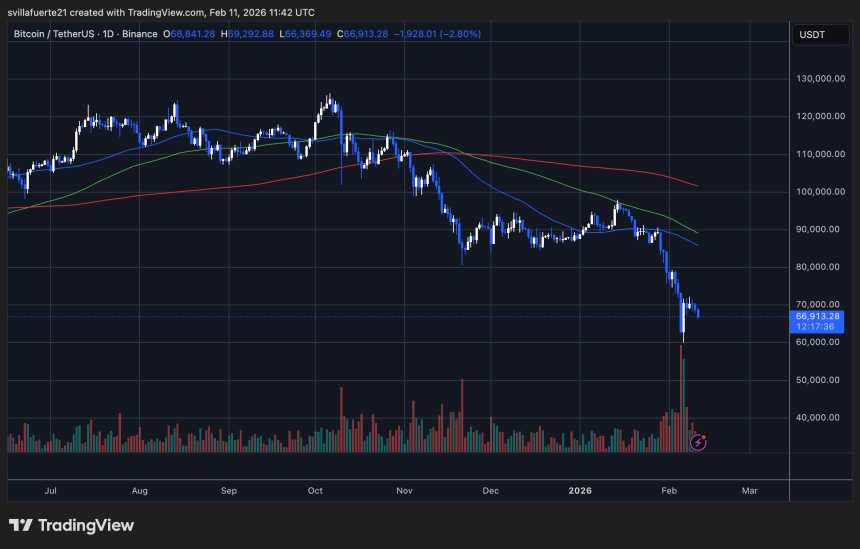
Technically, Bitcoin is trading below key moving averages, which now act as overhead resistance rather than support. The inability to recover these levels suggests that sellers continue to dominate short-term price action. Recent spikes in trading volume during the drop reinforce the idea of forced deleveraging and defensive positioning rather than orderly rotation or accumulation.
The $60,000–$62,000 region emerges as the next critical support area. Aligning with prior consolidation zones and historical liquidity clusters. Holding this range would help stabilize sentiment and potentially enable consolidation. A break below it, however, could open the door to deeper retracement scenarios.
Featured image from ChatGPT, chart from TradingView.com
What's Your Reaction?