













































Cardano Scaling Criticism Grows As Hoskinson Defends Leios Plan
Charles Hoskinson pushed back against criticism that Cardano prioritized governance over scaling, arguing that the network’s current roadmap reflects years of research rather than a delayed pivot. The dispute comes as Input Output’s latest treasury proposals put Leios, Peras, layer-2 infrastructure and developer tooling back at the center of Cardano’s 2026 technical agenda. In a […]


Charles Hoskinson pushed back against criticism that Cardano prioritized governance over scaling, arguing that the network’s current roadmap reflects years of research rather than a delayed pivot. The dispute comes as Input Output’s latest treasury proposals put Leios, Peras, layer-2 infrastructure and developer tooling back at the center of Cardano’s 2026 technical agenda.
In a post on X, the Cardano founder said he was “getting insanely tired” of what he called a “false narrative” that scaling had been abandoned in favor of governance. Hoskinson argued that scaling work had been continuous since before Shelley, spanning layer-2 designs, the eUTXO accounting model, zero-knowledge research, partnerchains and, ultimately, Leios.
“It was an enormously challenging problem that we relentlessly attacked from many different angles including L2 innovations, a brand new accounting model- eutxo- zero knowledge ideas, partnerchains, and capstoning with Leios,” Hoskinson wrote. “Many of these ideas required deep r&d and original publications. This cannot be made faster by throwing more people at it. It’s research.”
Cardano Scaling Debate Heats Up
His comments land at a sensitive moment for Cardano governance. Input Output has submitted nine treasury proposals for community review, describing them as tied to Cardano’s 2030 vision and focused on scalability and decentralization. IO says the 2026 funding request totals $46.8 million, down from $97.5 million last year, and is intended to help deliver key roadmap components while moving more development capacity into a broader contributor ecosystem.
That structure is part of the tension. In a separate exchange, Hoskinson warned against a fragmented voting outcome after community members debated whether the IO proposals should be treated as a coordinated package or as separate funding items. Responding to concerns that DReps could approve only a subset of the proposals, he wrote: “Sadly, this is the end result of a piecemeal roadmap. It’s an iPhone by committee, with people deciding whether they prefer the fingerprint sensor to wireless charging. You end up with a bizarre, useless product.”
The core of Hoskinson’s argument is that Cardano’s scaling path could not be separated cleanly from its governance path. Voltaire, in his view, was not a detour from throughput work but a prerequisite for deploying major upgrades in a system where parameters, client diversity and treasury spending now require community legitimacy.
“No one was pulled from scaling research and development,” he wrote. “There were dozens of scientists and engineers brainstorming and prototyping for years. A semi-centralized and not secure halfway house could have been implemented that crashed all the time like other blockchains. Or we could do it right like we’ve always done things with the Cardano ecosystem. We chose the latter.”
Leios sits at the center of that defense. IO’s treasury overview describes the consensus proposal as the largest technical initiative in the current portfolio and says it is designed to deliver sustainable throughput capacity at the protocol level. The same overview says a Leios testnet is expected soon, with mainnet targeted by the end of 2026, alongside a broader delivery model involving Intersect, Tweag and TxPipe.
Hoskinson presented that as the payoff from Cardano’s slower, research-heavy approach. “We now have a full design for Leios, Peras, and a great L2 strategy. They are elegant and future proof. We now have the best scaling strategy in the entire cryptocurrency space. That’s what the time bought us.”
The layer-2 side of the roadmap is also part of the argument. IO’s proposal package includes production hardening for Hydra, a planned Midgard mainnet launch, and shared L2-agnostic primitives meant to support current and future Cardano scaling systems. The overview frames Hydra and Midgard as complementary rather than competing designs, with Hydra targeting known-party, high-frequency environments and Midgard aimed at open, permissionless applications.
Hoskinson also used Bitcoin’s post-quantum debate as a contrast, arguing that Cardano’s governance system gives it a route to resolve contentious technical issues without splitting authority between informal factions. He claimed Bitcoin’s debate over whether to move or leave vulnerable coins exposed is “the single greatest endorsement of the value of governance,” adding that Cardano would “sidestep this issue thanks to governance.”
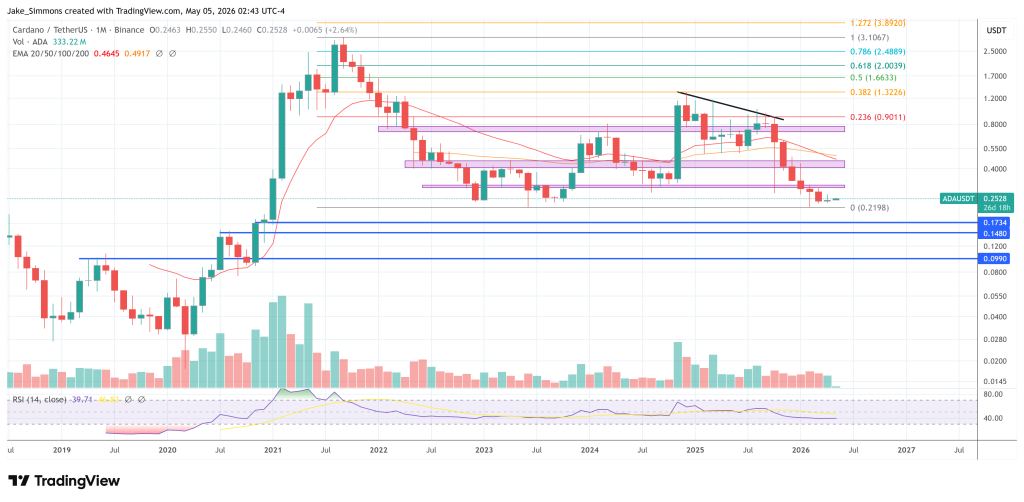
At press time, ADA traded at $0.2528.
What's Your Reaction?