













































HBAR Price Prediction 2026–2030: Hedera Has the Tech, But Does the Token Have a Pulse?
Let’s be straight about something that doesn’t get said enough in HBAR coverage: this token peaked at $0.57 in September 2021, collapsed to $0.036 by the end of 2022, bounced The post HBAR Price Prediction 2026–2030: Hedera Has the Tech, But Does the Token Have a Pulse? appeared first on NFT Evening.

Let’s be straight about something that doesn’t get said enough in HBAR coverage: this token peaked at $0.57 in September 2021, collapsed to $0.036 by the end of 2022, bounced all the way back to $0.40 in January 2025 — and then quietly gave most of that back again. Right now it sits just above $0.10, down over 74% from that January 2025 high.
And still, Hedera’s underlying network keeps adding enterprise partners. Google Cloud. IBM. Boeing. The Australian Reserve Bank. The DTCC. Real institutions running real pilots on real infrastructure — not vaporware, not promises on a whitepaper.
So what’s actually going on? Is HBAR genuinely undervalued relative to its network traction, or has the market decided that enterprise blockchain adoption just doesn’t move token prices the way crypto Twitter assumes it does? That’s the question this piece tries to answer honestly — without the price-prediction cheerleading that dominates most HBAR coverage.
HBAR Price Predictions at a Glance
| Year | Bear | Base Case | Bull |
|---|---|---|---|
| 2026 | $0.10–$0.13 | $0.15–$0.45 | $1.05 |
| 2027 | $0.11 | $0.22–$0.50 | $1.20–$1.84 |
| 2028 | $0.13 | $0.35–$0.65 | $1.40 |
| 2029 | $0.15 | $0.50–$0.80 | $1.60 |
| 2030 | $0.20–$0.28 | $0.50–$2.20 | $5.25 |
HBAR Right Now — March 2026
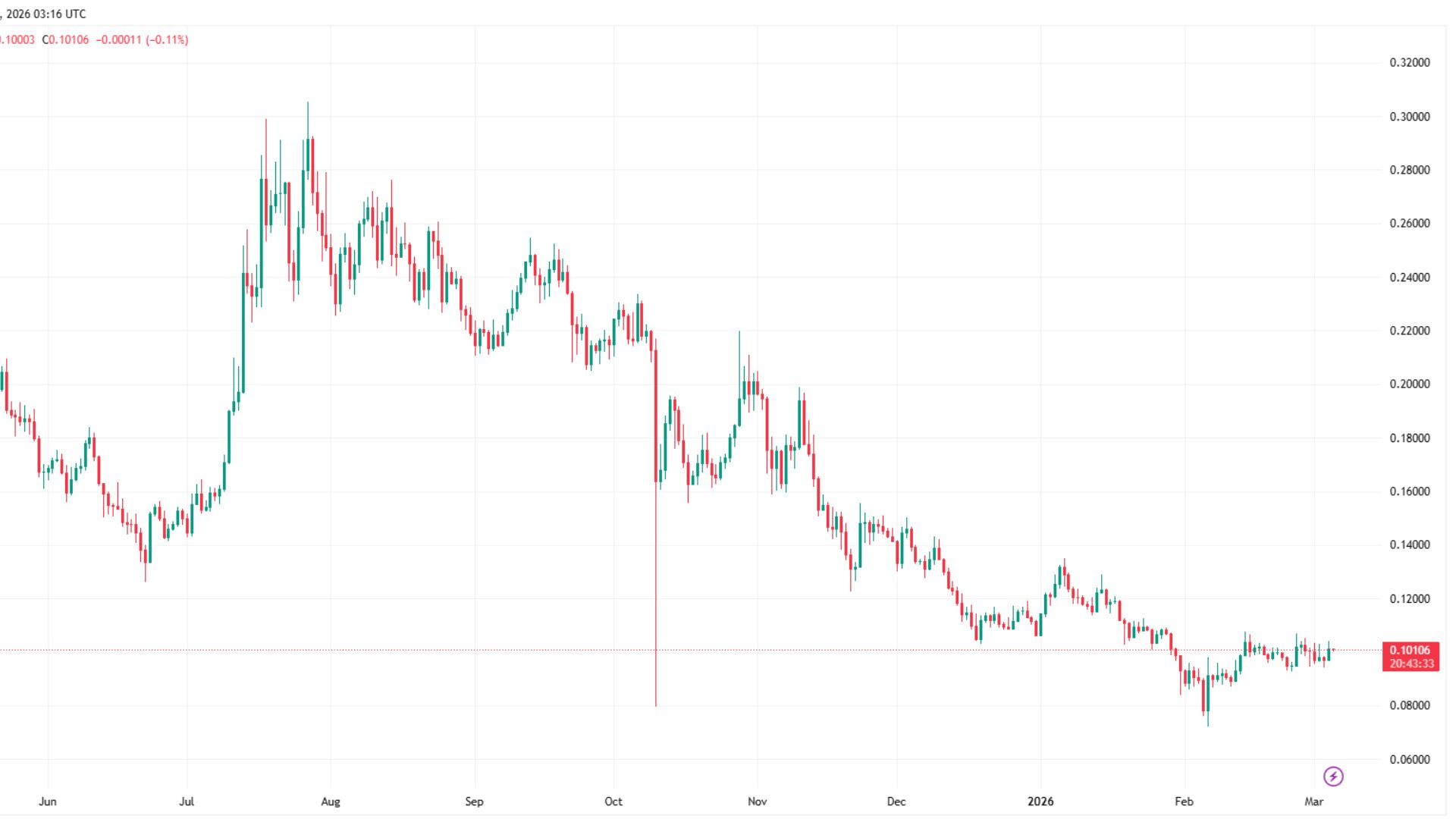
HBAR Price 2026
HBAR is trading at approximately $0.102, ranked around #21–24 by market cap, with a total valuation of roughly $4.4 billion and 24-hour volume near $132–137 million. On the face of it, those are respectable numbers for what is, fundamentally, an enterprise-grade distributed ledger that most retail crypto traders couldn’t explain at a dinner table.
The technical picture is interestingly split along timeframes. Weekly: bearish — the 50-day MA sits above price and is falling, the 200-day MA has been declining since August 2025. But flip to the 4-hour chart and the story changes: both moving averages are rising as of late February, suggesting short-term momentum is quietly turning. RSI on the daily sits around 47–48, which is neither here nor there — not oversold enough to trigger mechanical buyers, not healthy enough to confirm a trend shift.
Traders are watching $0.103 as the key level to confirm a bullish momentum shift in the near term, with $0.080 as the downside level to watch if that fails. The 30-day performance shows a correction of around 27%, but there was a 13% bounce during one week in mid-February, which is the kind of whipsaw HBAR holders have become grimly accustomed to.
One bright spot worth noting: HBAR rallied 8.7% in one week in early March, driven by a notable increase in stablecoin supply on the network and a general crypto market rebound — which suggests that when sentiment tilts even slightly, there’s a base of buyers ready to move.
Key levels to monitor:
| Level | What it signals |
|---|---|
| $0.080 | Critical support — losing this opens the $0.05 zone |
| $0.095–$0.100 | Current floor; buyers appearing here |
| $0.103–$0.120 | Reclaim is required to shift the short-term bias bullish |
| $0.178–$0.193 | First meaningful resistance zone (mid-2026 targets) |
| $0.401 | January 2025 cycle high — the big target |
| $0.569 | All-time high (September 2021) |
HBAR Price Prediction 2026
This is where the forecast landscape fragments completely, and understanding why it fragments tells you more than the actual numbers.
At the most conservative end, some algorithmic models project HBAR barely moving at all through 2026 — staying essentially flat around $0.10, which implies the market continues to treat Hedera as an enterprise curiosity rather than a speculative asset worth chasing.
Then you have mid-tier models: Binance community forecasts suggest a modest rise to around $0.177 by end of 2026, while DigitalCoinPrice puts the range at $0.12 to $0.15 — slow but steady. PricePrediction is slightly more optimistic, suggesting HBAR could reach $0.18 by year-end, a 75% gain from current levels.
At the aggressive end, CoinPedia’s model projects HBAR trading between $0.45 and $1.05 in 2026, with an average around $0.80 under favorable conditions — a scenario that assumes a strong altcoin cycle materializes in H2. Telegaon goes even further, projecting a range of $0.49 to $0.93 if a major adoption wave hits.
The honest read? For H1 2026, the bears probably have it right — HBAR is likely to grind between $0.10 and $0.18, influenced more by Bitcoin’s direction than by any Hedera-specific news. The bull case for H2 depends on two things happening simultaneously: the U.S. CLARITY Act passing (which executives from JPMorgan, Ripple, and Coinbase currently estimate at 80–90% probability by mid-2026), and an SEC decision on the pending spot HBAR ETF applications from Grayscale and Canary Capital.
If both materialize, $0.30–$0.45 by December 2026 is defensible. If neither does, $0.12–$0.18 is probably the ceiling.
HBAR Price Prediction 2027
By 2027, the gap between conservative and aggressive models doesn’t close — it widens. CoinCodex’s algorithm has HBAR trading within a $0.097 to $0.223 range, suggesting 2027 could be flat or even slightly down from a 2026 recovery.
On the other end of that spectrum, Telegaon’s model places 2027 HBAR somewhere between $0.96 and $1.84 — which would represent either a 10x from current levels or just a recovery to the January 2025 high, depending on whether you’re measuring from today or from wherever the market settles mid-cycle.
The $1 milestone is the psychological flashpoint for HBAR in 2027. Cryptonews considers it more realistic for HBAR to break $1 in 2029 or 2030 than in 2027, which feels like a grounded take given the current pace of institutional adoption versus actual price momentum.
What could push 2027 higher than most models expect: if the Kraken EVM and Hedera Token Service integration that launched in Q1 2026 actually generates developer momentum, and if the block node infrastructure upgrade planned for June 2026 noticeably improves transaction throughput metrics — two things that would make Hedera genuinely more attractive to DApp builders who currently default to Ethereum or Solana.
HBAR Price Prediction 2028
Most 2028 models cluster in the $0.35–$0.65 range as a base case, with CoinPedia projecting a minimum of $0.65 and a ceiling of $1.40. This is the year where the Real World Asset (RWA) tokenization narrative either starts delivering measurable on-chain activity or gets written off as another institutional blockchain promise that never quite arrived.
Hedera is uniquely positioned for the RWA story. The Hedera Council — which includes Alphabet (Google’s parent), IBM, LG, Deutsche Telekom, and others — gives the network enterprise credibility that permissionless chains genuinely struggle to replicate. Whether that credibility translates into HBAR token demand by 2028 is the core bet.
HBAR Price Prediction 2030
The 2030 forecasts are, candidly, all over the place in a way that should make anyone skeptical of pinning a number on them.
Conservative models like Changelly’s put HBAR between $0.207 and $0.281 by 2030 — modest growth, nothing dramatic. VentureBurn’s technical model suggests $0.294 as a reasonable end-of-decade target. These are the “adoption happens, but slowly” scenarios, and they’re probably the most common outcome historically for enterprise blockchain plays.
Then there’s CoinPedia’s bull model, which projects an average of $2.20 with a high of $1.70 — and Telegaon’s ultra-bull case of $3.82 to $5.25. For context, $5.25 would give Hedera a fully diluted market cap of roughly $262 billion, which would make it larger than JPMorgan Chase is today. That’s not physically impossible, but it requires believing that Hedera becomes foundational infrastructure for global financial markets within nine years.
The number most worth anchoring to, for investors who want something grounded: $0.50–$1.00 by 2030 in a base case where Hedera successfully executes on RWA tokenization, passes compliance hurdles in major markets, and benefits from one more broad crypto bull cycle.
What’s Actually Worth Watching on Hedera Right Now
Where the genuine bull case lives
The Hedera Council is unlike anything else in crypto
This is Hedera’s most underappreciated structural advantage. Most blockchains have foundations that are nominally decentralized but practically controlled by a small group of insiders. Hedera’s governing council reads like a Fortune 500 board meeting: Google, IBM, Boeing, LG Electronics, Nomura, Deutsche Telekom, Standard Bank, Wipro, and roughly a dozen others. Each member runs a consensus node and holds a council seat.
That structure means enterprise procurement teams can point to it and say “we’re running on infrastructure governed by IBM and Google” without anyone in legal raising an eyebrow. No other public network can say that. Whether it translates to HBAR price appreciation is a different question — but as a sales tool for institutional adoption, it’s genuinely powerful.
Hashgraph is meaningfully different from blockchain
Hedera doesn’t use a blockchain at all — it uses a directed acyclic graph (DAG) structure with a gossip-about-gossip consensus mechanism. The practical result: the network can process around 10,000 transactions per second with sub-3-second finality and transaction fees of approximately $0.0001. Compare that to Ethereum’s 15–30 TPS at peak, or even Solana’s occasional congestion problems. For high-volume enterprise applications — supply chain audits, micropayments, financial settlement — those specs matter.
CLARITY Act tailwinds
The U.S. CLARITY Act, which aims to divide regulatory oversight between the SEC and CFTC and end the “regulation by enforcement” era, has become the most important near-term catalyst for HBAR. If it passes by mid-2026 as executives from JPMorgan and Coinbase publicly estimate, it potentially classifies HBAR as a commodity — substantially reducing the compliance risk that has kept institutional allocators on the sideline.
Spot ETF applications are in play
Both Grayscale and Canary Capital have filed for spot HBAR ETFs. The SEC has delayed decisions, but those reviews extend into 2026 — meaning a decision is coming. An approval would be a significant institutional capital unlock, similar to what XRP ETFs did for that market in late 2025.
Network upgrades are consistent and real
Hedera’s testnet upgraded to v0.70.0 in February 2026, focused on smart contract automation and developer tooling. A transition from cloud storage to block nodes is scheduled to complete in June 2026, improving data access and reliability. These aren’t flashy announcements — they’re the unglamorous engineering work that either compounds into a durable platform or goes unnoticed. For Hedera, the track record of shipping is solid.
Where the skepticism is justified
The token-network disconnect is the defining HBAR problem
HBAR’s all-time high was $0.569 in September 2021. At that point, Hedera had a fraction of its current enterprise partnerships. Today, the network has significantly more adoption, more developers, more real-world pilots — and the token is 82% below that peak.
That gap doesn’t resolve itself automatically. You can build an incredible enterprise network and still have a token that doesn’t appreciate meaningfully if the token’s utility within that network is limited. HBAR is used to pay transaction fees (tiny amounts per transaction) and can be staked — but the economics of per-transaction HBAR consumption at $0.0001 per transaction don’t generate meaningful demand pressure at current scale.
“Enterprise blockchain” has a long track record of overpromising
IBM’s Hyperledger. R3 Corda. The Linux Foundation’s blockchain projects. Countless enterprise blockchain initiatives from 2016–2020 generated press releases, pilot programs, and conference keynotes — and then quietly failed to reach production scale. Hedera is better-positioned than most of those predecessors, but the pattern of enterprise interest without enterprise deployment is real and worth keeping in mind.
The supply picture is heavy
Hedera has a maximum supply of 50 billion HBAR, with approximately 43 billion currently in circulation. That’s an enormous float. For context, XRP has 100 billion total supply, Bitcoin has 21 million. When prices rise, there are a lot of coins available to sell — which creates structural headwinds for any sustained rally.
Competition for the enterprise DLT dollar is intensifying
R3, Quant Network, Polygon CDK, and Hyperledger Fabric are all competing for the same enterprise procurement budget that Hedera is pitching. And increasingly, private permissioned chains — where the customer controls everything — are winning deals over public networks simply because legal and compliance teams prefer them. Hedera’s public network model, despite its council governance, still faces this headwind.
The Technical Picture in More Detail
The weekly chart has looked bearish since August 2025, when the 200-day MA turned downward. The 50-day MA has been falling above price and acting as resistance — the classic configuration of a downtrend in progress.
What’s slightly interesting is the 4-hour chart behavior since late February. Both the 50-day and 200-day MAs started rising as of February 28, 2026 — a timeframe shift that can sometimes precede a weekly trend reversal, though it’s early to read too much into it.
The $0.10 level has become a psychological and technical battleground. HBAR dipped below it briefly in February and bounced hard both times — which suggests buyers are actively defending it. Whether they can defend it against a broader crypto market selloff is another question entirely.
If HBAR can hold $0.10 and reclaim $0.120 on a weekly close, the next realistic target zone is $0.178–$0.193 — roughly where Changelly’s mid-2026 models place the autumn price. Below $0.080, the picture deteriorates quickly toward the $0.055 demand zone.
Should You Hold HBAR?
The case for holding HBAR through 2026 rests on believing that eventually, network adoption translates into token demand. History of the current cycle (2024–2025) gave some hope for that thesis: the January 2025 pump to $0.40 happened, suggesting that when the market wanted exposure to “enterprise blockchain,” HBAR was where capital went.
The case against is that you might be waiting a long time for the adoption story to become a price story — and in the meantime, you’re holding a token that’s down 82% from ATH, in a market where attention rotates fast and patience is rewarded inconsistently.
For long-term investors who believe in the RWA and enterprise DLT narratives, HBAR at $0.10 offers a reasonable entry relative to the $0.40 it touched just 14 months ago. Position sizing conservatively, watching the $0.080 floor, and keeping an eye on ETF filing decisions seems like the sensible playbook.
For traders: $0.103 reclaim first. Weekly close above $0.120 is the confirmation you want before adding conviction.
FAQs
Most analyst models don’t project HBAR hitting $1 before 2029–2030. CoinPedia’s bullish 2026 scenario reaches $1.05, but that requires a strong altcoin bull market materializing in H2 2026 alongside regulatory catalysts. The base case for $1 is more realistically a 2028–2030 event.
Forecasts range from $0.20 (Changelly conservative) to $5.25 (Telegaon ultra-bull). The most grounded base case from multiple analysts sits between $0.50 and $2.20, with VentureBurn’s technical model suggesting $0.294 as a reasonable floor and CoinPedia projecting an average of $2.20 under sustained growth conditions.
The network charges roughly $0.0001 per transaction in HBAR fees. Even at millions of transactions per day, the token demand generated is tiny relative to the circulating supply of 43 billion HBAR. Unless token economics change — through significant staking uptake, ETF demand, or broader speculative appetite — enterprise adoption doesn’t automatically produce price appreciation.
The council includes Google (Alphabet), IBM, LG Electronics, Boeing, Nomura, Deutsche Telekom, Standard Bank, Wipro, Ubisoft, and others — major multinationals that each operate a consensus node and hold a governance seat. This is meaningfully different from most crypto foundations and gives Hedera a compliance credibility advantage with enterprise customers.
Grayscale and Canary Capital have both filed for spot HBAR ETFs with the SEC. Decisions have been delayed but are expected during 2026. An approval would be a significant catalyst for institutional capital inflows — similar to the effect XRP ETFs had in late 2025.
HBAR reached $0.5692 in September 2021. The most recent cycle peak was $0.4010 in January 2025 — a high that represented Hedera briefly entering the top 20 by market cap before giving back most of its gains through 2025 and into 2026.
Getting to $10 would require a fully diluted market cap of roughly $500 billion — making Hedera one of the most valuable financial networks on the planet. Most mainstream models don’t project $10 within a 10-year window. Technewsleader’s model suggests $10.94 is a potential 2030 peak in their most aggressive scenario, which they note requires conditions well beyond ordinary market cycles.
The post HBAR Price Prediction 2026–2030: Hedera Has the Tech, But Does the Token Have a Pulse? appeared first on NFT Evening.
What's Your Reaction?