






































Mukul Agrawal, Vijay Kedia and Ashish Kacholia: How The Ace Investors Are Playing The AI & Data Centre Boom Differently
Synopsis: While AI headlines focus on software and chips, ace investors Mukul Agrawal, Ashish Kacholia and Vijay Kedia are taking very different approaches. From data centre construction and cooling infrastructure to cybersecurity platforms, their portfolios reveal where they believe the biggest opportunities could emerge as India’s AI ecosystem continues to evolve. Artificial intelligence and data […] The post Mukul Agrawal, Vijay Kedia and Ashish Kacholia: How The Ace Investors Are Playing The AI & Data Centre Boom Differently appeared first on Trade Brains.

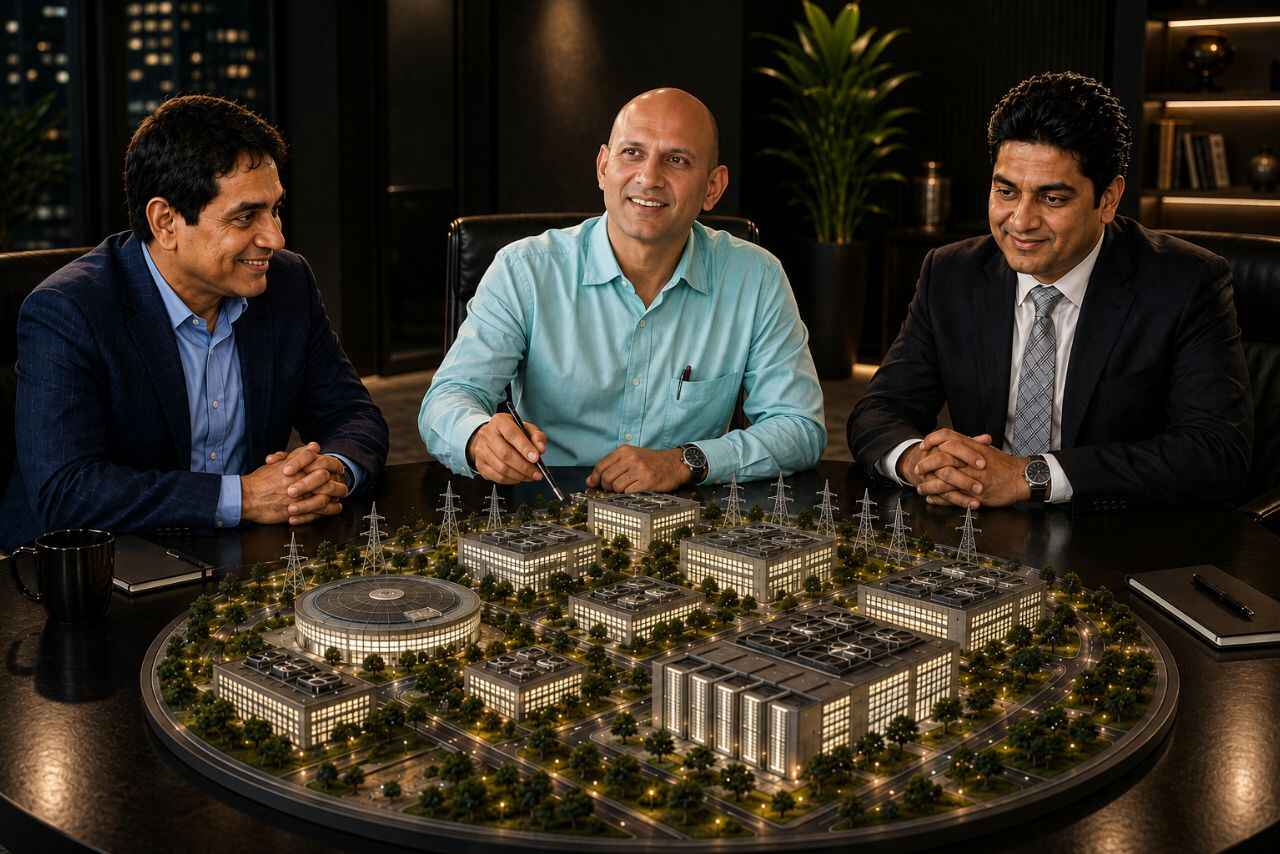
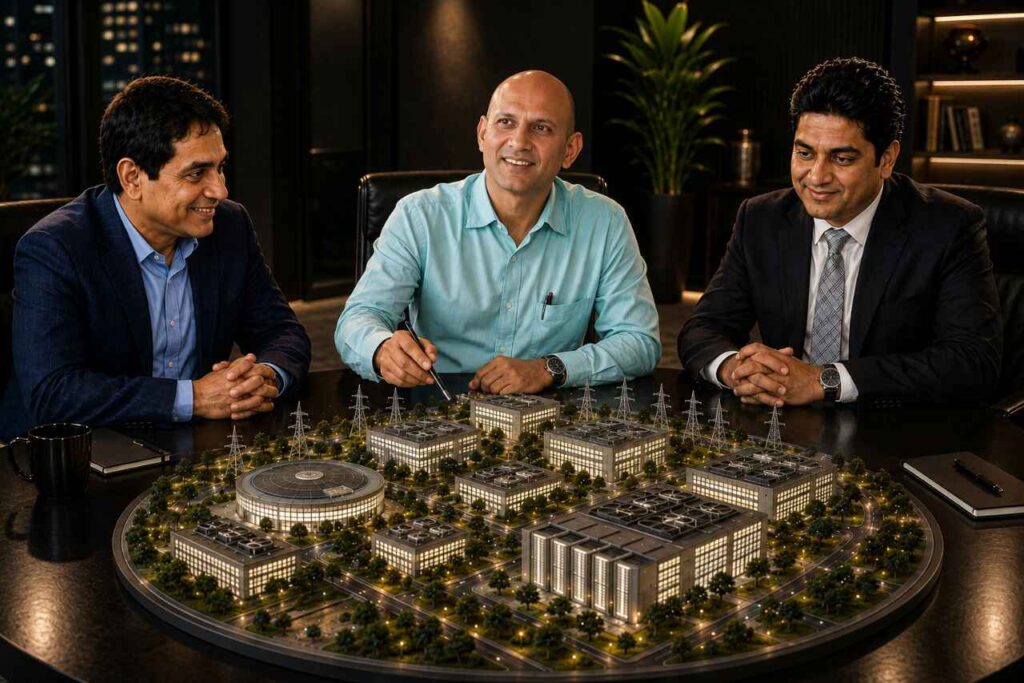
Synopsis: While AI headlines focus on software and chips, ace investors Mukul Agrawal, Ashish Kacholia and Vijay Kedia are taking very different approaches. From data centre construction and cooling infrastructure to cybersecurity platforms, their portfolios reveal where they believe the biggest opportunities could emerge as India’s AI ecosystem continues to evolve.
Artificial intelligence and data centres have become two of the biggest investment themes in the market. As AI adoption increases, demand for computing power, data storage, cooling systems and cybersecurity solutions is also expected to grow. This has created opportunities not just for technology companies, but for businesses operating across different parts of the broader ecosystem.
However, not every investor is looking at this opportunity in the same way. Ace investors Mukul Agrawal, Ashish Kacholia and Vijay Kedia have all invested in companies that could benefit from the growth of AI and data centres, but their bets are very different. While some are focused on the infrastructure needed to support this growth, others are looking at opportunities that may emerge as the ecosystem expands. Let’s take a closer look at how these investors are approaching the theme.
Mukul Agrawal
Rather than betting directly on artificial intelligence software, Mukul Agrawal appears to be focusing on the infrastructure that could support the next phase of AI-led growth. His portfolio exposure suggests a simple idea: as AI usage grows, India will need more data centres, construction execution, and better cooling systems. That is why his bets appear to be around the physical backbone of the AI boom.
Capacit’e Infraprojects
Mukul Agrawal owns around 6.6 percent stake in Capacit’e Infraprojects, valued at around Rs. 133.3 crore. He has been an investor as early as March 2023. This makes Capacit’e one of his direct infrastructure plays in the data centre theme.
Capacit’e is not an AI company. It is a building construction and infrastructure execution company. But that is where the connection becomes interesting. Before any AI model can be trained or any enterprise can store huge volumes of data, someone has to build facilities that house servers, cooling systems and power infrastructure.
The company’s filings show that FY26 was strong for execution and orders. Capacit’e reported FY26 order inflow of Rs. 4,446 crore, higher than its full-year guidance of Rs. 3,500 crore. Its order book stood at Rs. 13,498 crore as of March 31, 2026, giving the company an order book-to-sales ratio of 5.1 times. Revenue from operations for FY26 stood at Rs. 2,623 crore, while EBITDA stood at Rs. 427 crore, with EBITDA margin of 16.3 percent.
The most interesting part of Capacit’e is its client base. A credit report from Infomerics Ratings mentions reputed private developers such as Oberoi Realty, Raymond, Godrej Properties, Signature Global and Lodha. The company’s project portfolio also includes developers such as DLF, Prestige Group, Phoenix Mills, Brookfield, Hubtown and Piramal Realty.
This is particularly relevant because some of these developers are also expanding into digital infrastructure. For instance, Lodha has announced plans to develop a large data centre park in Palava, highlighting how traditional real estate players are increasingly participating in India’s growing data centre ecosystem.
In Q3 FY26, the company said it had delivered 11 data centres to the Department of Telecommunication for Indian defence over the last two years, while two more projects at Udhampur and Kolkata were pending. Management also said the company had lost a Rs. 1,000 crore data centre bid on pricing, but did not want work that could hurt margins.
Mukul’s investment suggests that he is betting on the construction side of the AI boom. If data centre construction accelerates in India, companies such as Capacit’e could benefit from the rising demand for project execution.
KRN Heat Exchanger and Refrigeration
Mukul Agrawal also owns around 1.6 percent stake in KRN Heat Exchanger, valued at Rs. 121.7 crore. He has been an investor since December 2024. Compared to Capacit’e, this is an even more direct data centre proxy because KRN sits inside the cooling value chain.
Data centres generate huge heat because thousands of servers run continuously. As AI workloads increase, cooling becomes critical. KRN manufactures heat exchangers, cooling coils and HVAC products used across HVAC, refrigeration, industrial cooling, mobility and data centres.
In FY26, KRN’s consolidated total income stood at Rs. 609.81 crore, up 38.06 percent year-on-year. EBITDA grew 59.52 percent to Rs. 112.48 crore, while net profit increased 44.62 percent to Rs. 76.47 crore. The new HVAC facility is important because management said the existing plant was near full utilisation, while the new plant has nearly six times the existing capacity and is expected to reach around 50 percent utilisation in FY27.
The stronger AI link comes from data centres. Management said data centres contributed around 18.7 percent of Q4 revenue and that the company had good order booking from this segment. It is receiving orders for fin-and-tube products used in HVAC data centre components, while also working on micro-channel products and plate heat exchangers for future cooling requirements.
This makes KRN a cooling-side AI infrastructure bet. In simple terms, Capacit’e can benefit if more data centres are built, while KRN can benefit if those data centres need advanced cooling equipment. Together, they show Mukul Agrawal is playing the AI boom through companies that support the physical infrastructure behind it.
Ashish Kacholia
Ashish Kacholia’s AI strategy appears to be similar to Mukul Agrawal’s infrastructure thesis, but with a sharper focus on one specific layer of the data centre value chain: liquid cooling. Instead of betting on software or cloud platforms, his exposure through Aeroflex Industries suggests a bet on the engineering products needed to keep next-generation AI data centres running efficiently.
Aeroflex Industries
Ashish Kacholia holds around 2.3 percent stake in Aeroflex Industries, valued at Rs. 141.1 crore. His holding has increased from 1.8 percent in September 2024 to 2.3 percent in March 2026, showing that his exposure to the company has grown as the data centre and AI infrastructure opportunity has become more visible.
Aeroflex is a manufacturer of metallic flexible flow solutions, including flexible hoses, assemblies, fittings, metal bellows and skid assemblies. The AI link comes from its entry into advanced flow control solutions and skid assemblies for liquid cooling systems used in data centres.
This is important because AI servers generate much higher heat compared to traditional computing systems. As data consumption rises because of AI, cloud and high-performance computing, management said traditional air cooling is showing limitations, while liquid cooling is becoming a preferred solution for next-generation data centre infrastructure.
The business has already started showing traction. In FY26, Aeroflex sold 617 skid assemblies over four months, generating around Rs. 21.2 crore in sales. The company has scaled skid assembly capacity from 2,000 units per annum to 6,000 units per annum and plans to increase it further to 15,000 skids per annum. It also showcased its advanced flexible flow solutions at the Data Center World Exhibition in Washington, highlighting its focus on global data centre thermal management opportunities.
Financially, FY26 was the company’s best year. Total income stood at Rs. 443.29 crore, up 17 percent year-on-year. EBITDA stood at Rs. 99.74 crore, up 26 percent, while EBITDA margin improved to 22.57 percent. Profit after tax stood at Rs. 55.53 crore. In Q4 FY26, total income rose 38 percent to Rs. 126.46 crore, while EBITDA grew 59 percent to Rs. 30.03 crore.
So, Ashish Kacholia’s Aeroflex bet is not a broad AI bet. It is a focused bet on the cooling and flow-control infrastructure behind AI data centres, making him aligned with Mukul’s infrastructure-led approach.
Vijay Kedia
Vijay Kedia’s AI strategy looks different from Mukul Agrawal and Ashish Kacholia. While the other two investors are closer to the physical data centre infrastructure theme, Kedia appears to be playing the second-order effect of the AI boom. His cybersecurity bets suggest a simple thesis: as data, cloud adoption, digital transactions and AI-led threats increase, companies will need stronger systems to protect themselves.
TechD Cybersecurity
Vijay Kedia owns 5.26 percent stake in TechD Cybersecurity, valued at Rs. 24.1 crore. TechD is an end-to-end cybersecurity company offering VAPT, managed security services (SOC/MSSP), compliance services, incident response, digital forensics, virtual CISO, red teaming and cybersecurity testing.
The company is also trying to move from a service-led model to a more product-led cybersecurity business. Its filings mention the launch of TechD CyberAGI in India, an AI cybersecurity platform, along with a UAE subsidiary for global market entry. It is also building a Global Security Operations Center to provide 24/7 monitoring, threat detection and incident response. Some of its notable clients include Adani Group, JM Financial, Astral Pipes, IndusInd Securities, MCX, Finserve, Torrent Power, Zee Learn, CDSL Ventures, Hocco and Havmor
The most interesting part is its regulatory cybersecurity opportunity. TechD closed FY26 with 405 SEBI-regulated customers, 117 managed SOC/SIEM clients from SEBI-regulated entities and 1,250 cyber and CSCRF audit deliverables. In the first two months of FY27, it onboarded more than 140 additional client entities, taking its active engagement footprint to more than 545 regulated entities across SEBI, RBI and IFSCA ecosystems. This shows that Kedia’s bet here is on cybersecurity becoming a compliance need, not just an optional IT expense.
TAC Infosec
Vijay Kedia has been an early investor in TAC Infosec, even before its listing. He owns 3.6 percent stake in the company, valued at Rs. 30 crore. TAC is a cybersecurity platform company, and this makes it a different kind of AI-linked bet.
In FY26, TAC reported total income of Rs. 57.19 crore, EBITDA of Rs. 30.75 crore and PAT of Rs. 26.35 crore. Its operating revenue grew 88 percent, while EBITDA margin stood at 53.8 percent and PAT margin at 46.08 percent. The company also said it now has more than 10,000 customers across TAC and CyberScope, with global reach across more than 100 countries.
The key point is that TAC does not want to scale like a manpower-heavy IT services company. Management repeatedly highlighted that it is building a platform business. Its products include ESOF as the core cyber-risk platform, Socify.ai as a compliance ARR layer, and CyberScope and CyberSandia as category growth pillars. So, Kedia’s TAC bet is on scalable cybersecurity software and recurring revenue, not just one-time security services.
Quick Heal Technologies
Kedia Securities Pvt Ltd purchased around 4.5 lakh shares of Quick Heal Technologies at Rs. 209.13 apiece through a bulk deal on May 8, 2026. The transaction size stood at nearly Rs. 9.41 crore.
Quick Heal is the most established name in this basket, but it is also going through the toughest transition. Management admitted that revenue has been stagnant for nearly a decade and that the company posted more than Rs. 10 crore loss in FY26. However, the bigger story is its shift from a B2C antivirus company to a broader cybersecurity company.
Its enterprise business, which was around 20 percent of revenue five years ago, now contributes more than 50 percent. Management wants enterprise to reach nearly 80-90 percent of revenue over the next two to three years. Seqrite is the enterprise arm, with focus areas including EDR, XDR, Zero Trust, data privacy, SIA, DRPS and RRaaS.
So, unlike Mukul Agrawal and Ashish Kacholia, Vijay Kedia is not betting on who builds data centres. He is betting on who protects the digital world that AI and data centres will create.
Conclusion
The AI and data centre opportunity is often viewed through the lens of software companies, semiconductor manufacturers and large technology platforms. However, the portfolios of Mukul Agrawal, Ashish Kacholia and Vijay Kedia show that the opportunity extends far beyond that. While Mukul Agrawal and Ashish Kacholia appear to be focusing on the infrastructure needed to build and operate data centres, Vijay Kedia is looking at the cybersecurity layer that could become increasingly important as AI adoption and digital activity continue to grow.
What also stands out is that these investors are not simply chasing the most popular AI names in the market. Instead, they appear to be identifying businesses that could benefit from the growth of AI and data centres while still offering attractive business economics and valuations at the time of investment.
Rather than making direct bets on AI developers, these investors seem to be positioning themselves across different parts of the broader AI and data centre value chain. As India continues to invest in digital infrastructure and artificial intelligence, it will be interesting to see which of these approaches delivers the strongest results over the long term.
Disclaimer: The views and investment tips expressed by investment experts/broking houses/rating agencies on tradebrains.in are their own, and not that of the website or its management. Investing in equities poses a risk of financial losses. Investors must therefore exercise due caution while investing or trading in stocks. Trade Brains Technologies Private Limited or the author are not liable for any losses caused as a result of the decision based on this article. Please consult your investment advisor before investing.
The post Mukul Agrawal, Vijay Kedia and Ashish Kacholia: How The Ace Investors Are Playing The AI & Data Centre Boom Differently appeared first on Trade Brains.
What's Your Reaction?