











































Vadilal vs Kwality: Which Ice Cream Stock Looks Best for This Summer?
Synopsis: India’s ice cream market is heating up as summer demand begins to surge across cities and towns. Investors are now watching two key players closely. Vadilal and KWIL are taking very different paths, yet both aim to capture seasonal demand. KWIL recently entered the market as an independent company after its demerger from HUL. […] The post Vadilal vs Kwality: Which Ice Cream Stock Looks Best for This Summer? appeared first on Trade Brains.

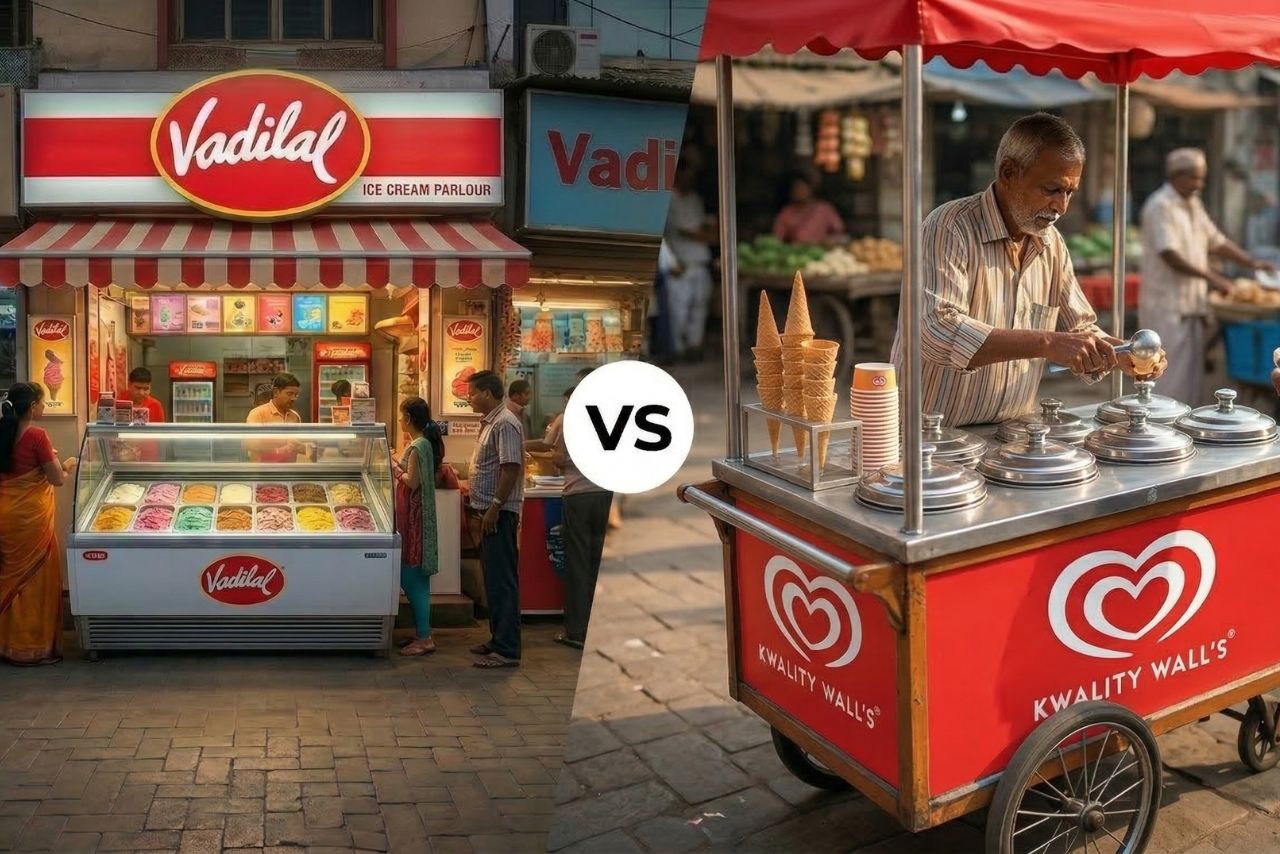
Synopsis: India’s ice cream market is heating up as summer demand begins to surge across cities and towns. Investors are now watching two key players closely. Vadilal and KWIL are taking very different paths, yet both aim to capture seasonal demand.
KWIL recently entered the market as an independent company after its demerger from HUL. It listed on exchanges in February 2026 and quickly drew investor attention. On the other hand, Vadilal continues to operate as a steady and profitable business with a long-standing presence.
However, the comparison is not simple. One company is stable and earnings-driven, while the other is a premium turnaround story. As temperatures rise, the question becomes clear. Which stock is better positioned to benefit from the summer surge? To answer that, we need to look deeper into profitability, distribution, product strategy, and consumer behavior.
Who Is Making Money?
Vadilal stands out as a consistently profitable company with improving financial performance. Its net profit ranges between Rs 122 crore and Rs 150 crore. Moreover, its net margins remain steady at 9 to 12 percent.
This stability gives investors confidence. The business generates earnings without relying on restructuring or one-time adjustments. In addition, its profitability improves gradually each year.
On the other hand, KWIL currently reports losses. The company recorded a loss of Rs 261 crore for the year ending December 2025. Furthermore, the third quarter alone contributed Rs 178 crore in losses.
A large portion of these losses comes from exceptional charges. These include brand write-offs, demerger-related costs, and asset restructuring expenses. These one-time costs total around Rs 93.7 crore. Even after adjusting for these items, the company still reports a loss of Rs 109 crore in the quarter. This suggests that the core business is still under pressure.
However, investors are not ignoring KWIL. They believe the losses are temporary and linked to the transition phase. Therefore, the market assigns a premium valuation based on future expectations.
Vadilal trades at a price-to-earnings ratio of 27 times, supported by actual profits. In contrast, KWIL has a negative P/E due to losses, yet commands a higher market capitalization. This difference reflects investor mindset. Vadilal represents stability, while KWIL represents potential.
Is the Ice Cream Business Sustainable?
Vadilal has improved its balance sheet over time. The company faced debt challenges in earlier years, but it has reduced its borrowings steadily. As profits accumulate, debt continues to decline. This deleveraging trend strengthens the company’s financial position. It also reduces interest burden and improves long-term sustainability.
KWIL, however, begins its journey with a clean balance sheet. It inherited a strong capital structure from HUL, which means no borrowings and zero interest costs. At first glance, this appears positive. Yet there is a risk ahead. Continuous operational losses can erode equity over time. If losses continue, the company may need to raise capital or take on debt by FY27 or in the near future. Therefore, while KWIL starts strong, its future depends heavily on execution. Vadilal, in contrast, already operates on a stable footing.
How Ready Are They For This Summer?
Summer demand in India is highly seasonal and often unpredictable. Companies must scale production quickly to meet spikes in consumption. Vadilal is built for this exact scenario. It has a strong domestic manufacturing base, particularly driven by Gujarat expansions. The company focuses on high-volume production and mass consumption. During the summer, its capacity utilization rises sharply. This creates operating leverage, which boosts margins as volumes increase. This setup allows Vadilal to serve large markets efficiently. Especially in Tier-2 and Tier-3 regions, where demand rises rapidly, and price sensitivity remains high.
KWIL approaches capacity differently. It leverages a well-developed supply chain inherited from HUL. However, its focus is not purely on volume. Instead, it prioritizes quality consistency across premium products.
This means its capacity is optimized for maintaining brand experience rather than maximizing output. While this works well in urban markets, it may limit scale in price-sensitive regions. Therefore, Vadilal leads in volume-driven demand, while KWIL focuses on controlled premium growth.
Distribution Network
Distribution plays a critical role in the ice cream business. Products require cold chain infrastructure and strong last-mile connectivity. Vadilal has built one of the widest distribution networks in India around 16% share. It operates through more than 150,000 dealers across the country. Its presence is strong in smaller towns, local shops, and regional parlours. This deep penetration gives it a clear advantage. It can reach customers even in areas where cold chain infrastructure is limited. As a result, Vadilal becomes the default choice in many regions. It is accessible, familiar, and widely available.
KWIL, however, benefits from a different type of distribution strength. It inherits a modern and efficient network from HUL. This includes a strong presence in modern retail chains and quick commerce platforms.
Its products are widely available in urban outlets, supermarkets, and delivery apps. This ensures high visibility among premium consumers. Thus, KWIL focuses on quality of distribution rather than sheer scale. Vadilal wins on reach, while KWIL wins on placement and experience.
What Is The Biggest Difference In Product Strategy?
The biggest difference between these companies lies in what they sell and who they target. Vadilal follows a mass-market strategy. It offers family packs, cones, cups, and traditional flavors like mango, kesar pista, and rajbhog. These products appeal to Indian taste preferences and seasonal demand.
In addition, Vadilal operates a strong frozen food segment. It sells frozen parathas, ready-to-eat snacks, and vegetables. This diversification helps stabilize revenue beyond summer months. Interestingly, about one-third of its revenue comes from exports, especially to Indian grocery markets in the United States. This adds another layer of stability.
KWIL, on the other hand, focuses entirely on premium ice cream. Its portfolio includes high-end products like chocolate-coated bars and branded cones. Its strategy revolves around indulgence and brand recall. The company targets consumers who seek experience rather than just quantity.
This creates a clear contrast. Vadilal offers affordability and familiarity, while KWIL delivers indulgence and aspiration. Consumer behavior further highlights this difference. Vadilal attracts families, value buyers, and customers in smaller towns. These consumers prioritize quantity and price. KWIL appeals to urban youth and premium buyers. These consumers prefer taste, brand, and convenience. They often make impulse purchases through malls or delivery platforms. Therefore, each company dominates a different segment of the market.
Ingredients and Health Considerations
Both companies use similar base ingredients such as milk solids, sugar, and stabilizers. However, their product formulations differ significantly. Vadilal focuses on cost optimization. It uses milk fat in traditional products and vegetable oils in some lower-priced variants. This results in balanced taste at affordable prices.
KWIL emphasizes richness and texture. It uses higher cocoa content and cream in many products. Premium coatings add to the indulgence factor. As a result, KWIL products often have a richer mouthfeel and higher calorie content.
However, ice cream is not suitable for everyone. Both brands rely heavily on dairy, which can cause issues for lactose-intolerant individuals. Many adults in India fall into this category.
Additionally, high sugar content makes these products unsuitable for diabetics and weight-conscious consumers. Premium products often contain even higher sugar and fat levels. High saturated fat content also raises concerns for heart patients. Moreover, stabilizers and emulsifiers may not appeal to consumers seeking natural products.
Vegan options remain limited for both companies, although this segment is growing rapidly. These factors highlight an important trend. Consumers are slowly shifting towards healthier alternatives, creating future opportunities.
The Summer Opportunity
Summer remains the most important season for ice cream companies in India. Demand spikes due to rising temperatures and changing consumption habits. Vadilal benefits from bulk purchases and family consumption. Its wide reach ensures strong sales across regions. Moreover, its pricing makes it accessible to a larger population. KWIL benefits from impulse buying in urban areas. Heat-driven demand in cities supports premium consumption. Its brand strength also drives higher margins per unit.
In a strong summer, both companies perform well, but for different reasons. If demand is driven by volume, Vadilal clearly leads. Its scale, pricing, and distribution give it an edge. If demand shifts towards premium consumption, KWIL gains an advantage. Its brand positioning and product experience attract higher spending customers.
At this stage, Vadilal appears to be the fundamentally stronger business. It is profitable, predictable, and improving its balance sheet. KWIL, however, represents a future story. It carries premium brands, strong expectations, and the potential for turnaround.
Investors should watch the next two to three quarters closely. Clean standalone results will reveal whether KWIL can deliver on its promise. Until then, the choice depends on risk appetite. Vadilal offers stability, while KWIL offers possibility. In simple terms, Vadilal sells volume, while KWIL sells experience.
Disclaimer: The views and investment tips expressed by investment experts/broking houses/rating agencies on tradebrains.in are their own, and not that of the website or its management. Investing in equities poses a risk of financial losses. Investors must therefore exercise due caution while investing or trading in stocks. Trade Brains Technologies Private Limited or the author are not liable for any losses caused as a result of the decision based on this article. Please consult your investment advisor before investing.
The post Vadilal vs Kwality: Which Ice Cream Stock Looks Best for This Summer? appeared first on Trade Brains.
What's Your Reaction?