












































.png)



Coal India Shares Steady as Q1 Offtake Hits 197 Million Tonnes Amid Record Summer Power Demand
Synopsis: The country’s largest coal producer posted a wide gap between falling output and rising dispatches in the first quarter of FY27, a divergence that points to inventory drawdown rather than demand weakness, even as record power consumption keeps pressure on the company to close the gap through the rest of the year. Provisional operational […] The post Coal India Shares Steady as Q1 Offtake Hits 197 Million Tonnes Amid Record Summer Power Demand appeared first on Trade Brains.

Synopsis: The country’s largest coal producer posted a wide gap between falling output and rising dispatches in the first quarter of FY27, a divergence that points to inventory drawdown rather than demand weakness, even as record power consumption keeps pressure on the company to close the gap through the rest of the year.
Provisional operational data released on July 1, 2026 showed cumulative coal production falling 7.5 percent year-on-year for the April-June quarter to 169.6 million tonnes, against 183.3 million tonnes a year earlier. Offtake moved in the opposite direction, rising 3.5 percent to 197.7 million tonnes from 191 million tonnes. For June alone, production slipped 0.6 percent to 57.4 million tonnes while offtake jumped 7.5 percent to 65.8 million tonnes. The state-run miner has now covered roughly 21 percent of its 815 million tonne production target for the full year.
With a market capitalization of Rs. 2,68,11.12 crore, the shares of Coal India Limited were trading at Rs. 435.15 per share, down 0.89 percent from its previous closing price of Rs. 439.05 apiece. It is trading at a P/E of 8.93.
Reading the Production-Offtake Gap
A quarter where offtake outpaces production by this margin means the company is drawing down pithead stocks to meet dispatches, not that demand has slackened. That distinction matters for how investors should read the headline numbers. Weak Q1 output is partly seasonal: the April-June period typically runs soft because of monsoon disruption to opencast mining, and the company itself points to a stronger second half as the usual pattern.
But this year’s shortfall builds on an already soft FY26, in which full-year output fell 1.7 percent to 768.1 million tonnes from 781.1 million tonnes the year before. Two consecutive years of production underperformance, even against a backdrop of resilient demand, raises the question of whether this is purely weather-driven or whether execution constraints at specific subsidiaries are becoming a recurring drag.
The subsidiary-level split supports the latter reading. South Eastern Coalfields led growth with production up 7.2 percent to 44.1 million tonnes, and Central Coalfields posted an 18.3 percent jump in June output alongside a 51.5 percent spike in monthly offtake. Mahanadi Coalfields, by contrast, saw production fall 17.5 percent for the quarter and 18.3 percent in June alone, even though it still delivered the highest single-month offtake volume among all subsidiaries at 18 million tonnes.
Bharat Coking Coal was the other laggard, with production down nearly 12 percent in June and offtake down 14.5 percent for the quarter. For a company that reports at the consolidated level, this unevenness across mining regions is worth tracking each month, since a sustained shortfall at one or two large subsidiaries can offset strong performance elsewhere without showing up clearly in the aggregate figures until it compounds.
The demand backdrop remains firm. India recorded an all-time high peak power demand of 271 gigawatts in May 2026, and the government is preparing grid infrastructure for a 300 gigawatt threshold over the coming year. Coal continues to supply the bulk of that generation capacity, and the government has maintained supply through strategic reserves even as mined output has lagged. For retail investors, the practical takeaway is that near-term power sector coal availability is not currently at risk, but the buffer being used to bridge the gap is finite, and a second consecutive weak monsoon-linked quarter would tighten that cushion further.
Valuation, Payout, and the R&D Pivot
At a P/E of 8.93 and a dividend yield near 6 percent, the stock is priced for modest growth rather than an operational turnaround, which is consistent with a business that has now posted two years of flattish-to-declining production. The government’s recent offer-for-sale, which reduced its stake by roughly 2 percent in late May, added supply to the float and is a factor that can weigh on near-term price action independent of operating performance. Separately, Coal India has committed Rs. 1,900 crore toward research and development by fiscal 2030, a sharp step-up from FY25, when R&D spending nearly quadrupled to Rs. 245 crore from Rs. 61 crore the year before.
Three Centres of Excellence set up with premier IITs and international partnerships covering underground coal gasification, mining automation, and critical mineral recovery point to a longer-term diversification push. None of this changes the FY27 production outlook, but it does signal that management is positioning the company beyond pure-play thermal coal extraction, a shift income-focused investors should watch alongside the dividend track record rather than expect to move earnings in the current year.
Business Overview
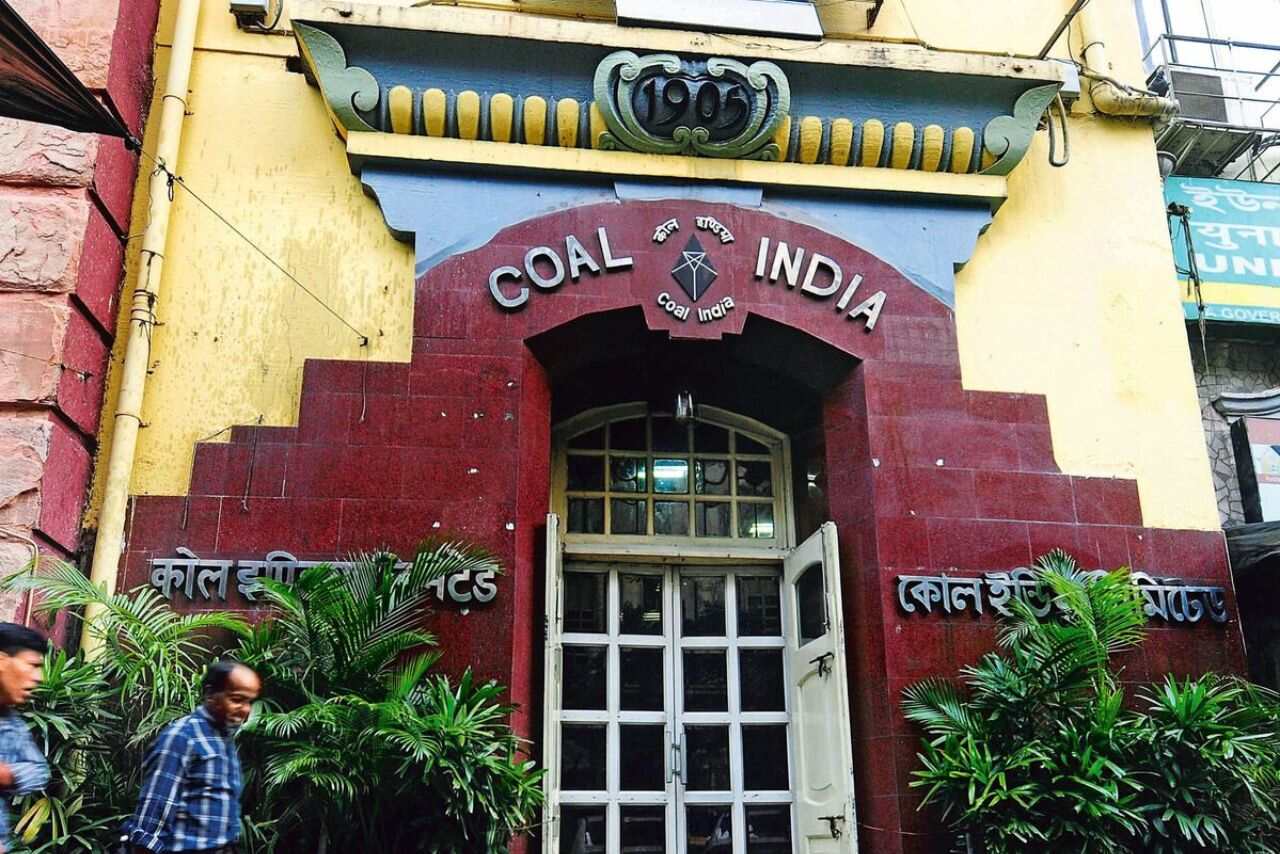
Coal India Limited is a Maharatna public sector enterprise under the Ministry of Coal, incorporated in 1973 and headquartered in Kolkata. It is the world’s largest coal-producing company, accounting for close to 80 percent of India’s domestic coal output through subsidiaries including South Eastern Coalfields, Mahanadi Coalfields, Central Coalfields, Bharat Coking Coal, Eastern Coalfields, and Western Coalfields, operating over 300 mines across the country. The company primarily sells coal to the power generation sector, followed by steel, cement, and fertiliser industries, and has raised its dividend for four consecutive years.
Disclaimer: The views and investment tips expressed by investment experts/broking houses/rating agencies on tradebrains.in are their own, and not that of the website or its management. Investing in equities poses a risk of financial losses. Investors must therefore exercise due caution while investing or trading in stocks. Trade Brains Technologies Private Limited or the author are not liable for any losses caused as a result of the decision based on this article. Please consult your investment advisor before investing.
The post Coal India Shares Steady as Q1 Offtake Hits 197 Million Tonnes Amid Record Summer Power Demand appeared first on Trade Brains.
What's Your Reaction?